Editorial
March 8 is traditionally an occasion to review progress made toward gender equality.
Undoubtedly, the 2026 edition of International Women’s Rights Day will be far from a celebration. It marks a turning point, one of unprecedented setbacks.
With the rise of anti-rights movements, attacks on diversity, equity, and inclusion (DEI) policies, the expansion of the Global Gag Rule, the withdrawal of the United States from UN agencies, and a historic drop in international funding, obstacles to achieving gender equality are multiplying.
At the current pace of progress, the United Nations warns that it could still take 300 years to achieve it.
Today, 78 million women of reproductive age lack access to the contraceptive methods of their choice, a woman dies every two minutes from pregnancy– or childbirth-related complications, and one in three women has experienced domestic or sexual violence in her lifetime.
In response to this ongoing backlash, an international movement is mobilizing – governments, diplomats, parliamentarians, NGOs, and feminist movements – to defend the rights of women and girls.
Beyond March 8, the 70th United Nations Commission on the Status of Women in New York (March 9–19, 2026), Women Deliver, the global conference of feminist movements held in late April in Melbourne, and the G7 under French presidency will all offer opportunities to take action and regain momentum in the face of setbacks to girls’ and women’s rights.
Explore Focus 2030’s special report, which, drawing on data and testimonies, provides an overview of the challenges ahead and the levers for action to make gender equality a concrete reality for all.
Table of contents
- Gender Inequalities: The Scale of the Challenges in Facts and Figures
- Budget cuts: worrying consequences for communities and organisations
- Focus on the right to abortion
- Overview of Gender Equality Funding
- Ensuring and Strengthening Access to Justice for All Women and Girls: Perspectives on CSW70
- Focus on Spain: host country for the next conference on feminist foreign policies
Gender Inequalities: The Scale of the Challenges in Facts and Figures
With only four years remaining until 2030, the deadline for achieving the United Nations Sustainable Development Goals (SDGs), gender equality remains out of reach. While progress has been made in access to education, health, and political participation, these gains remain fragile and highly uneven across countries. Between 2019 and 2022, nearly four in ten countries experienced stagnation or backsliding in women’s rights, affecting more than one billion women and girls.
These trends stand in stark contrast to the central role of gender equality within the 2030 Agenda : 73% of the 169 SDG targets depend directly or significantly on progress toward gender equality. Inequalities manifest at every stage of life. Globally, nearly one in five girls is still married before turning 18, and one in three women has experienced physical and/or sexual violence in her lifetime.
Gaps also persist in the labor market. Women account for 39% of the global workforce, remain overrepresented in the lowest-paid jobs, and earn on average 20% less than men. Only 4% of women worldwide live in countries that guarantee them economic rights that are virtually equal to those of men. Gender inequality in lifetime earnings between women and men represents USD 160 trillion in lost global wealth.
Conflicts, economic shocks, and climate change further exacerbate existing inequalities. Women are among the populations most exposed to these crises. If current trends continue, over 351 million women and girls could still live in extreme poverty by 2030. UN Women estimates that at this rate, nearly 300 years will still be needed to achieve gender equality.
Budget cuts: worrying consequences for communities and organisations
Cuts in Official Development Assistance have not spared funding allocated to gender equality : since January 2025, it has even been one of the main targets of the United States’ administration, which has made historic cuts to its funding for sexual and reproductive health and rights (SRHR). According to estimates by the Center for Global Development (CGD), US funding for family planning and reproductive health fell by 94% in 2025, a decline expected to continue in 2026. Until then, the United States had been the largest donor of ODA supporting SRHR (9.35% of its total ODA, or $5.8 billion) and accounted for more than half of global funding in this area. In 2024, the United States also funded 17% of the total budget of UNFPA, the United Nations agency responsible for sexual and reproductive health, until it announced its departure from the organisation in early 2026.
The United States is not an isolated case. European countries, which provided more than one third of SRHR funding in 2023, have also introduced budget cuts. According to Countdown 2030, five of them reduced their contributions in 2025. This is particularly true of the United Kingdom, which plans to make drastic cuts to its ODA by 2028, which could lead to a 70% reduction in its SRHR funding. According to the Guttmacher Institute, this decision alone could result in up to 2.6 million unintended pregnancies, 875,000 unsafe abortions and 2,740 maternal deaths.
Focus on the right to abortion
In 2026, abortion is permitted on demand in 76 countries and in 12 countries for socio-economic reasons. According to the Center for Reproductive Rights, 40% of women of reproductive age worldwide live in countries with restrictive abortion laws. As Amnesty International points out, regardless of a country’s legislation, women resort to abortion in the same proportions: 37 out of 1,000 where it is illegal, and 34 out of 1,000 where it is legal. The difference lies in the danger to women’s health: clandestine abortions are the third leading cause of maternal mortality worldwide.
Find out more on the right to abortion.
The consequences of these budget cuts are alarming : reduced access to contraception, disappearance of databases essential for monitoring the health of women and girls, undermining of awareness-raising policies and research programmes, suspension of NGO activities, etc. According to a study conducted by UN Women among 428 women’s rights organisations, more than one in three organisations has been forced to suspend or shut down programmes aimed at combating gender-based violence. The very existence of these organisations is compromised : only 5% believe they will be able to continue operating for more than two years.
While it is still too early to fully assess the impact of these cuts on populations, estimates have already been made. According to the Centre for European Policy Studies, reductions in US UNFPA funding could jeopardize access to SRHR for tens of millions of women and girls, including 9 million people in Afghanistan, 1.7 million in Pakistan and 1.5 million in Yemen. Overall, according to estimates by the Guttmacher Institute, every $10 million cut in SRHR funding leads to 362,000 unintended pregnancies, 161,000 unplanned births, 110,000 unsafe abortions and 718 maternal deaths. Within a single year, approximately 48 million people lost access to contraception, 17 million unplanned pregnancies occured, and an additional 34,000 women died from pregnancy-related complications. In five years, up to 100 million people could be left without contraception, leading to 55 million unwanted pregnancies and 16 million unsafe abortions across 51 countries. The populations most affected would be those living in Tanzania, the Democratic Republic of Congo, Uganda and Mozambique.
Overview of Gender Equality Funding
Which Donor Countries Support Gender Equality Through Their Official Development Assistance ?
In 2015, all countries committed to achieving the 17 United Nations Sustainable Development Goals(SDGs) by 2030, including SDG 5 which aims to achieve gender equality and the empowerment of women and girls worldwide. Maintaining sufficient funding, particularly in low-income countries, is essential to achieving this goal.
Official Development Assistance (ODA) from the OECD’s Development Assistance Committee (DAC) is an essential source of funding in this regard, although it is complementary to the actions of governments in developing country. However, after five years of increases in their international cooperation budgets, the 32 member countries of the OECD’s Development Assistance Committee (DAC) and the European Union began a historic decline in their ODA in 2024, which amounted to $214.5 billion, a 6% decrease compared to 2023. The OECD estimates that DAC members’ ODA could decline by a further 18% in 2025 (-$40 billion). France is among the major donor countries scaling back their commitments, with a 40% reduction in its ODA budget between 2024 and 2026.
This widespread decline directly threatens funding for gender equality. The OECD has already identified a significant drop in DAC members’ commitments starting in 2024.
On average in 2023 and 2024, i.e. before the United States’ reversal, the 32 DAC donor countries and the EU collectively disbursed $60.7 billion per year for projects promoting gender equality, representing 44% of their bilateral ODA. Of this amount, $6.3 billion was allocated to projects directly targeting gender equality, and $54.4 billion supported projects that contributed to gender equality.
In terms of funding volume, the donors that disbursed the most ODA for gender equality (the Netherlands, Spain, Iceland, Ireland and Sweden) are not the largest providers of overall ODA. This discrepancy highlights the collective failure to meet the international target of allocating at least 85% of ODA to programmes supporting gender equality. Furthermore, only the Netherlands and Spain dedicated at least 20% of their ODA to projects whose primary objective is gender equality.
Focus on the G7
The sharp decline in Official Development Assistance poses a systemic risk to global funding for gender equality. G7 countries account for 63% of DAC gender-related ODA, representing an average of US$44.9 billion per year between 2023 and 2024 (before the United States’ withdrawal in 2025). These actors are the main providers of international funding for women’s rights and empowerment. In particular, they provide 65% of funding for reproductive health, 85% for family planning, 66% for feminist movements and 66% for combatting violence against women and girls.
However, the massive cuts announced in European ODA, combined with the United States’ withdrawal from international solidarity and the reinstatement of the Global Gag Rule, herald a brutal shock for these essential sectors. The withdrawal, or even disappearance, of the world’s largest donors risks triggering a domino effect, causing a historic decline in funding for gender equality and directly compromising the achievement of the SDGs and the eradication of poverty.
With France holding the G7 presidency in 2026, a clear and ambitious political commitment is needed. As part of its feminist diplomacy, France has a particular responsibility to mobilise G7 members to preserve and strengthen funding for gender equality, particularly in the area of sexual and reproductive health and rights.
To ensure that these ambitions translate into concrete commitments, feminist civil society is mobilized through the Women 7 (W7). Created in 2017, the W7 is an international coordination platform that brings together feminist organisations to engage with the G7 process. Under the French presidency of the G7, the W7 has set itself the goal of placing gender equality at the heart of the agenda and the summit’s outcomes. The coalition urges France to make this presidency a pivotal moment for renewing global support for human rights and multilateralism. In its Call to Action, the W7 also emphasizes the urgent need for official recognition of the fundamental role played by feminist organisations, which must be accompanied by the maintenance and renewal of financial support from governments.
Feminist organisations: on the front line but underfunded
In 2023–2024, OECD DAC members disbursed $784 million per year to feminist organisations and movements, representing 1% of ODA dedicated to gender equality, despite their crucial role.
Massive cuts in international funding are now threatening the global feminist movement. According to UN Women’s survey At a breaking point, 90% of the 411 feminist organisations active in 44 countries in crisis are feeling the effects of declining aid. More than 60% have already had to scale back their operations, while 47% are at risk of closing in the next six months. At the same time, 72% of organisations have had to lay off staff, further weakening their ability to support women and girls who are particularly affected by conflicts and humanitarian crises, from Myanmar to Palestine, Sudan and Afghanistan.
These financial constraints are compounded by structural precariousness: in 2023, feminist and women’s rights organisations had a median annual budget of only USD22,000, according to AWID’s report Where is the Money for Feminist Organizing? Behind this figure lies a wide disparity: a few organisations have access to significant resources, but the vast majority survive on very limited budgets, which exacerbates inequalities and limits the scope of their actions.
Ensuring and Strengthening Access to Justice for All Women and Girls: Perspectives on CSW70
From 9 to 19 March, 2026, the 70th session of the Commission on the Status of Women (CSW70) will bring together governments and civil society organizations in New York around a central theme at a time of mounting international tensions and setbacks for women’s rights. Held under the theme “Ensuring and strengthening access to justice for all women and girls,” this session will place particular emphasis on the need for inclusive and equitable legal systems, the elimination of discriminatory laws and practices, and the removal of structural barriers that hinder the effective exercise of rights.
This theme is more relevant than ever, as women’s rights are backsliding in many regions of the world. The withdrawal of the United States from UN Women, the decline in international aid, the reinstatement of the Global Gag Rule, challenges to multilateralism, and ongoing reforms within the UN system, including a proposed merger between UN Women and UNFPA, are all weakening hard-won gains.
In this context, a delegation of French parliamentarians will take part in CSW70, an opportunity to put forward a strong political voice in support of sexual and reproductive health and rights (SRHR)at the international level, and to reaffirm France’s central role within the Commission on the Status of Women, the world’s leading intergovernmental body dedicated to gender equality and women’s empowerment.
Each year, civil society organizations working on women’s rights play an active role in CSW, contributing their expertise to the Commission’s formal discussions while also fostering open and independent debate outside official sessions. Discover all official side events on the CSW website.
| Update – March 10, 2026 Governments gathered at the 70th CSW adopt agreed conclusions On March 9, 2026, governments meeting in New York adopted agreed conclusions aimed at “ensuring and strengthening access to justice for all women and girls, including by promoting inclusive and equitable legal systems, eliminating discriminatory laws, policies and practices, and addressing structural barriers”. For the first time in the history of the Commission on the Status of Women, the Commission was unable to adopt the text by consensus. Due to opposition from the United States, member states had to proceed to a vote. The conclusions were ultimately adopted with the support of 37 countries, while six countries abstained and the United States voted against. Further reading : CSW70: UN Women’s rights negotiations marked by deepening divisions |
Focus on Spain: host country for the next conference on feminist foreign policies
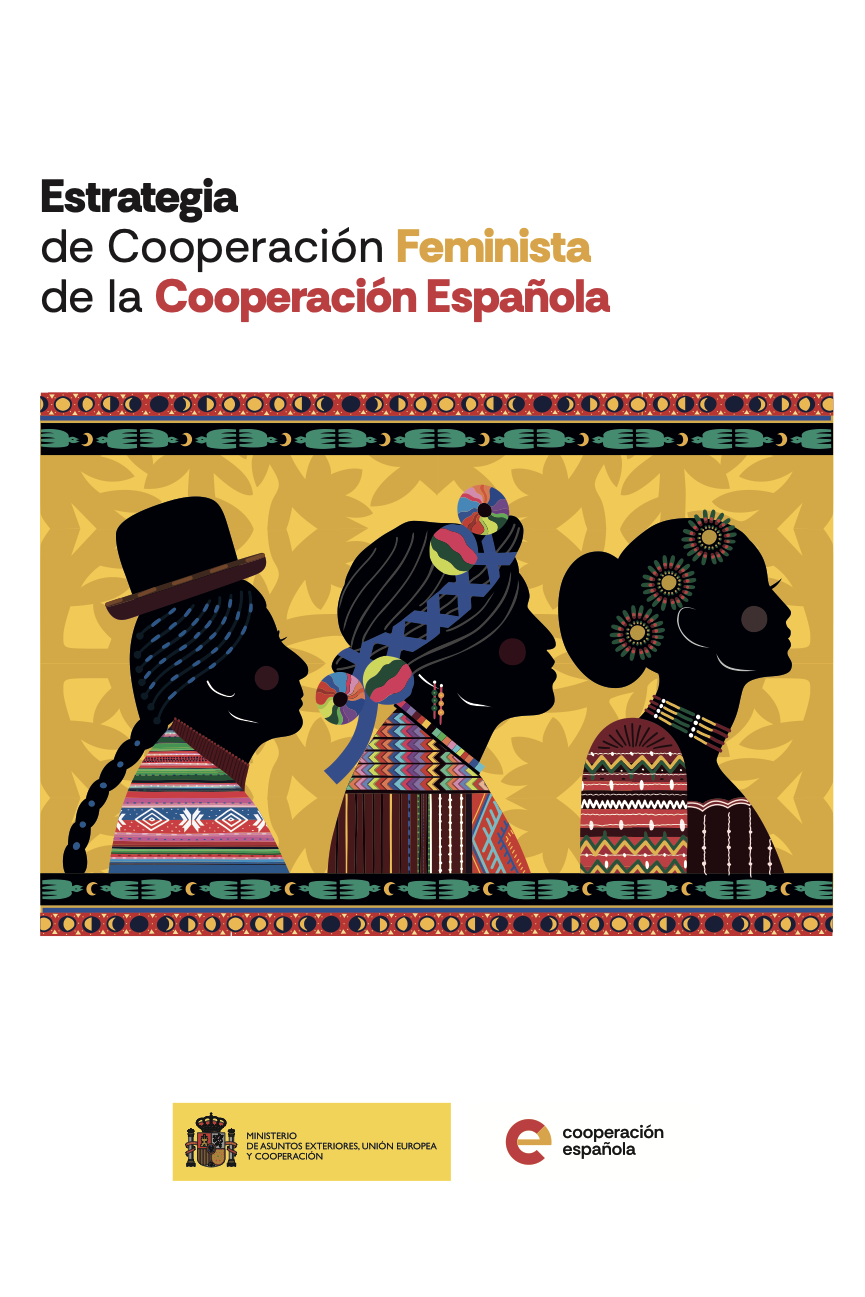
Spain is positioning itself as a driving force behind feminist foreign policies, translating its historic commitment to gender equality into concrete actions on the international stage : following the official adoption of a feminist foreign policy in 2021, in December 2025 the Spanish government published its new Feminist Cooperation Strategy, a reference framework for all its international cooperation (development, humanitarian action, multilateral and financial cooperation).
Spain’s strategy for feminist cooperation is based on several pillars, including:
- Defending the human rights of women and girls, including sexual and reproductive rights and health;
- Combating all forms of gender-based violence and discrimination by addressing their root causes;
- Empowering women and feminist movements, particularly in decision-making spaces, and promoting their participation and leadership;
- The integration of a cross-cutting feminist approach into all international cooperation policies, instruments and practices;
- The mobilisation of funding, particularly flexible, multi-year and accessible funding, adapted to the realities of local feminist organisations.
After France in 2025, Spain will host the 5th InternationalConference on Feminist Foreign Policies on June 2-3, 2026, an event aimed at bringing together committed States, sharing good practices, strengthening accountability mechanisms and reinforcing alliances around a diplomacy that places human rights and gender equality at the heart of external action.


ALSO READ
Feminist Foreign Policies: Key Takeaways from the 5th Ministerial Conference in Madrid
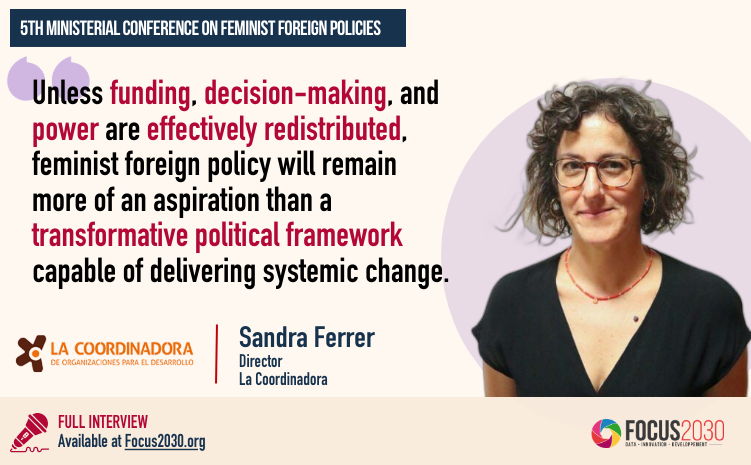
Interview with Sandra Ferrer, Director of la Coordinadora, on the Fifth Ministerial Conference on Feminist Foreign Policies.
5th Ministerial Conference on Feminist Foreign Policies: Building Peace and Promoting Democracy
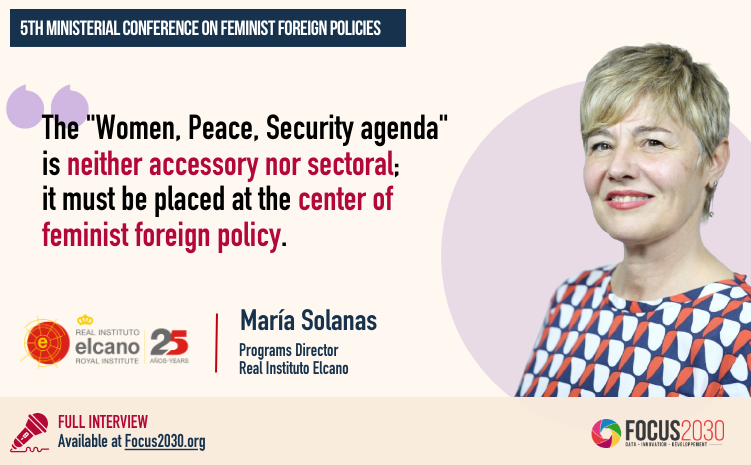
Interview with María Solanas, Programs Director, Real Instituto Elcano, ahead of the 5th ministerial conference on feminist foreign policies
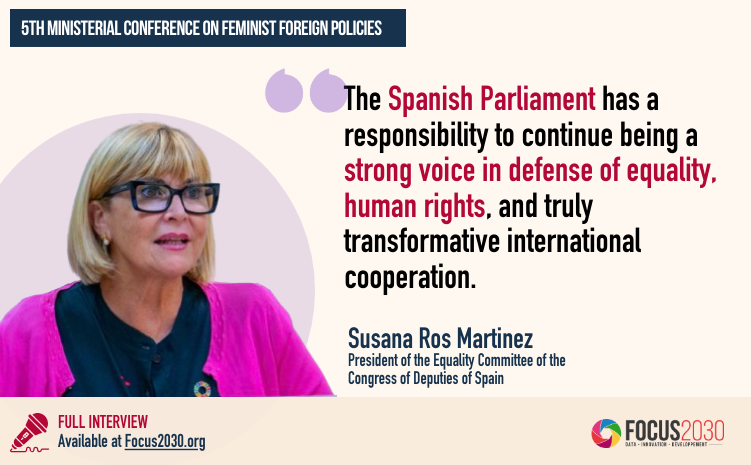
Interview with Susana Ros Martinez, President of the Equality Committee of the Congress of Deputies of Spain, ahead of the Fifth Ministerial Conference on Feminist Foreign Policies.