3 questions to Lucie Daniel, Head of Advocacy and Research at Equipop, member of the Women 7 Secretariat
| As March 8 and CSW70 approach, Focus 2030 turns the spotlight on the state of gender inequality worldwide, against a backdrop of sharp cuts to official development assistance and mounting attacks on the rights of women and sexual and gender minorities. At this critical juncture, Focus 2030 brings together data, key facts, campaigns, and expert voices to assess the progress made through these partnerships and the challenges that lie ahead in the fight for equality. Read our special edition. |
Interview with Lucie Daniel, Advocacy and Research Manager at Equipop, member of the Women 7 secretariat
Focus 2030: Since 2017, the Women 7 is one of the official engagement group of the G7, bringing together feminist organizations to formulate recommendations for Heads of State and Government. How is the W7 you coordinate structured, and how does it operate under the current presidency?
Lucie Daniel: During France’s previous G7 presidency in 2019, collective mobilization proved effective, as it pushed France toward adopting a feminist foreign policy and led to the creation of the Support fund for feminist organizations. This fund (FSOF), managed by the French Development Agency (AFD), has since provided financial support to nearly 1,500 organizations worldwide, enabling collective mobilization, legislative changes, and the implementation of significant, sometimes vital, actions: preventing gender-based and sexual violence, improving access to justice, and tackling climate change.
This year, as France once again holds the G7 presidency, feminist mobilization is gaining momentum. A total of 260 organizations from more than 60 countries have joined the W7. All G7 countries are represented, and more than half of the members come from Global South countries, reflecting a strong determination from international feminist civil society to make its voice heard. The collective is coordinated by Equipop, CARE France, Le Planning Familial, PLAN International France, and the Mediterranean Women’s Fund.
Despite the absence of a dedicated Gender track this year, several entry points have been identified to advance W7 demands. Backlash, masculinism, and funding for feminist organizations are among the key priorities structuring the W7’s work. Other issues will also be addressed, such as the links between gender and climate justice, and the “Women, Peace and Security Agenda”. The objective is both to secure commitments for women’s rights and gender equality, and to promote and adopt feminist approaches, which are essential for addressing the challenges facing the international community today.
To achieve this, the W7 carries out collective advocacy actions, engaging in G7 processes (ministerial meetings, Sherpa meetings, etc.) and leveraging events and processes directly or indirectly linked to France’s G7 presidency (Commission on the Status of Women, One Health Summit, Paris Peace Forum, etc.).
For its 2026 presidency, France has chosen to focus on major “global imbalances.” For decades, feminist activists and researchers have developed analytical frameworks and solutions to address these imbalances, highlighting, for example,the links between masculinist culture, the rise of far-right and populist movements, the brutalization of international relations, and geopolitical crises.
Above all, the W7 identifies a major factor of imbalance that must not be overlooked: the backlash against the rights of girls, women, and LGBTQIA+ people. This organized, planned, and well-funded phenomenon relies on anti-rights movements and conservative political parties, with the complicity of parts of the private sector and Big Tech. Beyond its impact on women’s rights and gender equality, this trend represents a major warning sign for democracy. This is the core message of the W7 Declaration, which will be published in March and shared, notably, with Emmanuel Macron.
Finally, the G7 is a high-level political platform that puts Heads of State in the spotlight. For W7, it is therefore also an opportunity to remind them of their commitments to gender equality, mobilize the media, and raise public awareness of these issues.
Focus 2030: G7 countries account for a major share of international funding for gender equality, sexual and reproductive health and rights, and more broadly for development policies. In 2023–2024, they allocated $6 billion in bilateral ODA to gender equality as a principal objective (3.9% of their bilateral ODA), and $65.9 billion when gender equality is a significant objective (42.1%). In this context, what is the concrete impact of declining G7 ODA on women’s rights, particularly sexual and reproductive health and rights, and on feminist organizations?
Lucie Daniel: Women’s rights, and the feminist organizations that defend them, are under attack from all sides. This is not new, but the backlash we are facing today is unprecedented in its speed, brutality, and scale. The measures taken by the Trump administration have created an international shockwave. The dismantling of USAID, the United States Agency for International Development, and the expansion of the Global Gag Rule have had extremely serious consequences for women’s health and rights.
To understand the scale of these impacts, it is important to recall that the United States was until recently the leading contributor to many UN agencies such as the UN Refugee Agency (UNHCR) and the United Nations Population Fund (UNFPA), which play a key role in advancing sexual and reproductive health and rights for women and girls worldwide. Diplomatic offensives against gender equality have also intensified at the UN, forming the first step of a broader agenda targeting multilateralism and international law.
In this particularly hostile context, feminist organizations are also facing funding cuts from European donors. European institutions, along with several Member States (including the Netherlands, Belgium, Finland, Sweden, and France) have significantly reduced their official development assistance budgets. These cuts deprive women of access to essential services, such as care for survivors of sexual violence or access to safe abortion.
Beyond women’s rights, our democracies themselves are at stake. Wherever civil society organizations, particularly feminist groups, are attacked or weakened, civic space shrinks, checks and balances erode, and authoritarian regimes gain ground.
Focus 2030 In a context marked by setbacks in gender equality and women’s rights in several G7 countries, and even openly hostile positions, particularly in the United States, how does the W7 position itself? To what extent is gender equality taken into account by the G7? What priorities and recommendations is it putting forward this year, and what lessons do you draw from previous G7 summits regarding progress on gender equality?
Lucie Daniel: The G7 has always been an ambivalent decision-making space. On the one hand, its legitimacy is questionable compared to UN forums. On the other, it is a space where initiatives on gender equality have emerged, such as the creation of the “Biarritz Partnership” or the Support Fund for Feminist Organizations (FSOF) mentioned previously.
Today, an additional layer of complexity must be acknowledged: recent policies by some G7 member states seriously undermine gender equality, human rights, multilateralism, and democratic principles. Ignoring this reactionary offensive will not make it disappear; on the contrary, it will become more deeply entrenched, further exacerbating global imbalances.
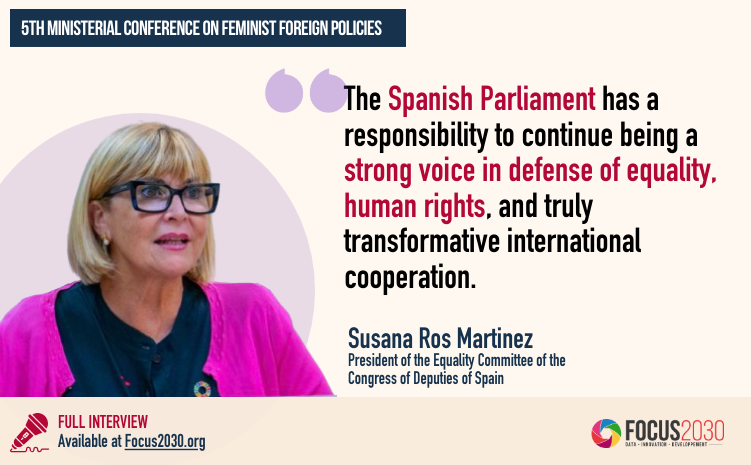
According to the W7, the minimum objective is to prevent any rollback within the G7. It is also important to highlight that the 5th Conference on Feminist Foreign Policies and Gender Equality will take place in Madrid ten days before the G7 Summit. Germany, Canada, France, and the United Kingdom, representing the majority of G7 members, signed the political declaration of the 4th conference held in Paris in October 2025.
The French G7 presidency must therefore be a key moment of clarification. States that are turning a blind eye to the backlash must break their silence, and those that have committed to fighting it must demonstrate it by stepping up their efforts.
In both cases, W7 calls on these states to uphold four uncompromising priorities ahead of the U.S. presidency in 2027:
- Affirm that the backlash against the rights of women and girls in all their diversity, as well as LGBTQIA+ communities more broadly, constitutes a major global imbalance for democracies.
- Explicitly recognize the fundamental role of civil society organizations, particularly feminist groups, in addressing global imbalances and defending democracy.
- Commit politically to allocating substantial public financial resources to support these organizations at a time when funding is at its lowest. Concretely, this means providing direct, flexible, and multi-year funding to feminist organizations in G7 countries and beyond, especially local and Global South-led groups. It also involves mobilizing private foundations, companies, and financial institutions as key actors in financing gender equality and feminist organizations.
- Leverage state influence to mobilize and amplify a broad range of actors (institutions, civil society, public opinion, media, and the private sector).
It is often in spaces of power, especially those where feminists are least expected, that their presence and action are most crucial, at the very least to ensure that decisions do not harm women, and ideally to transform them. In 2019, the creation of broad alliances between international solidarity organizations, feminist actors, researchers, and journalists proved to be a key factor for success. By influencing both formal processes and parallel advocacy, through the #FeministCount campaign, the W7 managed to drive change despite the highly constrained G7 framework.
This year, the context is even more challenging. This is precisely why mobilization must be stronger than ever, and why the call to join W7 is particularly broad: all organizations willing to do so can join the movement by signing this call to action.
| This interview has been translated to English by Focus 2030. The original version can be consulted here. The opinions expressed in this interview do not necessarily reflect the views of Focus 2030. |