The Global Fund: channelling the world’s resources to fight AIDS, Tuberculosis and Malaria
The Global Fund to Fight HIV, Tuberculosis and Malaria is an international partnership set up to combat these three infectious diseases, which are among the deadliest the world has ever known. Its mission is to attract, mobilize and invest funds from international donors in order to defeat these three diseases, reduce inequalities and contribute to the achievement of the Sustainable Development Goals for health.
It was in 2000 that the leaders of the G8 countries recognized the need to allocate far greater resources to the fight against these three diseases, as very few people in the world had access to the necessary tools at the time. This need was reaffirmed the following year at the African Union Summit, then at the United Nations General Assembly, and endorsed at the G8 Summit. The Global Fund was eventually launched in January 2002.
Based in Geneva, this partnership between public authorities, civil society, disease-affected communities, technical partners, the private sector, faith-based organizations and other donors, strategically invests in programs aimed at ending these epidemics.
The Global Fund’s unique model was created on the basis of founding principles that continue to guide its action : partnership, country ownership, transparency, and funding based on results and impact.
Its investments have helped preserve 70 million lives and reduce the number of annual deaths from the three diseases by 63 % since 2002.
Operating model
The Global Fund’s partnership model is designed to promote innovative solutions to global health challenges. Collectively, the Global Fund draws on the best assets of the public and private sectors, in terms of experience, knowledge and innovation, in order to fight diseases and build resilient, sustainable health systems.
The Global Fund acts as a catalyst for the development of innovative solutions to global health challenges.
In practical terms, the Global Fund acts as a financing platform, directing international resources towards the most affected contexts. Its partnership-based governance model involves all stakeholders. Donor countries fund the mechanism and participate in strategic decisions. Beneficiary countries define their national priorities and steer interventions. Civil society organizations are involved at all levels, from program design to evaluation. Communities affected by the diseases take part in the governance. Technical partners such as WHO and UNAIDS, as well as international donors, provide support and expertise. Finally, private and philanthropic players are mobilized for their capacity for innovation, financing and rapid action.
The Global Fund provides grants to public, private and non-governmental programs in support of technically viable and effective interventions, with priority given to regions with the highest burden of disease. Each country adapts its response according to the political, cultural and epidemiological context, and decides where and how best to fight AIDS, tuberculosis and malaria.
Impact on global health issues
Between its creation in 2002 and June 2025, the Global Fund has disbursed 70 billion dollars in support of the HIV, tuberculosis and malaria responses and health systems strengthening programs in more than 120 countries. Each year, the Global Fund invests more than US$5 billion in support of programs led by local specialists.
Since its creation in 2002, the Global Fund partnership has helped preserve 70 million lives and reduced the combined death rate from AIDS, tuberculosis and malaria by 63%.
In its countries of operation, the proportion of people living with HIV and receiving antiretroviral treatment increased from 0% in 2002 to 78% in 2023, or 25 million people on treatment that year. The same year, 13.1 million tests were administered to key populations, 17.9 million people accessed prevention services, and 695,000 mothers living with HIV received treatment to prevent transmission to their child. Regarding tuberculosis, treatment coverage almost doubled, from 45% in 2010 to 75% in 2023. In 2023, 7.1 million people were treated for tuberculosis. Regarding malaria, 61% of the population had access to a long-lasting insecticide-treated mosquito net in 2023, compared to 4% in 2002. In 2023, 227 million insecticide-treated mosquito nets were distributed.
News
In November 2021, the Global Fund’s Board of Directors approved its strategy for the period 2023-2028. Its primary goal, in accordance with the Sustainable Development Goal no. 3, is to end AIDS, tuberculosis, and malaria, focusing on catalytic investments and innovation to accelerate progress, addressing structural barriers to improved outcomes and enhancing equity, sustainability and sustainable impact.
To carry out this strategy, the seventh replenishment conference of the Global Fund was held on 21 September 2022 in New-York, USA. It has leveraged 15.7 billion dollars from donors, an unprecedented amount, although below the target of 18 billion.
Since then, the Global Fund has approved 152 new grants covering more than 70 countries for the period 2024-2026, representing an amount of 9.2 billion dollars. These funds are aimed not only at intensifying the fight against the three pandemics, but also at strengthening health systems in the face of climate change, armed conflicts and political crises.
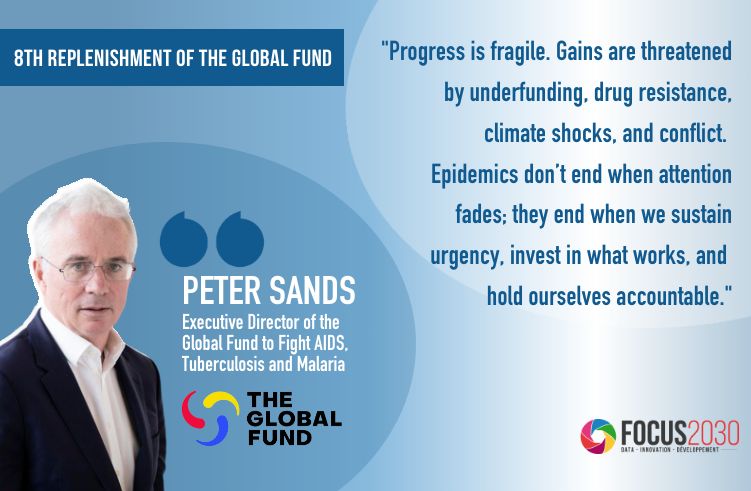
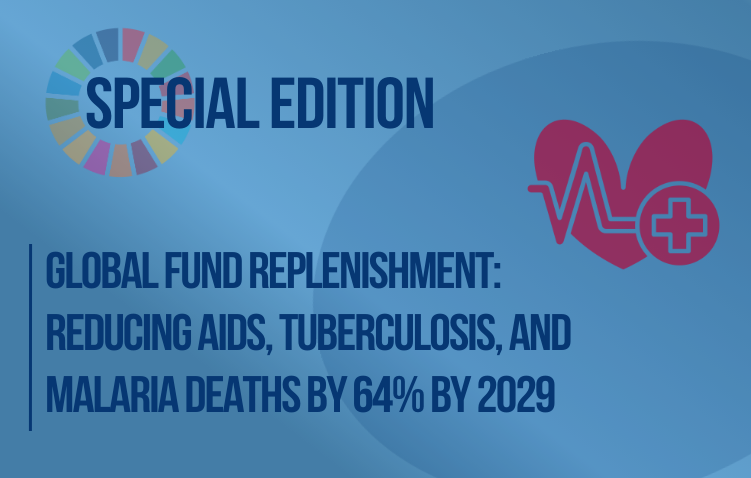
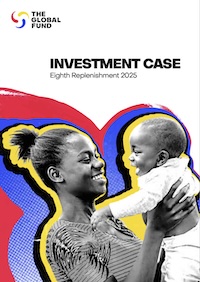
In February 2025, the Global Fund launched the investment case for its eighth replenishment, scheduled for fall 2025. This call aims to mobilize 18 billion dollars for the period 2026-2028. This level of investment would allow for the preservation of 23 million additional lives between 2027 and 2029, a 64% reduction in deaths from HIV, tuberculosis and malaria compared to 2023, and the avoidance of approximately 400 million new infections. The Global Fund estimates that each dollar invested will generate a return of 19 to one, for a total impact of 323 billion dollars between 2027 and 2029. This approach would also save 42 billion dollars in primary health care by avoiding 3.1 billion medical visits and 1.6 billion days of hospitalization. One third of the requested resources will be dedicated to strengthening health systems and communities. This priority includes the development of critical infrastructure, staff training, epidemiological surveillance and support for front-line actors, particularly in fragile contexts or those affected by multiple crises.
Covid-19 Pandemic response
In 2020, the Covid-19 pandemic had a devastating effect on the fight against other diseases. For the first time in the history of the Global Fund, some of the key program indicators recorded declines. Compared to 2019, HIV testing decreased by 22% in countries where the Global Fund invests, 18% fewer people were treated for tuberculosis, and the number of people tested for malaria decreased by 4.3%.
However, the situation would have been even worse without Global Fund interventions. As early as 2020, the Global Fund launched the Covid-19 response mechanism (C19RM), aimed at helping countries fight the Covid-19 pandemic, mitigate its impacts on programs to fight AIDS, tuberculosis and malaria and to urgently strengthen their health systems. This mechanism deployed more than 5.4 billion dollars in support to 130 countries between 2020 and 2023. Two-thirds of these resources were allocated to purchase tests, medical oxygen, personal protective equipment and essential treatments. Other funding has supported the adaptation of programs to combat the three diseases. The C19RM also served as a lever to strengthen the capacities of national laboratories, logistics chains, and health surveillance mechanisms.
The Global Fund was one of the organizations coordinating the Access to Covid-19 Tools Accelerator (ACT-A), the global facility set up to facilitate a more equitable access to tests, treatments and vaccines across countries. The Global Fund co-led two of the four pillars of the ACT-A: one working towards the equitable distribution of diagnostics, and one focusing on strengthening national health and response systems to health threats. As such, it has contributed to the delivery of more than 185 million tests, the supply of oxygen therapy equipment in nearly 80 countries and the distribution of protective equipment worth more than 600 million dollars.Presentation of the Global Fund, a global partnership to accelerate the fight against the HIV, tuberculosis and malaria epidemics.