Contact

  • English
  • Español
  • Analysis

    Understanding development aid (an overview)

    Publié le 14/05/2021.

    Official Development Assistance (ODA) is an essential public policy for meeting the Sustainable Development Goals, and alleviating poverty for millions of people around the world.

    Despite this, ODA is one of the least-well known or understood of public investments. This overview offers a brief history of commitments on development aid, its aims and methods, and what makes up our aid budgets.

    You will also find the latest figures available on the amounts and breakdown of aid provided by the most frequently-referenced group of donor countries, members of the Development Assistance Committee of the OECD.

    Aid developed as an instrument to support poverty-stricken countries after the second world war, and became a definitive part of government policy with the creation of the OECD Development Assistance Committee (DAC).

    But the use and objectives of aid in international policy have been fluid over time, as has its popularity. In the 1990s came the phenomenon of “aid fatigue”, followed by renewed interest and enthusiasm by the 2000s with the UN’s first-ever development framework, the Millennium Development Goals (MDGs). These were a set of goals which set out to inspire specific action on international poverty. They were updated by the Sustainable Development Goals (SDGs) in 2015, a framework which sets out 17 goals on international development, governance and climate change, which the world is due to meet by 2030.

    In 2022, the DAC OECD members provided 204 billion dollars in total aid, double the levels of 2000. But though this sounds like a substantial increase, it is actually fairly modest, ODA spending representing an average of only 0.36% of Gross National Income (GNI). As a comparison, an informal objective for defence spending in NATO is 2% per member state.

    Today, only five countries have met the UN international commitment, agreed back in 1970, to provide 0.7% of their GNI in aid.

    An English translation of our Policy Brief on ODA (in French here) is forthcoming.

    Pour aller plus loin
  • Understanding Official Development Assistance (in French) - Focus 2030
  • Increase of Development Aid in 2020
  • À LIRE AUSSI

    G7 en - 12 February 2026

    Which G7 countries consider gender equality in their foreign aid?

    At-a-glance: discover the OECD’s Development Assistance Committee (DAC) assessment of G7 member states' financial support for gender equality around the world.
    Sustainable Development Goals - 09 February 2026

    37% of French people have already adapted their consumption habits in order to better fight against world poverty

    Poverty and development can change consumer behavior for 37% of French people, whether through a boycott or particular product choice.
    Uncategorized - 09 February 2026

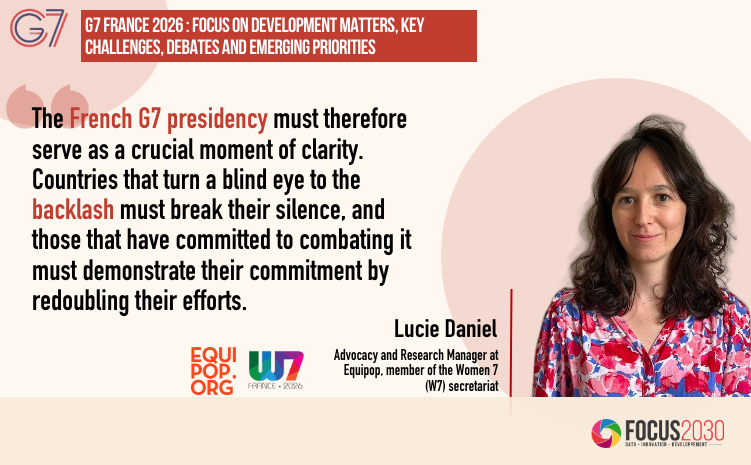
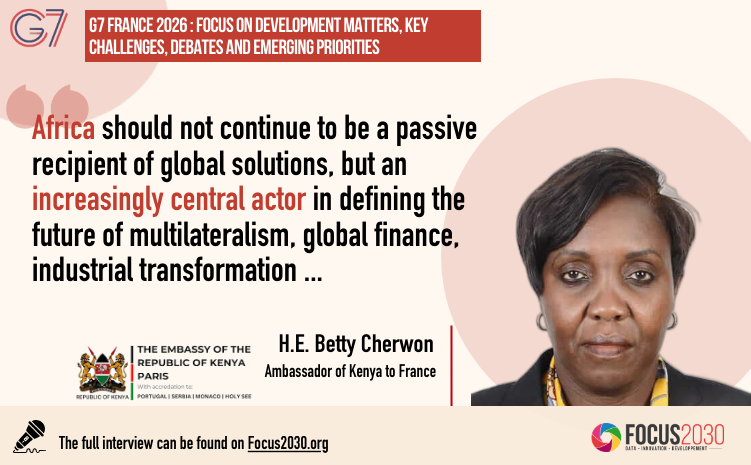
    G7 France 2026: Focus on development issues, understanding the challenges, keeping up with the latest news

    En 2026, la France assure la présidence du G7, dont le Sommet des chef·fe·s d'Etat est prévu à Évian du 15 au 17 juin 2026. Cette séquence s’inscrit en parallèle de la présidence américaine du G20, dont le Sommet se tiendra les 14 et 15 décembre 2026 à Miami.
    Official development assistance - 03 February 2026

    2026 Finance Bill: a fifth cut in French official development assistance

    The draft finance bill (PLF) for 2026, adopted on February 2 in accordance with Article 49.3 of the Constitution, confirms a cut of €803 million in the “Official Development Assistance” (ODA) budget. This is the fifth consecutive cut in the ODA budget in less than two years, which accounts for only 0.45% of the national budget. […]
    Gender equality - 26 January 2026

    Spain’s new Feminist cooperation strategy : Scope and orientations

    Spain unveils its new Feminist Cooperation Strategy, designed to structure and operationalize the integration of gender equality throughout its international cooperation policy. Rooted in multilateralism and the 2030 Agenda, this strategy proposes a feminist, intersectional, and transformative approach aimed at addressing the structural causes of inequality and transforming power relations. Analysis.
    Financing for Development (ODD) - 20 January 2026

    United States withdrawal from 66 international organizations: a new step in a disengagement initiated in 2025

    On January 7, 2026, the United States announced its withdrawal from 66 international organizations, including 31 entities within the United Nations system. This decision marks a new phase in a disengagement from multilateral cooperation initiated early 2025, directly affecting progress toward all the Sustainable Development Goals, particularly in the areas of climate, gender equality, global health, and development financing. An analysis. Key measures […]