Editorial
The reinstatement of the “Global Gag Rule” by the new US administration, banning all public funding for international NGOs working on abortion access and information, is a stark reminder that gender equality remains a global struggle, fragile and constantly called into question.
While the international community pledged to achieve gender equality by 2030, successive crises – armed conflicts, democratic setbacks, climate change, and now drastic cuts in official development assistance – are threatening what little progress has been made and exacerbating inequalities.
Between 2019 and 2022, nearly 40% of the world’s countries, representing a population of more than a billion women and girls, experienced stagnation or regression in terms of gender equality.
At the current rate of progress, it will take another 300 years to achieve gender equality on a global scale. This is the sobering conclusion of the UN.
The rollback of women’s rights in many countries is the result of a historic reversal – what some have called a “global backlash” – orchestrated and funded by conservative governments and increasingly influential anti-rights movements.
Just a few months into 2025, we have seen a series of unprecedented setbacks, particularly affecting sexual and reproductive health and rights, and consequently the very ability of women and girls to take charge of their own lives. This complete reversal is an all-out assault on the Sustainable Development Goals (SDGs). As the deadline approaches, their achievement is more at risk than ever.
“Stop talking, start funding !”, was the rallying call of feminist movements at the Generation Equality Forum held in France and Mexico back in 2021. Four years on, the moment of reckoning has arrived, and funding for gender equality has failed to materialize.
As we celebrate the 30th anniversary of the Beijing Declaration and Platform for Action, this ambitious action plan is more than ever in jeopardy.
This Focus 2030 special report takes a look at the current state of women’s rights around the world, while highlighting the resistance and initiatives of those fighting to make equality a reality.
Contents
– Gender inequality : the challenge in key facts and figures
– Looking ahead to CSW69 and assessing progress over the past 30 years
– Funding the fight : persistent underfunding for gender equality worldwide
– The global state of sexual and reproductive health and rights in the age of backlash
– A polarized world : reactionary international forces vs. Feminist foreign policy ?
– Exclusive interviews with leading experts on gender inequality
Gender inequality : the challenge in key facts and figures
Looking ahead to CSW69 and assessing progress over the past 30 years
The 69th session of the United Nations Commission on the Status of Women (CSW69) will be held in New York from March 10 to 21, 2025. This session marks the 30th anniversary of the 1995 World Conference on Women (Beijing+30). On this occasion, the international community will evaluate the implementation of the Beijing Declaration and Platform for Action, while identifying the current obstacles to the full achievement of gender equality and women’s empowerment.
France sent a delegation of 22 MPs and Senators to New York to participate in the CSW69, in a context marked by the right to abortion being enshrined in the French Constitution a year ago, but also by the reactivation of the Global Gag Rule, which suspends US funding for SRHR.
Funding the fight : persistent underfunding for gender equality worldwide
Which donor countries support gender equality in their official development assistance ?
In 2015, all countries committed to achieving the 17 Sustainable Development Goals (SDGs) by 2030, including SDG 5, dedicated to gender equality and the empowerment of women and girls worldwide. Adequate funding, especially in the poorest countries, is critical to achieving this.
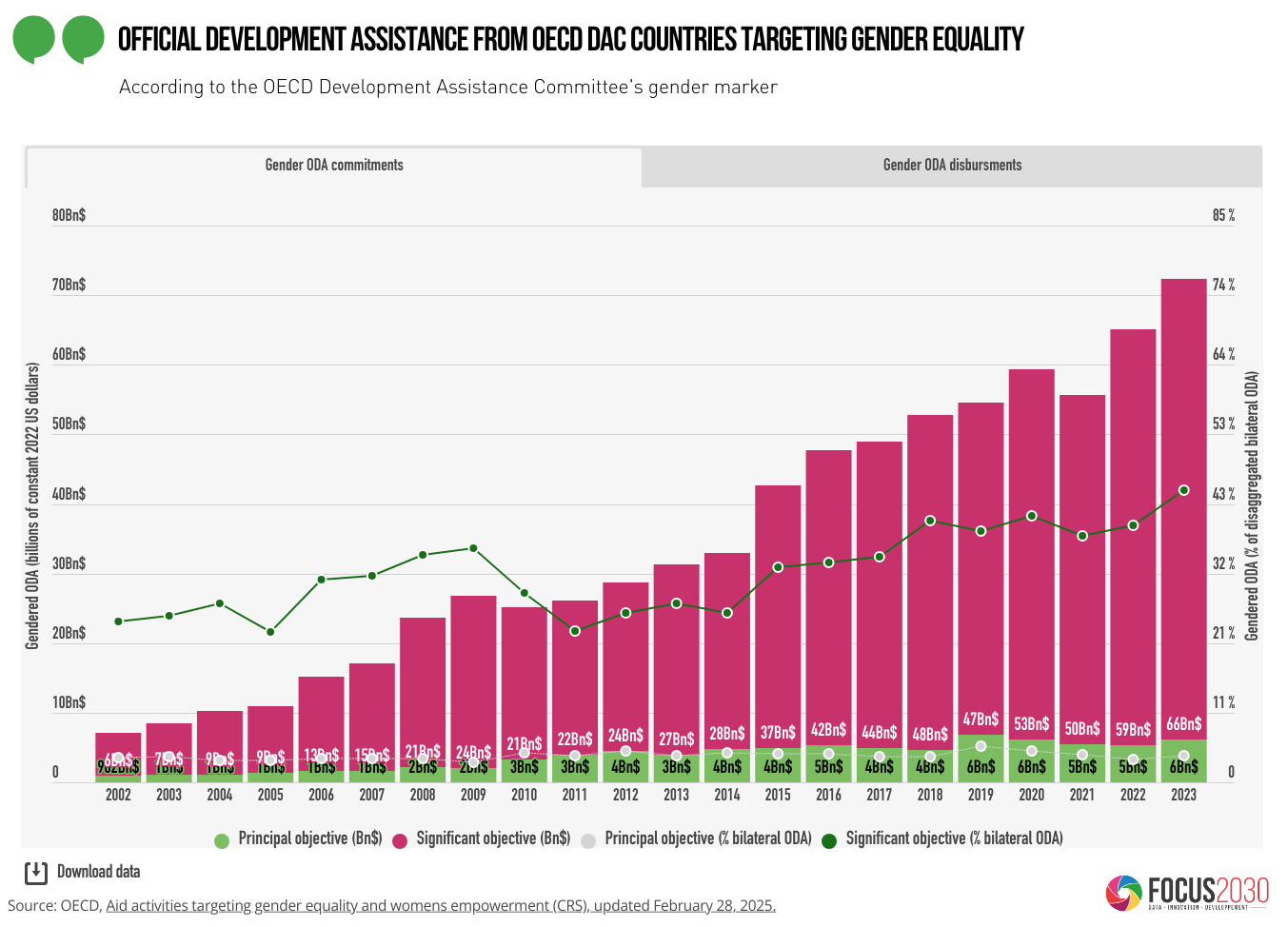
Official Development Assistance (ODA) from the OECD’s Development Assistance Committee (DAC) is an essential source of funding in this regard. Between 2022 and 2023, the 31 DAC donor countries and the EU have pledged to allocate an average of $68 billion per year to this goal, or 45.7% of their bilateral ODA. Of this amount, $5.7 billion has been earmarked for projects that have gender equality as a primary objective, and $62.9 billion for projects that make a significant contribution to it.
In terms of volume, the top donors of ODA for gender equality are also the top donors of total ODA (Germany, Japan, USA, France, Canada).
However, no country has reached the international target of directing at least 85% of its ODA to gender equality, although the Netherlands comes close at 84.7%. Only the Netherlands and Spain devote at least 20% of their ODA to the direct promotion of equality.
🔗 Find out more about ODA to support gender equality
Feminist organizations : leading the charge, but lacking financial support
In spite of their crucial role, feminist organizations receive only $0.6 billion in support per year, which is less than 1% of the official development assistance dedicated to gender equality. In 2023, the total amount allocated by OECD DAC members to feminist organizations and movements was $645 million.
France joined the group of major donors to feminist organizations in 2019, the year it launched its support fund for feminist organizations, providing $132 million in 2021-2022, replenished for the following five years at 250 million euros. Between 2022 and 2023, France allocated an average of $97 million to feminist organizations and movements worldwide.
The global state of sexual and reproductive health and rights in the age of backlash
An alarming overview
Sexual and reproductive health and rights (SRHR) are essential to women’s empowerment and the achievement of the Sustainable Development Goals. SRHR refers to all rights that guarantee individuals the right to control their own bodies and freely make decisions about sexuality and reproduction. They are therefore not limited to maternal health alone, but include other fundamental aspects such as information and sex education, access to contraception, prevention and screening of sexually transmitted diseases, etc.
Despite notable progress, such as the recognition of SRHR at the Cairo (1994) and Beijing (1995) conferences and their inclusion in the UN’s 2030 Agenda, challenges remain. Maternal mortality decreased by 34% between 2000 and 2020, but restrictive abortion policies, public health crises, and the rise of anti-rights movements threaten this progress.
Today, 40% of women of reproductive age live under restrictive abortion laws, resulting in thousands of deaths from unsafe abortion each year. In addition, 270 million women lack access to modern contraception, and nearly 4.4 million girls – 12,000 a day – are at risk of female genital mutilation.
Insufficient funding
Since 2000, the volume of aid that integrates gender equality has increased sevenfold, reaching $59 billion in 2020. However, of the average $5.7 billion allocated annually in 2020 and 2021 to promote gender equality as a primary objective, only $1 billion was earmarked for reproductive health programs.
The Countdown 2030 Europe report, Tracking What Counts 2023/2024, highlights an increase in European funding for sexual and reproductive health and rights (SRHR). In 2023, overall funding for SRHR increased by 10% to €3.2 billion, while European donors maintained funding for sexual and reproductive health and family planning (SRH/FP) at €1.7 billion. However, European donors have reduced their funding to the United Nations Population Fund (UNFPA) for the first time since 2019, including funding for the UNFPA Supplies partnership, a program dedicated to expanding access to family planning products, which has seen a sharp 31% decrease.
A polarized world : reactionary international forces vs. Feminist foreign policy ?
U.S. Focus : Once the world’s top contributor to SRHR, now its foremost threat
Immediately upon taking office, President Donald Trump reinstated the Global Gag Rule (or Mexico City Policy) and suspended US development assistance for 90 days, denying millions of women access to family planning services and reproductive healthcare. In some countries, these far-reaching decisions are likely to lead to an increase in unintended pregnancies and unsafe abortions (and thus an increase in maternal mortality) or to a resurgence of disease, threatening decades of progress.
With more than $9 billion in funding in 2022, accounting for 66% of the total, the United States is the leading donor for SRHR. USAID, the U.S. bilateral development agency, is the second largest supplier of contraceptives in the developing world and provides key funding to many family planning organizations.
The country is also the leading donor to UNFPA, to which it allocated $160 million in support in 2023, and to the World Health Organization (WHO), from which a withdrawal process has been initiated following Donald Trump’s inauguration on January 20, 2025.
Significant consequences : According to the Guttmacher Institute, an average of 130,390 women receive U.S.-funded contraceptive care every day. As a result of the suspension of U.S. aid, approximately 11.7 million women and girls will lose access to contraception. Based on global trends, this could result in 4.2 million unintended pregnancies and 8,340 deaths from pregnancy and childbirth related complications by 2025.
Increasingly well-funded and organized conservative movements
Anti-gender activism in Europe, supported by alliances between religious extremists and far-right political parties, is fuelling an ongoing offensive against sexual and reproductive rights. More than 50 anti-rights actors operate across the european continent, exploiting anti-gender narratives to polarize the electorate and destabilize democracies. A report by the European Parliamentary Forum for Sexual & Reproductive Rights (EPF) revealed that USD 707.2 million in anti-gender funding was mobilized between 2009 and 2018, from 54 organizations, including NGOs, foundations and political parties, mainly based in the USA, Russia and Europe.
Some conservative nations have coalesced around the Geneva Consensus Declaration on Promoting Women’s Health and Strengthening the Family, which the new administration recently reintegrated. The previous Trump administration was instrumental in securing its adoption in 2020. Endorsed by 36 countries, the declaration opposes abortion and promotes a conservative vision of the family and the rights of sexual minorities.
Progressive countries united around the adoption of “feminist foreign policies”
Following Sweden in 2014, fifteen countries have adopted a feminist foreign policy, which aims to establish a new approach to international relations that puts gender equality and women’s rights at the centre. These initiatives aim to dismantle systemic inequalities by integrating a feminist perspective into diplomacy, official development assistance, and peace and security.
In addition to countries that have formally adopted a feminist foreign policy, some twenty countries are mobilising around the Feminist Foreign Policy Plus (FFP+) group, a coalition of countries and organizations that support and promote this approach to diplomacy at the international level. This group was created to strengthen these initiatives by sharing best practices, developing common strategies and advocating for policies that integrate a gender approach.
France unveiled its strategy for “feminist foreign policy” (2025-2030) on March 7, 2025, International Women’s Rights Day, aimed at promoting gender equality and women’s rights in international relations. This strategy is structured around 5 pillars :
- Defending rights and freedoms
- Promoting participation and representation in all decision-making processes
- Tackling all forms of gender-based inequality and violence
- Ensuring access to resources and mobilize funding
- Adopting and promoting a feminist methodology
France will co-chair the Feminist Foreign Policy Group (FFP+), and host the 4th Feminist Foreign Policy Conference in June 2025. This event will bring together governments, NGOs and experts committed to putting gender equality at the heart of international action.
Exclusive interviews with leading experts on gender inequality


ALSO READ
Gender equality in philanthropy in France: assessing a still limited level of engagement
CSW70: UN Women’s rights negotiations marked by deepening divisions
Special Edition : The state of gender inequalities around the world in 2026
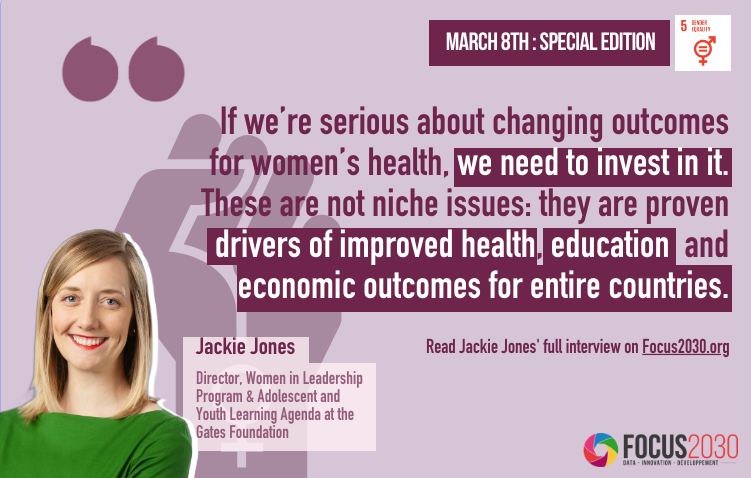
3 questions to Jackie Jones, Director of the Women in Leadership Program & Adolescent and Youth Learning Agenda at the Gates Foundation
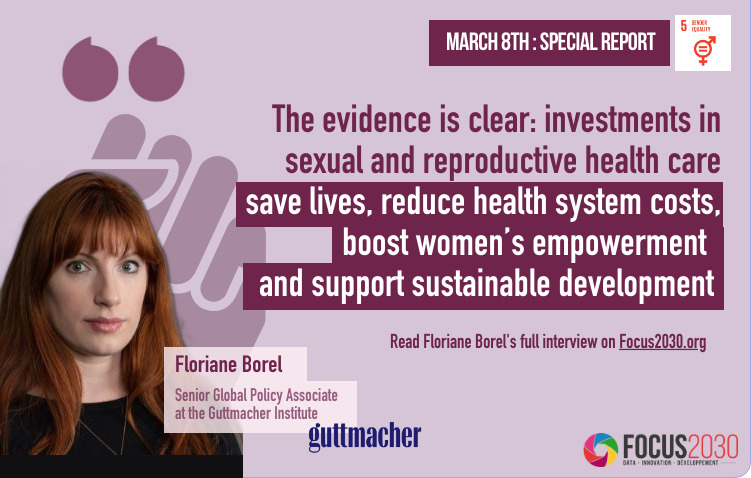
3 questions to Floriane Borel, Senior Global Policy Associate at the Guttmacher Institute