Gender equality in philanthropy in France: assessing a still limited level of engagement
Published on 08/04/2026.
While gender equality is widely recognized as a driver of social justice and development, it remains insufficiently funded within the philanthropic sector. This gap unfolds in an international context marked by the rise of “anti-gender” movements, which oppose the rights of women and gender minorities and are increasingly structured and well-funded.
At the global level, most organizations defending the rights of women and girls operate with limited resources: many have annual budgets below USD 30,000, and 31% operate with less than USD 5,000. According to the OECD, only 8% of philanthropic funding for development worldwide targets gender equality, representing an average of USD 1.8 billion per year over the 2022–2023 period.
At the same time, funding for anti-gender movements has reached significant levels, estimated at at least USD 1.18 billion in Europe between 2019 and 2023, according to The Next Wave report by the European Parliamentary Forum (EPF). France contributes to these flows, with USD 165.7 million originating from French donors, positioning the country as a leading source of such funding in Europe, after Hungary.
In this context, resources mobilized for gender equality appear misaligned with the scale of the challenges. Funding dedicated to women’s rights remains limited, while actors opposing these rights are strengthening their capacity for action.
Understanding persistent underfunding : To address this issue, the Coalition for Feminist Philanthropy, bringing together twelve donors and created in 2021, commissioned Agence Phare to analyze the place of gender equality in French philanthropy. Published in 2025, the study aims to identify, quantify, and analyze funding allocated to this cause.
Key findings and areas for action.
A persistently underfunded issue
The study highlights a gap between the urgency of the challenges and the level of funding mobilized. In France, only 7% of philanthropic funds, approximately €140 million, are dedicated to gender equality.
Beyond financial volumes, the study points to limited engagement among philanthropic organizations:
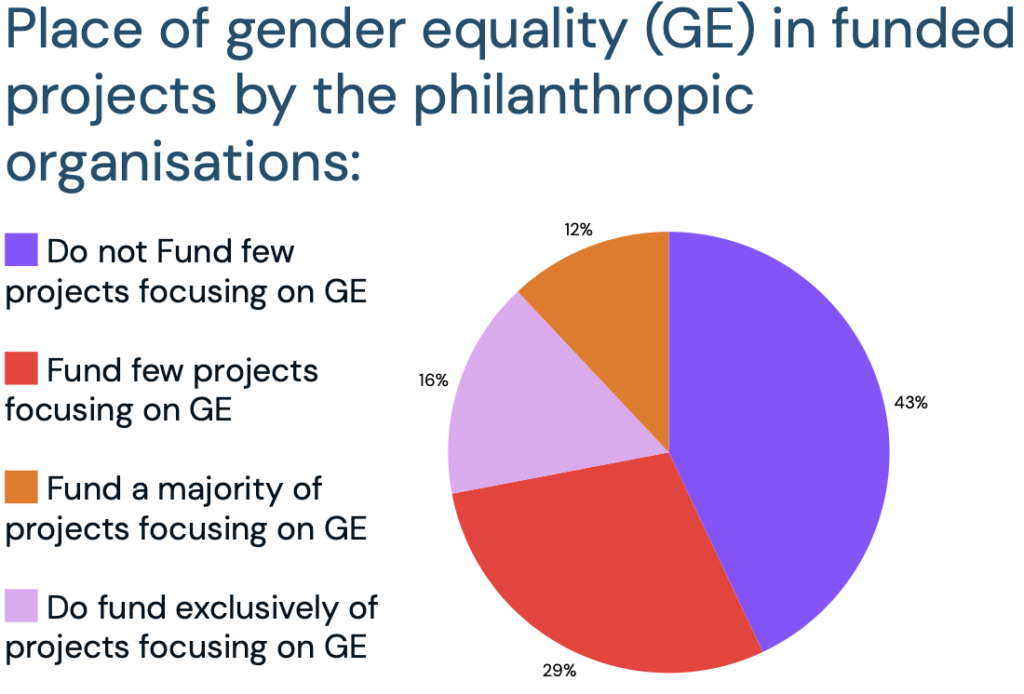
• Only 28% primarily or exclusively fund projects related to gender equality.
• 43% of organizations do not fund any gender equality projects;
• 29% fund only a minority of projects;
Overall, nearly three-quarters of organizations provide little or no funding for gender equality.
Even among committed organizations, efforts often remain limited: 36% allocate less than 10% of their funding to this issue, while only around one quarter devote more than half of their budget.
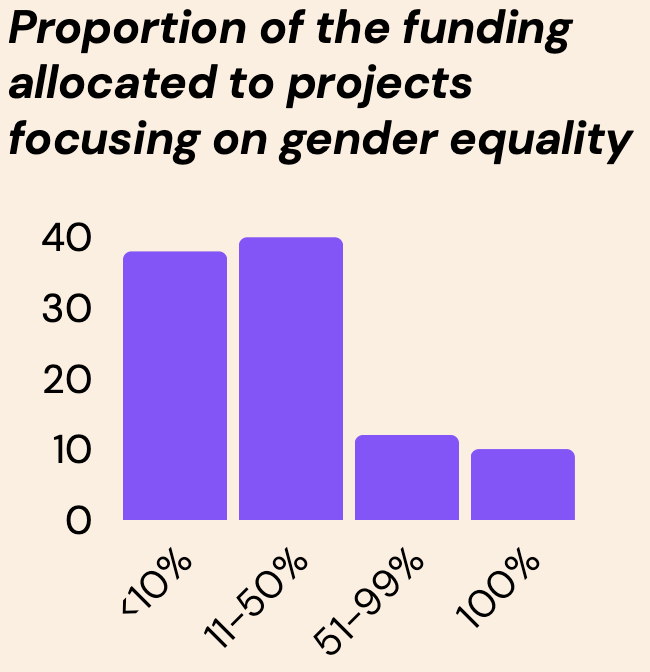
Different funding priorities depending on level of engagement
The study also highlights significant differences between “generalist” organizations and more committed ones, those that primarily or exclusively fund gender equality.
Broader approaches among most organizations
Most organizations supporting gender equality adopt relatively broad approaches, primarily targeting:
- all women (85%);
- women in precarious situations (75%);
- migrant or displaced women (65%).
Their funding also focuses on widely shared thematic areas:
- economic and professional rights (77%);
- education and training (65%);
- combating violence (58%).
More targeted and transformative funding among the most committed organizations
By contrast, the most committed organizations, those that integrate gender strategically and allocate a significant share of their funding to it, stand out through more targeted and structural approaches.
They are more likely to support:
- racialized women (68% vs. 45% on average);
- women affected by prostitution or trafficking (41% vs. 26%);
- LGBTQIA+ people (68% vs. 35%).
Thematically, they also invest more in areas that are often underfunded:
- reproductive rights (64% vs. 31%);
- advocacy and political action (68% vs. 38%).
They also adopt funding practices better aligned with the needs of organizations:
- more frequent use of flexible, unrestricted funding (49% vs. 33%);
- fewer very small grants (under €10,000: 14% vs. 25%).
This distinction highlights two approaches to philanthropy: a generalist approach, often more consensual but less transformative, and a feminist, strategic approach that more directly targets structural inequalities and the most marginalized groups.
Structural drivers of underfunding
The study identifies several factors explaining this persistent underfunding:
- limited strategic integration of gender, often treated as one issue among others;
- governance structures that remain unequal, despite evidence that women’s presence in leadership positions increases funding for gender equality;
- political and cultural constraints in a context of rising conservative movements.
More broadly, the persistence of the misconception that gender equality has already been achieved continues to obscure the depth of existing inequalities.
Women’s representation in governance: a key lever
The study highlights a direct link between women’s representation in decision-making bodies and the level of financial commitment.
While women are highly represented in the philanthropic sector (80% of employees and 52% of board members), they remain underrepresented in leadership positions, holding only 40% of presidencies.
This underrepresentation has tangible effects on funding priorities. Organizations that support gender equality are more often led by women:
- 72% have a woman executive director, compared to 67% among those that do not fund this issue;
- 47% have a woman president, compared to 40%.
In other words, the greater the access of women to positions of power, the more gender equality is integrated into philanthropic strategies. This finding points to a structural issue: promoting equality in governance is not only a matter of representation, but also a key lever for directing funding and accelerating progress on gender equality.
Toward more feminist philanthropy
The study calls for a shift in both scale and approach. It notably encourages:
- treating gender as a cross-cutting issue at the core of all philanthropic actions;
- developing more flexible, multi-year, and unrestricted funding adapted to the needs of organizations;
- adopting a progressive stance in a context marked by the rise of anti-rights movements.
Beyond these recommendations, the study underscores a deeper challenge: a shift in paradigm.
The issue lies not only in the lack of resources, but also in how philanthropy conceptualizes gender equality. It is still too often treated as one issue among others, rather than as a structural dimension that cuts across all causes. As long as this shift in perspective does not occur, funding will remain marginal and insufficient relative to needs.
In a context of declining rights and the rise of anti-gender movements, the implication is clear: failing to fund gender equality effectively leaves space for actors who oppose it.
| The Coalition for Feminist Philanthropy Created in 2021 at the initiative of twelve French philanthropic organizations, the Coalition for Feminist Philanthropy (CPF) emerged from a shared observation: gender equality remains significantly underfunded in France, despite its critical importance. Its objectives: • promote gender equality and strengthen its visibility within philanthropy; • mobilize greater resources for the rights of women and girls; • enhance collective impact through shared expertise and initiatives. Among its missions, the Coalition develops tools, data, and analysis to better guide funding and encourage more philanthropic actors to engage. The study conducted by Agence Phare constitutes an initial step in establishing a detailed and evidence-based overview of the situation in France. The CPF currently includes: • Focus 2030 • Fondation CHANEL • Fondation de France • Fondation des Femmes • Fondation Kering • Fondation Médecins du monde • Fondation RAJA-Danièle Marcovici • Fondation pour la Recherche sur l’Endométriose • Fondation BNP-Paribas • L’Oréal Fund for Women • Mediterranean Women’s Fund |