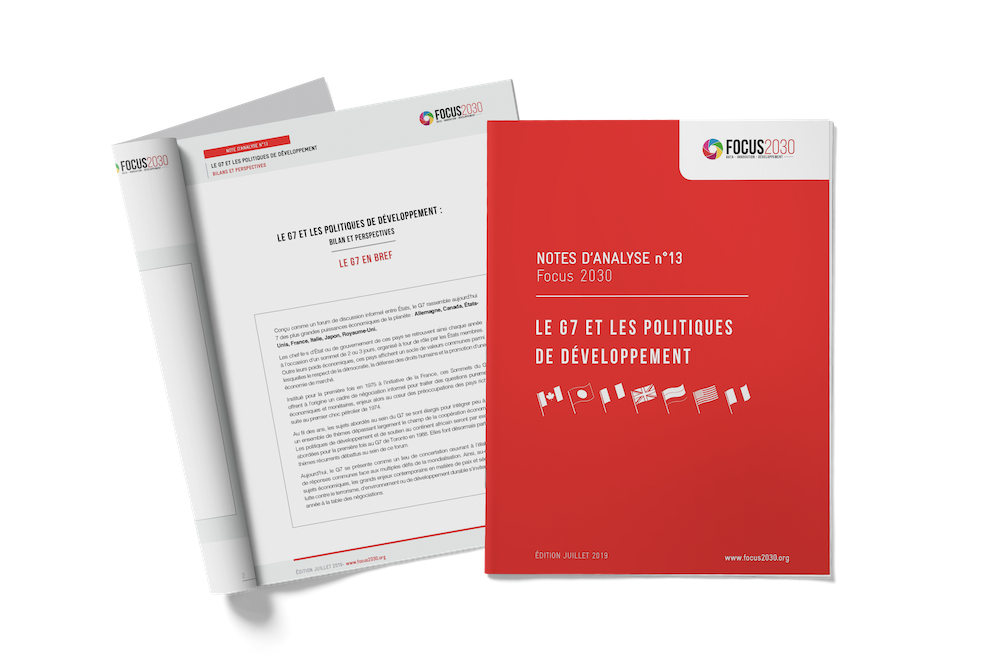
Policy Brief n°13: Development policy and the G7
In light of the French Presidency of the G7 in 2019 and the G7 summit of 24-6 August in Biarritz, this Policy Brief provides an overview and assessment of previous G7 (and G8) commitments on development.
The annual G7 Summit takes place under the glare of the world’s media and, since the launch of the G7 forty years ago, has been one of the key moments for international diplomacy.
Despite evident friction between member states and regular criticism from civil society, the G7 – historically presented as a “club of the world’s seven richest countries” – remains a central force which cannot simply be reduced to a handshake and photo-shoot between heads of state and government. Indeed, the G7 is a political process, where commitments and deliverables are negotiated months before the summit, driven by a genuine desire to find solutions to some of the world’s biggest challenges.
It is the difference of opinion over what these challenges are and the best way to solve them – including the G7’s own responsibility – which draws criticism from civil society. France’s G7 Presidency in 2019 was focused on the fight against inequalities, however, G7 countries themselves drive global inequalities, generating 45 % of global GDP, a quarter of all greenhouse gas emissions (and paying out 100 billion USD every year in fossil fuel subsidies), exporting 56 % of weapons: and yet only home to 10 % of the world’s population.
Nevertheless, the G7 provides an important space to build action on development and the fight against inequality. Together, G7 member states provide 76% of global ODA. This makes the G7 a key lever when it comes to efforts to encourage donor countries to increase the quantity and quality of their ODA.
In the past, G7 and G8 negotiations have led to some major breakthroughs such as the creation of the Global Fund to Fight Aids, TB and Malaria, or the IPCC (Intergovernmental Panel on Climate Change), the Global Partnership on Education (GPE) or the cancelling of multilateral debt for poor countries, through the HIPC initiative.
However, important commitments on development and poverty have been less frequent in recent years. France has put inequality – particularly gender inequality, education, the fight against global pandemics, and specifically tackling poverty in the Sahel – at the heart of its G7 Presidency in 2019. However, even if strong commitments were made on these or other subjects, it will not be sufficient to win back public confidence; our opinion polls show that French people have little faith in the implementation of their G7 politicians’ promises.
This underlines how essential it is to put in place a new, independent and strengthened accountability framework to assess commitments made and their implementation over the following years.
You can download Policy Note n°13 in French here. An English translation is forthcoming.