Contact

  • Français
  • Español
  • News
    Français    Español    

    The 2024 international agenda of climate and development financing

    Published on 25/03/2024.

    Find out the key events on the 2024 international agenda for climate and development financing.


    To view the agenda in full screen or download it, hover your mouse over the top right-hand corner of the image to display the share button.


    What are the key events of development and climate financing in 2024?


  • The Spring and Annual Meetings of the IMF and the World Bank, in April and October 📆, will be the occasion to adopt new measures to reform the practices of these institutions, that will celebrate their 80th anniversary in 2024. This reform is being pushed forward by a growing number of developing countries facing an unprecedented contraction of their fiscal space. Progress is also expected on the recapitalization of the World Bank, the mobilization of its callable capital for development and climate financing, and ambitious commitments for the replenishment of the International Development Association (IDA) on December 5-6.
  •  

  • COP29, which will take place from November 11 to 22 📆 in Baku, Azerbaijan, will be an opportunity to place climate finance at the center of the meetings and make clear commitments to limit global warming to 1.5°C.
  •  

  • The G7 Summit under the Italian presidency will gather heads of States and government from June 13 to 15 📆 in Italy. The summit will be the occasion to pursue discussions on reforming the international financial architecture. Find out here the calendar of G7 and G20-related events in 2024.
  •  

  • The G20 Summit, under Brazilian presidency, will bring together heads of States and governments in Rio de Janeiro. This annual meeting, that’ll be held on November 18 and 19 📆, will be an opportunity to make commitments on the challenges linked to developing countries’ fiscal room for maneuver, in particular the better allocation of IMF special drawing rights, the reform of global tax rules, and the treatment of debt.
  • ALSO READ

    Development financing - 09 April 2026

    Historic drop in Official Development Assistance in 2025

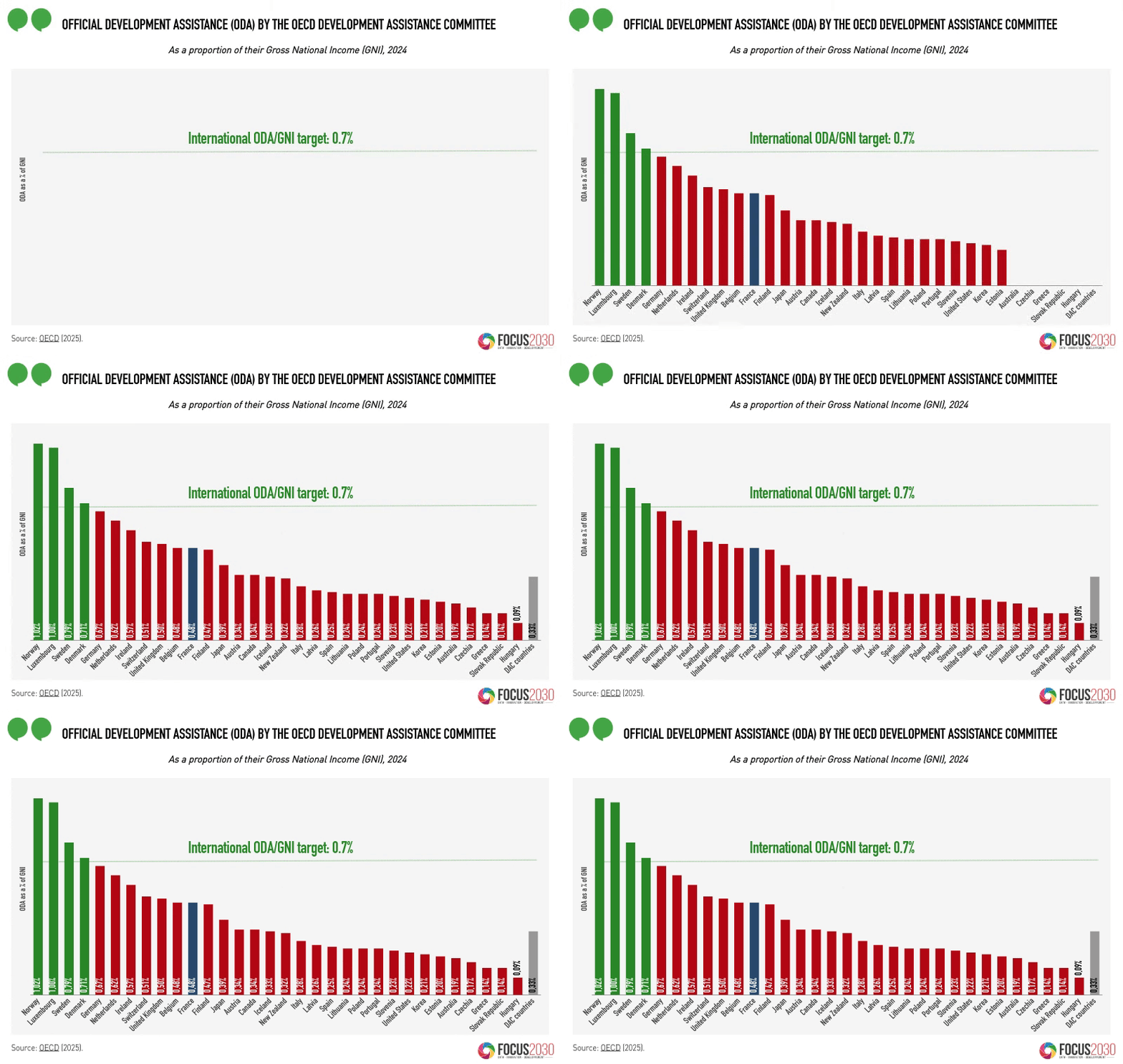
    ODA from DAC members fell to 174.3 billion USD in 2025, a 23.1% drop from 2024 (-50 billion USD in real terms), representing 0.26% of their income. It is the highest fall on record. 
    Development financing - 30 March 2026

    The African Development Fund: allocating concessional resources to the 37 most vulnerable countries on the continent

    As the 17th replenishment of the African Development Fund (ADF-17), held on 15-16 December 2025 in London, draws to a close, expressed financing needs from beneficiary countries have reached USD 25 billion. In a context of mounting budgetary pressures among traditional donors, a central question emerges : will international mobilization be sufficient to meet the challenges ?
    Development financing - 03 February 2026

    2026 Finance Bill: a fifth cut in French official development assistance

    France's finance bill for 2026 enshrines a 803 million euros cut in the ODA budget, the fifth in less than two years. Analysis.
    Development financing - 08 January 2026

    A majority of French people support an increase in development aid

    56% of French people want to maintain or increase official development assistance to the poorest countries.
    Development financing - 01 July 2025

    Increase or decrease development aid? Evolution of opinions in France, Germany, the United Kingdom and the United States

    In partnership with University College London (UCL) and Birmingham University, Focus 2030 is conducting a research-action program to analyze the perceptions, attitudes, behaviors and feelings of citizens on international solidarity issues in four countries: France, Germany, United States and United Kingdom.
    Development financing - 20 June 2025

    The impact of Donald Trump’s presidency on international development. An analysis.

    As Donald Trump is sworn in for a second term, what are the consequences for the international solidarity sector and the global fight against poverty and inequality? Analysis.