3 questions to Guillaume Lafortune, Vice-president of the UN Sustainable Development Solutions Network
Published on09/09/2025.
3 questions to Guillaume Lafortune, Vice-President of the UN Sustainable Development Solutions Network
Focus 2030 : The 2025 edition of the SDSN report, which focuses on financing the SDGs by 2030, reveals that none of the 17 Sustainable Development Goals are currently on track and that only 17% of the targets are advancing at the required pace. With five years to go until the deadline for the 2030 Agenda and the SDG Moment taking place on the sidelines of the 80th UN General Assembly, what key lessons can we draw so far ?
Guillaume Lafortune : Ten years after their adoption by all UN Member States, the SDGs remain highly relevant objectives. They provide a framework to balance economic and social progress with environmental sustainability, and to respond to the major challenges of the 21st century, including collective security and international partnerships.
“The main obstacle to achieving these goals is the lack of political will from some of the world’s most powerful states, which refuse to mobilize financial flows, technology, and international cooperation for sustainable development.“
The rise in armed conflicts, blatant violations of international law by certain states, and unilateral actions (particularly in trade) are having direct humanitarian and environmental impacts and are diverting attention and resources away from sustainable development.
We must also recognize that the U.S. federal government now explicitly opposes the SDGs, especially Goal 13 (climate action) and Goal 5 (gender equality). The United States is among the three countries that have never taken part in the Voluntary National Review for the SDGs under the 2030 Agenda, including under the previous Biden administration. Already in 2005, under the Bush administration, there was an attempt to undermine the Millennium Development Goals (set for 2000–2015) ahead of theWorld Summit. Of course, this does not reflect the commitment of U.S. intermediary bodies — including cities and universities — which remain strongly engaged in sustainable development and international cooperation.
At the same time, the 2025 report also highlights that the vast majority of countries worldwide continue to adhere to the SDGs, the 2030 Agenda, and the Paris Agreement. At the national level, remarkable progress has been achieved over the past decade in some countries. For example, Benin (in Sub-Saharan Africa) and Uzbekistan (in Central Asia) are among the five countries in the world that have made the most progress towards the SDGs. These countries have introduced innovative, long-term policy and investment frameworks aligned with the SDGs. There are other good examples that should be drawn upon between now and 2030, and beyond, to accelerate sustainable development progress both nationally and globally.
Focus 2030 : According to the SDSN Index, countries’ commitment to multilateralism varies greatly : Barbados stands out for its strong investment in the UN system, while, by contrast, the United States is pulling away. In a context of multiple crises and weakening multilateralism, how can the UN be reimagined to strengthen international cooperation and ensure the achievement of the Sustainable Development Goals ?
Guillaume Lafortune : Generally speaking, the UN can only function if its Member States truly wish to remain “united.” In other words, if they adhere to the principles of the UN Charter, adopt and respect major international treaties, and agree to fund the functioning of UN agencies.
At the SDSN, we believe it is important to go beyond rhetoric about multilateralism and international law and provide a data-based assessment of states’ support for UN multilateralism. While the SDG Index focuses on outcomes, the SDSN’s UN Multilateralism Index (UN-Mi) primarily assesses political will : the willingness of states to adhere to and contribute to building an international order based on the principles of the 1945 UN Charter. Since 2023, we have assessed this support annually, based on a methodology published in peer-reviewed literature, using six main indicators :
Ratification of major international treaties,
Percentage of votes at the UNGA aligned with the majority,
Participation in key UN agencies,
Use of unilateral sanctions (prohibited under international law and paragraph 30 of the 2030 Agenda),
States’ contribution to global militarization, and
Financial contributions to the UN (and for rich countries, the share of GDP allocated to Official Development Assistance).
For 2025, we estimate that Barbados is the country most supportive of UN-based multilateralism. Among the major G20 countries, Brazil ranks highest. By contrast, the United States is at the very bottom of the ranking — 193rd out of 193. Israel is 190th, and countries such as Russia and Iran also rank near the bottom of the 2025 index.
The contrast in support for UN multilateralism between the United States and China is striking. The U.S. withdrew from the Paris Agreement in 2025 and rejects the SDGs. Historically, the U.S. has tended to withdraw from international organizations when it disagrees with their strategic direction, as it did with UNESCO. By contrast, China strengthened its commitment to the Paris Agreement, presented two SDG action plans at the UN, and supports initiatives that advance collective security and international cooperation. It has played a significant role in reducing the global cost of renewable energy and has ratified three-quarters of major international treaties, compared to approximately 60% for the U.S. From 2020 to 2024, the U.S. voted with the international majority only 30% of the time (with only Israel having a lower percentage), while China voted with the majority over 70% of the time.
These figures aim to support an informed debate on multilateralism. Readers (including journalists) can access the full datasets online at the SDG Transformation Center’s website.
Focus 2030 : The UN Secretary-General will soon present “UN803, an ambitious reform plan for the UN. What directions do you consider most relevant ? To what extent could a reform of the UN Charter contribute ?
Guillaume Lafortune : The world of 2025 is very different from that of 1945. Yet, to a large extent, the way the UN and the Bretton Woods institutions (the World Bank and the International Monetary Fund) operate remains rooted in the balance of power that existed in 1945, before decolonization. At that time, there were only about 50 nation-states in the world, whereas today, there are 193 UN members. Climate change and biodiversity loss were not on the agenda at that time. In light of today’s societal shifts, challenges, and power dynamics, it’s clear that transformations are needed to ensure a fair and effective global order.
Indeed, the UN Secretary-General has put forward several reform areas under the UN80 initiative, which aims to strengthen the UN’s functioning in a rapidly changing world. This initiative has a well-defined scope. UN80 focuses on three key areas—efficiency, mandates, and UN agency structures—and covers seven broad sectors, including international security, humanitarian action, and development. Ultimately, Member States will decide the level of ambition and implementation of these reforms.
Clearly, a properly reformed UN Charter would contribute to a more stable world order and better advance societies towards the SDGs. On September 17, 2025, the SDSN will host a workshop at Columbia University in New York, where experts and practitioners will discuss the UN Charter reform. The 2024 edition of the SDSN Sustainable Development Report contains concrete and detailed proposals based on contributions from numerous experts. Proposals include the creation of a UN Parliamentary Assembly, Security Council reform, and establishing subsidiary bodies to strengthen the role of regions, cities, and youth at the UN. The SDSN also advocates for transforming the international financial architecture.
Let us keep in mind that, at 80 years old, the UN is still “young” compared to humanity’s age-old challenge of international governance, which has been debated for over two millennia. The creation of the UN in 1945 was a major breakthrough, but the organization remains fragile and is still a work in progress.
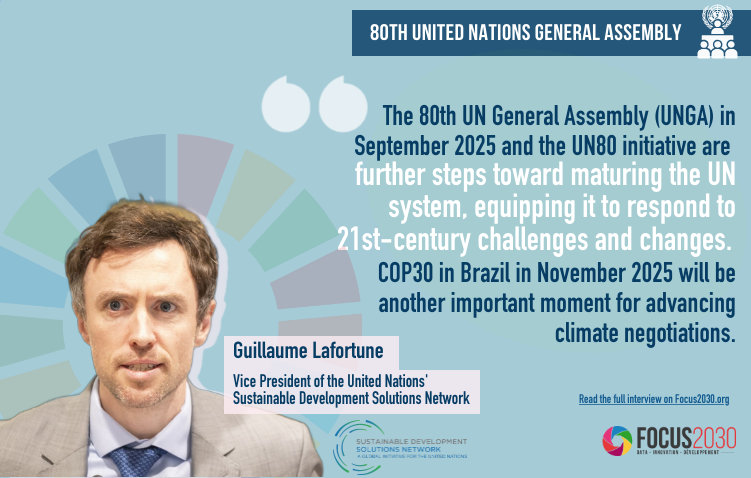
The 80th UN General Assembly (UNGA) in September 2025 and the UN80 initiative are further steps toward maturing the UN system, equipping it to respond to 21st-century challenges and changes. COP30 in Brazil in November 2025 will be another important moment for advancing climate negotiations.
Looking ahead to 2027, the SDG Summit at the Heads of State level will be a pivotal moment to establish a shared framework for sustainable development beyond 2030. One approach would be to reinforce implementation mechanisms, such as financing, international cooperation, access to technology, long-term policy and investment frameworks, and collaboration with the scientific community, without overhauling the goals, targets, and indicators themselves. This would enable us to build on the knowledge and instruments developed since 2015 to promote the SDGs.
NB : The opinions expressed in this interview do not necessarily reflect the ideas of Focus 2030.
Pour offrir les meilleures expériences, nous utilisons des technologies telles que les cookies pour stocker et/ou accéder aux informations des appareils. Le fait de consentir à ces technologies nous permettra de traiter des données telles que le comportement de navigation ou les ID uniques sur ce site. Le fait de ne pas consentir ou de retirer son consentement peut avoir un effet négatif sur certaines caractéristiques et fonctions.
Fonctionnel
Always active
L’accès ou le stockage technique est strictement nécessaire dans la finalité d’intérêt légitime de permettre l’utilisation d’un service spécifique explicitement demandé par l’abonné ou l’utilisateur, ou dans le seul but d’effectuer la transmission d’une communication sur un réseau de communications électroniques.
Préférences
L’accès ou le stockage technique est nécessaire dans la finalité d’intérêt légitime de stocker des préférences qui ne sont pas demandées par l’abonné ou l’internaute.
Statistiques
Le stockage ou l’accès technique qui est utilisé exclusivement à des fins statistiques.Le stockage ou l’accès technique qui est utilisé exclusivement dans des finalités statistiques anonymes. En l’absence d’une assignation à comparaître, d’une conformité volontaire de la part de votre fournisseur d’accès à internet ou d’enregistrements supplémentaires provenant d’une tierce partie, les informations stockées ou extraites à cette seule fin ne peuvent généralement pas être utilisées pour vous identifier.
Marketing
L’accès ou le stockage technique est nécessaire pour créer des profils d’internautes afin d’envoyer des publicités, ou pour suivre l’utilisateur sur un site web ou sur plusieurs sites web ayant des finalités marketing similaires.