3 questions to Juan Pablo Uribe, Director of the Global Financing Facility for Women Children and Adolescents (GFF)
Published on07/03/2024.
| In the run-up to March 8, International Women’s Day, and as part of its special edition on the state of inequality in the world in 2024, Focus 2030 wants to put forward the stakeholders who try to achieve gender equality on a daily basis. |
The Global Financing Facility (GFF) is a country-led partnership, hosted at the World Bank, that fights poverty and inequity by advancing the health and rights of women, children and adolescents.
Interview with Juan Pablo Uribe, Director of the Global Financing Facility for Women Children and Adolescents (GFF)
Focus 2030 : The Global Financing Facility for Women, Children and Adolescents (GFF), a global partnership hosted by the World Bank and created in 2015, aims to address the gaps in the areas of health, nutrition and well-being for women, children and adolescents. Can you share the trends observed since the start of the covid-19 pandemic which has had a major impact on women’s health ? Is there a return to pre-crisis trends or even progress ?
Juan Pablo Uribe : We observe a trend where countries we support have made progress however overlapping crises related to health emergencies, macroeconomic conditions, climate change, and conflict threaten these gains. Too many disruptions risk taking countries back on their hard-fought progress unless urgent action is taken.
Right now, 250 million women and girls who want to avoid pregnancy are unable to access safe, modern methods of contraception. Today, 800 women will die from preventable causes related to pregnancy and childbirth – and 40,000 girls under the age of 18 will be married – taking away their education, and agency.
Until this is addressed, adolescent pregnancies will remain high, and complications during pregnancy and childbirth will remain a leading cause of mortality among teenage girls in Africa.
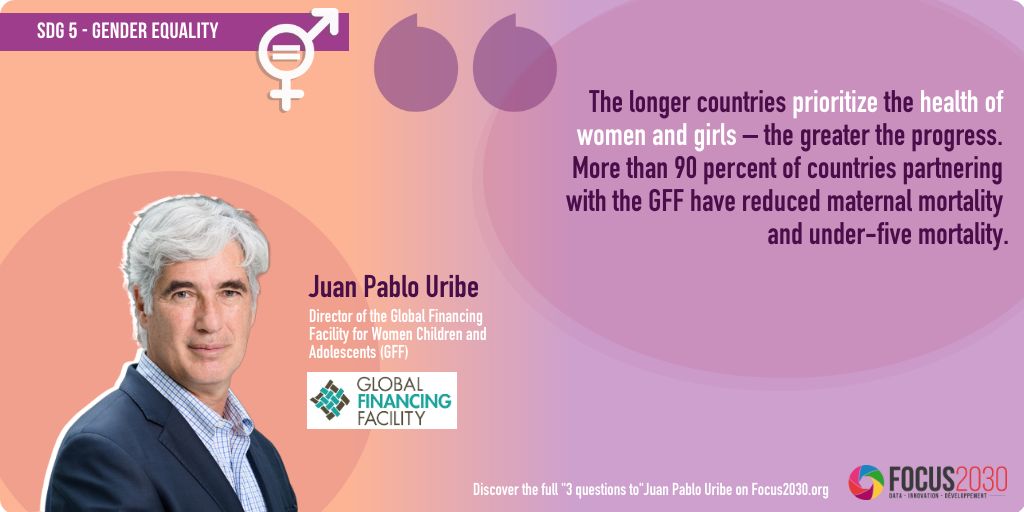
For many countries, this reversal is not just impacting lives today. It is limiting future growth; it is restricting resilience and risking security. All of these are needed for a more stable future. The good news is that we can see that the longer countries prioritize the health of women and girls – the greater the progress. More than 90 percent of countries partnering with the GFF have reduced maternal mortality and under-five mortality. Major progress has also been achieved across other health outcomes — including reductions in adolescent birth rates, stunting and stillbirths. There are many challenges, but I do want to pass a more positive message, which is that based on our experience, change is possible with the right financing, engagements, and partnerships.
Focus 2030 : Part of the GFF’s work is to mobilize catalytic funds in favor of women’s health, drawing on public, private and domestic financing. What are the key tangible results achieved ?
Juan Pablo Uribe : One of the greatest challenges is finding ways to allocate more financing to health, and to ensure that increasing proportions of that money is from domestic budgets and targets the needs of women, children and adolescents. Because of the GFF’s partnership with the Bank, countries use relatively small amounts of GFF grant financing blended with the WB resources to drive more funding towards women, children and adolescents. And it works, the average percentage of IDA funding (the WB main financing instrument to the poorest countries) allocated to this agenda has risen by 40 percent between 2016-2023 as compared to the previous years.
We use our catalytic funding and deploy our resources in three different ways :
- First, the data, evidence and knowledge that build a common platform of understanding to advocate for stronger opportunities for women and ensure that all partners align behind a prioritized costed plan led by countries.
- Second, driving policy and health financing reforms. For instance, we saw that changes in legislation were causing uncertainty about what package of services are available for women’s health, which is just one type of barrier we need to address. In Cameroon, the GFF and the WB supported the reversal of a circular from 1980 that banned pregnant girls from staying in school. We cannot ignore the political discussions at stake for governments, but our approach is always to work with governments as the starting point and meet them where they are on policy matters. This is essential for country-owned and sustainable outcomes. We are using evidence to show that creating an enabling environment and driving reforms can lead to countless opportunities for women – from the pursuit of an education to employment, to actively contributing to the economy.
- Third, supporting expansion of services to reach more women and girls and working across sectors. As part of our partnership with Mozambique, for example, the country expanded sexual and reproductive health services through a school health platform with a particular focus on adolescent girls. Between 2015 and 2022, Mozambique reported a 19-percent reduction in its adolescent birth rate. We are now looking at how to use this platform for HPV roll out. In Burkina Faso for example, the GFF funding focuses on ensuring that the health workforce reaches community in conflict-affected areas. Despite security challenges, nearly 10,000 health workers were trained in 2022 with GFF–World Bank support, up from 2,000 health workers in 2021.
And of course, we can’t do this alone and we are working in close partnership with many stakeholders including public, private, and civil society actors, UN agencies. We are for example deepening our partnership with UNFPA to coordinate efforts in countries on family planning. We have also expanded our support to CSOs and youth so they can have a seat at the table and push government and the GFF partnership further.
Focus 2030 : You launched your “Deliver the Future” replenishment campaign in July 2023, aiming to raise at least $800 million by the end of 2023. An event will be organized in April 2024 by the GFF at the Spring Meetings of the World Bank and IMF, providing an opportunity for several countries to announce new contributions. Major donors such as Canada, the United Kingdom, the Netherlands, Germany or the Bill & Melinda Gates Foundation already support the GFF. What will be needed to ensure the GFF can properly support countries to deliver on their population needs ?
Juan Pablo Uribe : We need a relentless commitment, focus and continued investment in women, children and adolescent health and well-being. We need all partners to come together to support efforts and champion innovative approaches to sustainable development financing. We know that there are a lot of competing priorities, and that budget are stretched.
The GFF is highly cost effective when you consider the significant leverage effect and scale that it helps bring: working with catalytic grants, the model allows for increasing the scale and impact of World Bank and government funding for women’s health. As a country-led approach, with on-budget on-system focus, the GFF partnership ensures that donors are aligned with national priorities, which leads to better coordination, pooling of funding, and efficiency gains and sustainability. The numbers speak for themselves: to date, every US dollar invested in the GFF has generated a US$7 match from the World Bank, US$6.3 from other global funders and US$9.3 from governments’ own domestic resources.
We want to focus on practical solutions and policy reforms; we want to focus on bringing new models of co-investment and partnership that can bring financing to scale and break silos across sectors.
I am convinced that progress is possible if we highlight both the cost of inaction and the opportunities.
There is a lot of work ahead of us, but I am also hopeful that we can deepen our partnership with partners, such as France – whose leadership has been instrumental and steadfast in support of better health and opportunities for women, adolescents, and marginalized populations.
NB: The opinions expressed in this interview do not necessarily reflect the ideas of Focus 2030.