3 questions to Maria Grazia Panunzi, President and Advocacy Manager, AIDOS
Published on05/03/2024.
| In the run-up to March 8, International Women’s Day, and as part of its special edition on the state of inequality in the world in 2024, Focus 2030 wants to put forward the stakeholders who try to achieve gender equality on a daily basis. |
AIDOS – Associazione Italiana Donne per lo Sviluppo (Italian Association of Women for Development) works for the rights, dignity and freedom of choice of women and girls worldwide.
Interview with Maria Grazia Panunzi, President and advocacy manager, AIDOS
Focus 2030 : Italy does not officially have a feminist foreign policy, and the actions of the current Conservative government don’t seem to be in favor of the adoption of measures in this direction. In this context, Italy will hold the G7 presidency, from June 13 to 15 in Borgo Egnazia. What role will gender inequality play in the summit’s agenda? Can you tell us more about the W7, the group of civil society organization promoting women rights in this arena? What are your ambitions in this context ?
Maria Grazia Panunzi : Gender equality is set as one of the Italian G7 priorities. This priority will focus on the elimination of gender-based violence, including harmful practices and any form of discrimination; the promotion of women’s participation in policy making processes; the gender pay gap, care work; the impact of climate change on women’s life; the interlinkages with war and food security.
Women 7, created in 2018, is one of the official G7 engagement groups and focuses on gender equality and women’s empowerment, bringing together associations from different countries, including those that are not a part of the G7. The group’s mission is to bring attention to equality as both a specific issue and a cross-cutting theme in the work of the G7. This transversality can be seen in several key issues, such as tackling gender stereotypes, access to education, with a focus on STEM disciplines, access to health and, in particular, sexual and reproductive health and rights. Gender equality is closely linked to the fight against poverty, and the issues we have mentioned are vital in reducing poverty, especially for women who often face multiple and intersecting forms of discrimination.
We have an advisory group of 72 people from 30 countries that aims at developing a W7 communiqué delivered to the Italian prime minister and other institutional representatives at the W7 summit on May 8 and 9 in Rome.
I think it is important not to go back on the positions expressed by the Japanese G7 presidency on gender equality and women’s rights, where there was a commitment “to work with all segments of society to ensure the full, equal and meaningful participation of women and girls in all their diversity and LGBTQIA+ persons in politics, business, education and all other spheres of society, and to consistently mainstream gender equality in all policy areas.”
In addition, I think it is crucial to have concrete actions and initiatives supported by adequate and appropriate financial resources to contribute to the achievement of the 5th SDG of the 2030 Agenda for Sustainable Development and to increase the ODA of G7 countries for gender equality and, in particular, for sexual and reproductive health and rights as a critical part of Universal Health Protection (UHC).
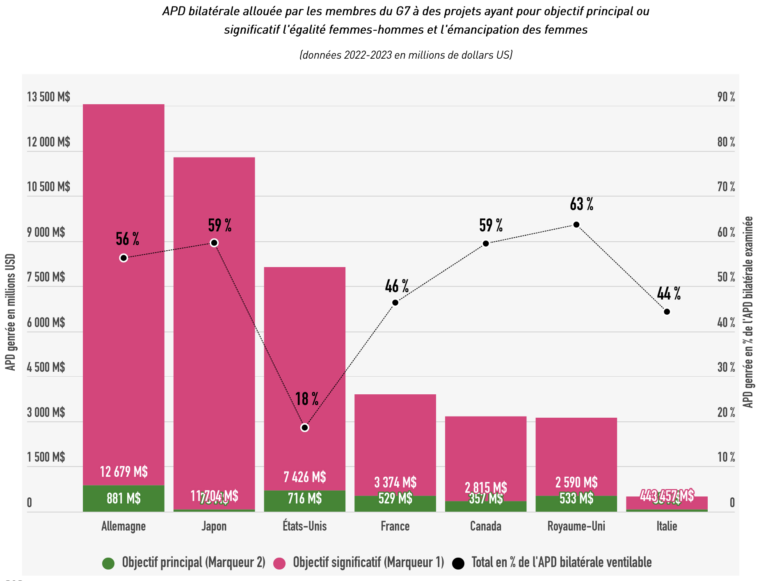
Focus 2030 : According to the OECD, only 5% of Italy’s bilateral aid supports women rights as a main objective, i.e. 42 million dollars per year on average between 2020 and 2021. As a result, Italy ranks 19th among 28 nations providing resources to tackle gender inequality. As an advocacy NGO specialized in those issues, do you envision any potential progress in the future ?
Maria Grazia Panunzi :
Increasing the share of the ODA to support women’s rights and gender equality as main objective is a political decision, it is a matter of firmly believing that gender equality is the basis for the sustainable development.
In 2022 Italy increased its ODA for sexual and reproductive health and rights compared to 2021. This increase was due to the allocation of major funds (UNICEF, UNFPA) to specific programs in humanitarian contexts. If this increase will be maintained, it is possible to think that Italy will make some progress and increase its position in the OECD ranking.
Focus 2030 : At an international level, millions of women do not have access to modern contraception methods. 12 million women lost access to contraception during the pandemic leading to 1.4 million unintended pregnancies. As an organization dedicated to SRHR with field experience for more than 43 years, what are your key recommendations to drastically advance access to contraception and meet the SDGs targets ?
Maria Grazia Panunzi :
-
Increase information and awareness raising activities, especially targeting young people, in particular girls, on sexual and reproductive rights and remove any barriers to contraception information and services. To ensure that everyone not only has the right to SRH, but also access to this right, we must work at every level of society: strengthening public health services and more specifically community health services, improving access to education for girls, working towards the elimination of gender stereotypes, promoting the empowerment and self-determination of girls and adolescents, and so on.
-
Increase services, including youth friendly space and online services, to provide information on SRHR and more specifically contraception options.
-
Support UNFPA as the main agency working on contraception and SRHR at large.
-
Scale up the financial support for CSOs working on sexual and reproductive rights and gender equality.
These recommendations are crucial to meet today’s challenges and contribute to the achievement of the SDGs by ensuring that all women have equitable access to contraceptive services and can fully exercise their sexual and reproductive health rights.
NB: The opinions expressed in this interview do not necessarily reflect the ideas of Focus 2030.