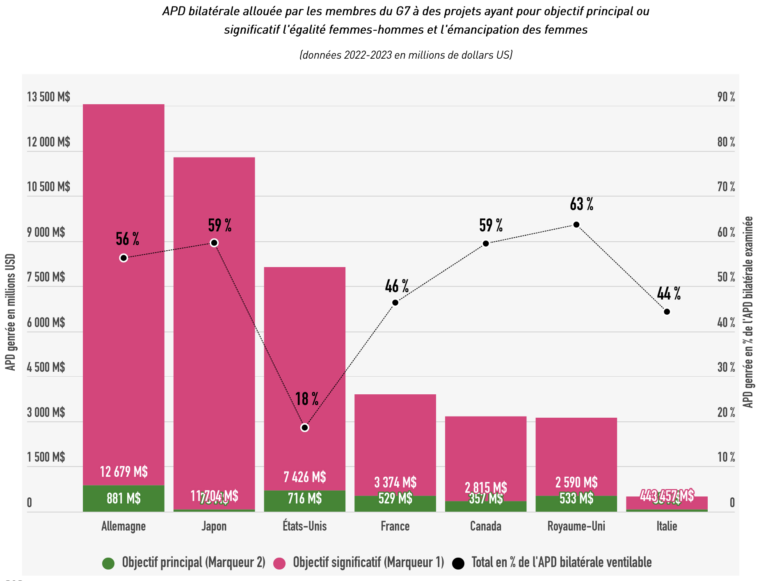
Which G7 countries consider gender equality in their foreign aid?
Published on12/02/2026, modified on28/02/2026.
Each year, the member countries of the OECD’s Development Assistance Committee (DAC) report back to the organization the amount of Official Development Assistance (ODA) they have provided in the year. As part of this exercise, DAC members (including the seven G7 countries) are asked to indicate, for each project or program, whether it promotes or not gender equality, based on a three-value « marker »:
- Value 2: gender equality is the main objective of the project/program
- Value 1: gender equality is a significant objective of the project/program
- Value 0: the project/program does not target gender equality.
This data is published in n+2 for year n. In 2023-2024, DAC members allocated an average of USD 71.9 billion per year (45.9% of their allocable bilateral ODA screened against the gender marker) to gender equality and women’s empowerment as either a primary objective (USD 6 billion or 3.9% of bilateral ODA) or a significant objective (USD 65.9 billion or 42.1% of bilateral ODA).
Among DAC members, the G7 countries allocated more than USD 44.8 billion to these issues, representing an average of 48% of their allocable bilateral ODA.
Between 2023 and 2024, the trend is downward: the share of ODA devoted to gender equality as a primary objective (value 2) has decreased by 6.5% (in volume), accompanied by a 14% drop in aid devoted to equality as a significant objective. Only three G7 countries have increased their ODA for gender equality: France, Italy, and the United Kingdom. Given the targeted cuts made by the United States since 2025 and the overall decline in ODA from major DAC donors, this downward trend is likely to continue in the coming years.