CSW70: UN Women’s rights negotiations marked by deepening divisions
Published on 02/04/2026.
The 70th session of the United Nations Commission on the Status of Women (CSW70) took place in New York from March 9 to 19, 2026. A functional body of the UN Economic and Social Council (ECOSOC), the Commission, established in 1946 and composed of 45 member states, is the main intergovernmental forum dedicated to advancing gender equality and women’s empowerment.
Each year, the CSW brings together Member States, UN agencies, and civil society organizations around a priority theme to assess progress, identify persistent challenges, and guide public action at the international level. These negotiations lead to the adoption of “agreed conclusions,” which serve as a reference for public policies on women’s rights.
In 2026, these conclusions focused on access to justice for all women and girls. For the first time in the Commission’s history, the final text was not adopted by consensus but by vote: 37 states voted in favor, six abstained, and one opposed it (the United States). This departure from established practice highlights a deepening divide among states over several key issues related to gender equality, sexual and reproductive rights, and, more broadly, the role of international norms on women’s rights.
An analysis.
A multilateral framework weakened by institutional and financial shifts
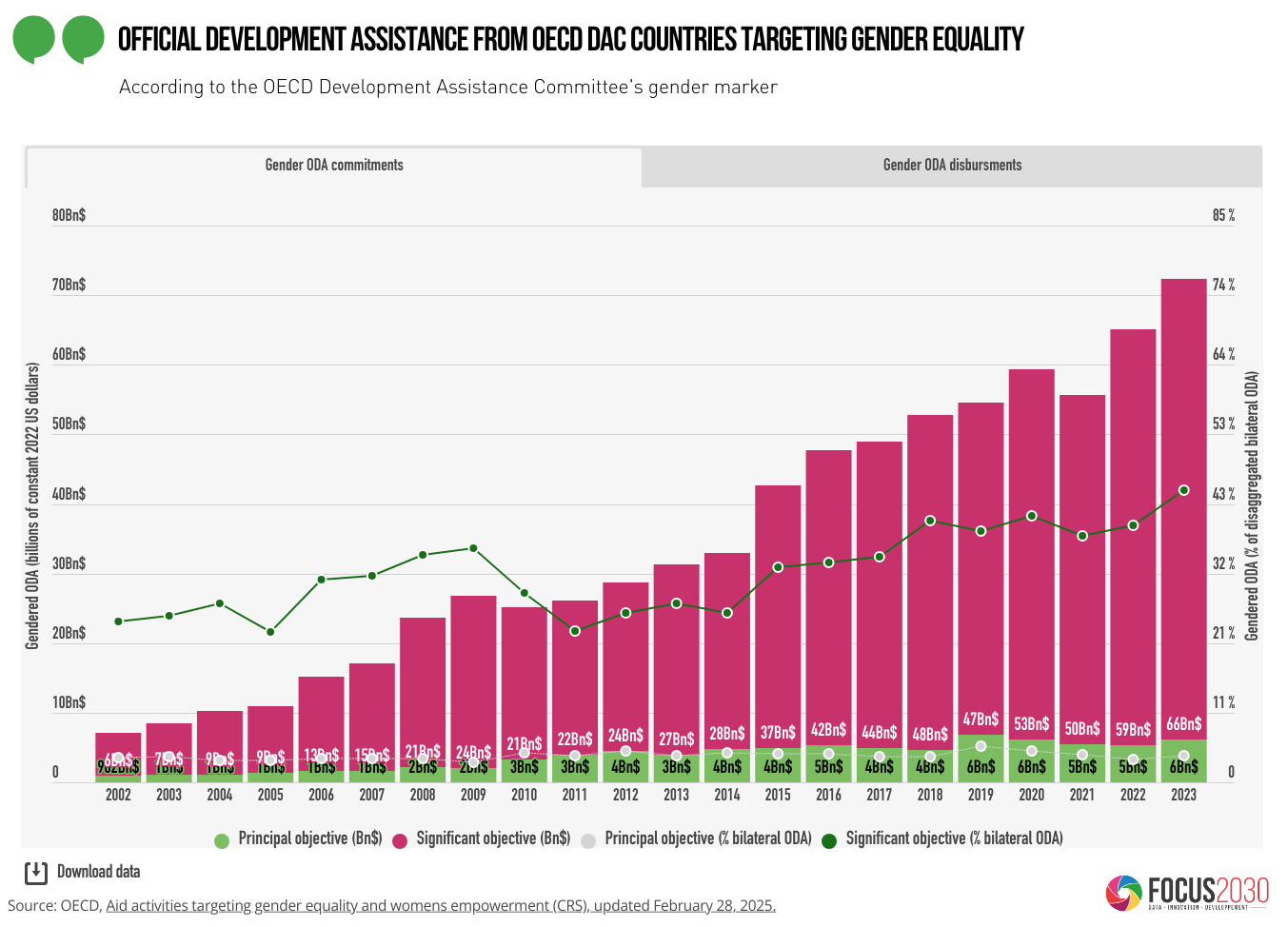
CSW70 took place against a backdrop of a global rollback of women’s rights in several regions, institutional restructuring within the UN system, and growing contestation of multilateral norms. The widespread decline in official development assistance, combined with the dismantling of the U.S. development agency USAID, the announcement of the United States’ withdrawal from UN Women at the beginning of 2026, and the reinstatement and extension of the “Global Gag Rule”, has weakened the existing institutional architecture and reduced the UN system’s capacity to act.
At the same time, the proposed merger between UN Women and the United Nations Population Fund (UNFPA), as part of the “UN80” UN reform initiative, has raised questions about potential changes in mandates and priorities of these agencies. Several organizations warn of the risk that issues specific to gender equality could lose visibility within a broader institutional framework, at a time when attacks on women’s rights are intensifying.
Agreed conclusions focused on access to justice
In this context, Member States negotiated agreed conclusions on the theme: “Ensuring and strengthening access to justice for all women and girls, including by promoting inclusive and equitable legal systems, eliminating discriminatory laws, policies and practices, and addressing structural barriers” The final text calls for strengthening legal frameworks, combating systemic discrimination, and improving responses to gender-based violence.
These priorities respond to an alarming reality: according to the United Nations, women enjoy on average only 64 percent of the legal rights granted to men. Significant gaps remain, particularly regarding the inclusion of consent in the definition of rape, equal pay, and the prohibition of child marriage.
The adopted text affirms that access to justice is essential to achieving gender equality throughout life. It identifies persistent barriers: discriminatory laws and practices, unfavorable social norms, power imbalances, and intersecting forms of discrimination, for example those linked to disability, origin, or migration status.
The conclusions adopted at CSW70 build on the 1995 Beijing Declaration and Platform for Action. They set out several international priorities to strengthen women’s and girls’ access to justice:
Key areas of the text:
- Sexual and reproductive health and rights (SRHR): reaffirmation of commitment to universal access to sexual and reproductive health and rights.
- Gender-based violence: strengthened commitments to prevent and respond to violence, including technology-facilitated and online violence.
- Conflicts and crises: increased attention to access to justice and reparations in humanitarian and conflict settings, particularly for sexual violence.
- Intersectionality: clear recognition of multiple forms of discrimination as a major barrier to access to justice.
- Civil society: emphasis on the importance of ensuring safe spaces and sustainable funding for civil society organizations.
The text calls on states and partners to undertake structural reforms, remove discriminatory provisions, strengthen accessible, inclusive, and gender-responsive justice systems, and ensure effective implementation of international commitments.
At the opening of CSW70, nine governments involved in the SheDecides initiative also issued a joint statement reaffirming their commitment to sexual and reproductive rights and bodily autonomy, illustrating the high level of tension now surrounding these issues in multilateral forums.
A procedural break reflecting deeper divides
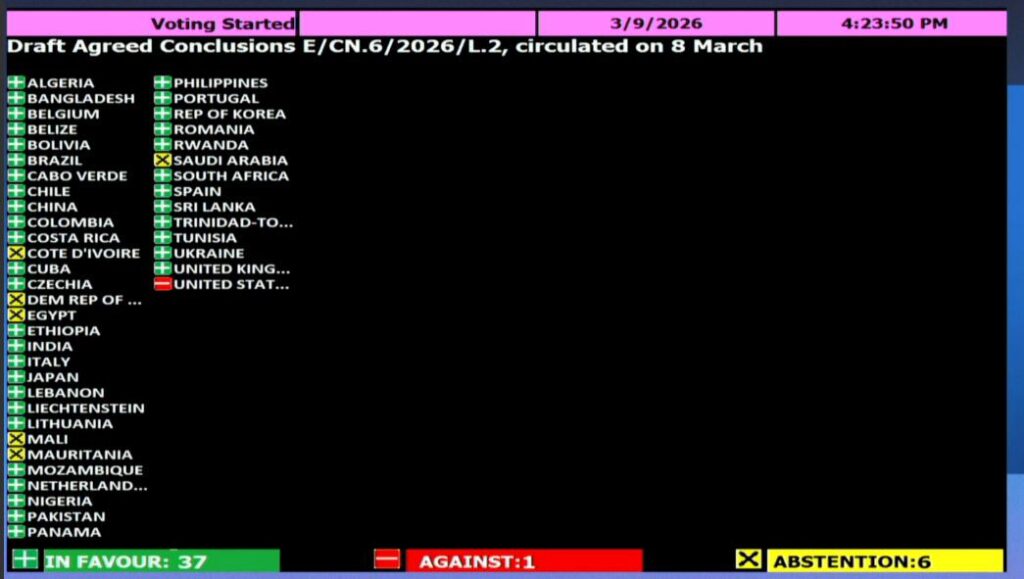
Despite the importance of these issues, negotiations were marked by significant disagreements. After initially withdrawing from the talks, the U.S. delegation returned with more than 90 amendments aimed at removing or rewording several references in the text related to climate change, gender mainstreaming in justice systems, and reparations for victims of violence.
The decision to proceed to a vote, unprecedented in CSW history, was seen by many delegations and feminist organizations as a way to preserve the core of a shared normative framework. At the same time, it signals a weakening of the consensus-based approach that has historically structured the Commission’s work. In other words, the text was preserved, but at the cost of a procedural break that shows how difficult it has become to build compromises.
Another episode illustrates this hardening. The United States was also the only country to vote against a resolution on “Women, the girl child and HIV and AIDS,” led by South Africa, due to references to sexual and reproductive rights.
U.S. influence and attempts to redefine the international normative framework
Beyond formal negotiations, the United States stepped up its influence efforts outside UN headquarters by organizing or sponsoring side events bringing together conservative and anti-abortion groups, mobilizing networks of conservative organizations, and promoting discourse denouncing a supposed “gender ideology.” This strategy reflects a broader political continuity, marked by the rejection of certain international commitments on gender equality and a stated desire to refocus debates on national sovereignty and “family values.”
Within the UN itself, this strategy also took the form of attempts to redefine concepts already established in international agreements. A draft resolution on the “Protection of women and girls through appropriate terminology” sought to assert that, in the 1995 Beijing Declaration and Platform for Action, the term “gender” should be restricted to “men and women.”
This interpretation was widely contested by many states and civil society actors. In response, the Women’s Rights Caucus, comprising more than 900 feminist organizations, issued a statement urging states to reject the initiative. The group also warned of the precedent such reinterpretation could set: revisiting international agreements after the fact could weaken the entire normative framework of the multilateral system and undermine gains achieved since 1995.
The resolution was ultimately blocked before debate following a “Motion fo no-action” led by Belgium and Brazil. This rejection sends a strong political signal: the majority of states refused to open the door to rolling back established international norms on gender.
Structured alliances and shifting power dynamics
That said, U.S. positions are not isolated. They find support among several states, particularly in Africa, as reflected in certain positions taken during CSW70 negotiations and the presence of diplomats at conservative side events held alongside the session.
These convergences are rooted in ideological affinities but also in broader geopolitical dynamics. Since late 2025, under its “America First” strategy, the United States has signed a series of bilateral agreements, particularly in the health sector, with several countries, including Côte d’Ivoire and the Democratic Republic of the Congo. These agreements, worth several billion dollars, reflect a shift toward bilateral relations and come with conditions and priorities that may influence national policies, particularly on reproductive health.
Without drawing a direct causal link between funding and diplomatic positions, these elements illustrate how power dynamics are shifting. Multilateralism is weakening, while bilateral relations, implicit conditionalities, and transnational networks are playing an increasingly significant role in shaping state positions.
A turning point for multilateral negotiations on women’s rights
CSW70 illustrates a growing polarisation in international discussions on gender equality. A majority of states and organisations continue to support a comprehensive approach, including sexual and reproductive rights, the fight against violence, and the recognition of intersecting inequalities. At the same time, a group of actors seeks to limit the scope of internationally recognized rights and block proposed advances.
Ultimately, CSW70 appears to be a turning point. The unprecedented vote on the agreed conclusions, the failure of U.S. attempts to redefine the international normative framework, and the strong mobilization of feminist organizations show that a majority of states remain opposed to a direct rollback of established gains. However, this resistance should not obscure a key reality. Multilateralism is entering a more conflictual, fragmented, and unstable phase.