Contact

  • English
  • Español
  • Surveys

    Fertility rates in 2018: a guessing-game for most French people

    Publié le 19/12/2018, modifié le 07/08/2019.

    The global fertility rate in 2018 was an average of 2.4 children for each woman, compared to 2.6 in 2008 (Population Reference Bureau – PRB – août 2018).

    Questioned on their knowledge of this figure, between one third and one quarter of French respondents were able to reply correctly. Another third/quarter thought that women had 3.5 children on average. And finally, 29% – the majority of all respondents – said they were unable to answer the question (which required choosing one of the four proposed fertility rates, only one of which was right).

    Factors such as level of education, gender, or political preference only seem to influence the “I don’t know” answers rather than having any particular impact on who was able to give the correct answer.

    17% of French people were the furthest away from the correct answer in choosing the ’5.5 or more’ rate.

    Women were better than men at choosing the right answer. Interestingly, the older respondents were, the less likely they were to provide an answer, and also interestingly, correct responses varied with political opinion but without any coherence or pattern of linearity.

    Those with higher levels of education were more likely to give an answer, but not necessarily the right one.

    This data comes from our survey conducted by the YouGov Institute and piloted by the research team at University College London and the University of Birmingham as part of the project Aid Attitudes Tracker which measures the evolution of opinions and behaviors on issues of international solidarity in four countries.

    Pour aller plus loin
  • Retrouvez la méthodologie du projet Aid Attitudes Tracker
  • À LIRE AUSSI

    Gender equality - 26 January 2026

    Spain’s new Feminist cooperation strategy : Scope and orientations

    Spain unveils its new Feminist Cooperation Strategy, designed to structure and operationalize the integration of gender equality throughout its international cooperation policy. Rooted in multilateralism and the 2030 Agenda, this strategy proposes a feminist, intersectional, and transformative approach aimed at addressing the structural causes of inequality and transforming power relations. Analysis.
    Gender equality - 07 March 2025

    State of gender inequality in the world – 2025 edition

    What is the state of gender inequality in the world in 2025? Discover our special report.
    Gender equality - 16 February 2025

    Overview of data resources on gender equality across the world

    Overview of the resources to understand gender inequalities around the world in key areas.
    Gender equality - 09 December 2024

    2025 International feminist agenda: major upcoming events and meetings

    Discover in this timeline or “feminist agenda”, all the major international events in 2025 related to the achievement of the Sustainable Development Goal #5 – “Achieve gender equality and empower all women and girls“.     Click on the button on the top-right to view the timeline in full-screen, or to download it.   What […]
    - 22 October 2024

    France’s Official Development Assistance in a world of uncertainty: a fading ambition? Review 2017-2024 and outlook

    Where do we stand on the evolution of France's ODA policy since 2017? With figures to back it up, Focus 2030 takes a closer look, at a time when France's ambitions may be coming to an end.
    Gender equality - 13 March 2024

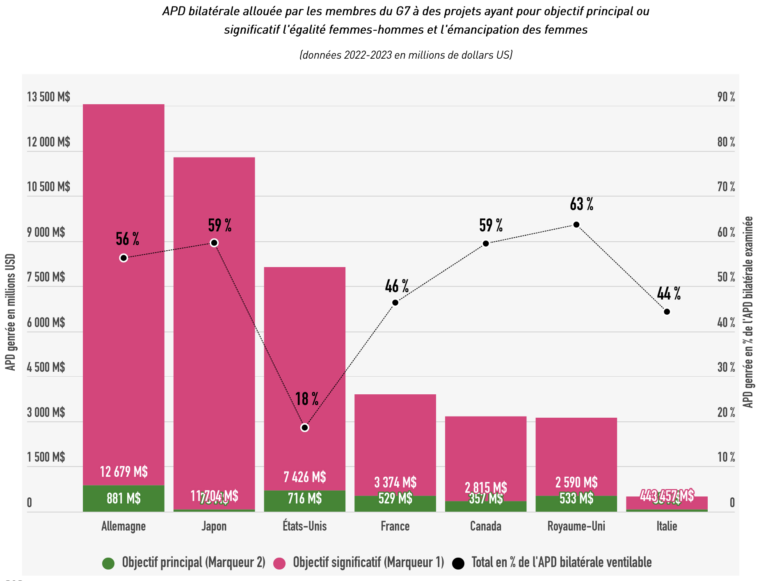
    Which countries support gender equality in their Official Development Assistance?

    Discover the ranking of OECD donors' financial support for gender equality and women's empowerment around the world.