Contact

  • Français
  • Español
  • AnalysisReports
    Français    Español    

    Policy Brief n°5: gender equality, development, and sexual and reproductive health and rights

    Published on 02/09/2019.

    Tackling gender inequality and promoting sexual and reproductive health and rights (SRHR) have become major issues at the heart of public development aid, both in terms of donor countries, developing country governments, and civil society.

    Unlike the Millennium Development Goals (MDGs), gender equality is a central pillar of their successor the Sustainable Development Goals (SDGs), with a standalone Goal (Goal 5) and transversal objectives on gender equality throughout the other goals. On a global scale, though is good news that aid labelled by donors as contributing to gender equality (amongst other objectives) has increased five-fold since 2000 to reach 41 billion USD in 2016, it is worth remembering that only 4% of total ODA is exclusively focused on promoting gender equality.

    And again, though important progress has been made on gender equality in the last twenty years, there are still huge challenges in particular areas: unmet need for contraception in developing countries is one of them. Sexual and reproductive health and rights however suffer from the additional challenge of donors’ conservative positions on these issues. The USA’s “global gag rule” for example places restrictions on organisations applying for American aid to use funds for providing information on safe and legal abortion.

    In France, we can also see a gap between the rhetoric and the reality on SRHR, notably between the official vision of France at the forefront of defending these rights, and the very small amounts which are actually dedicated to SRHR in French aid.

    The progress achieved by the MDGs on gender equality between 1990-2015, notably a 44% reduction in maternal mortality (deaths during or shortly after the birth of a baby), mean we can be hopeful about progress on the deeper and broader SDG gender commitments.

    That said, nothing can be taken for granted, and women’s rights and empowerment globally are still very much to fight for:

    • Women represent almost 70% of those living with less than a dollar per day, and they are also make up 2/3 of all illiterate adults.
    • The lack of family planning and contraceptive services results each year in 89 million unwanted pregnancies almost a quarter of which (25million) end in high-risk abortions which end in the deaths of some 50,000 women each year.
    • There are still 303,000 maternal deaths each year, or 830 every day, caused by complications during or shortly after pregnancy or childbirth. 99% of these are in developing countries.
    • 1 girl in 5 is married before she is 18 across the planet. In developing countries, this percentage rises to 40%.

    You can download our Policy Note n°5 in French here. An English translation is forthcoming.

    To learn more
  • Note d’analyse n°5 : inégalités de genre, droits sexuels et santé reproductive, et développement
  • ALSO READ

    Gender equality - 17 June 2026

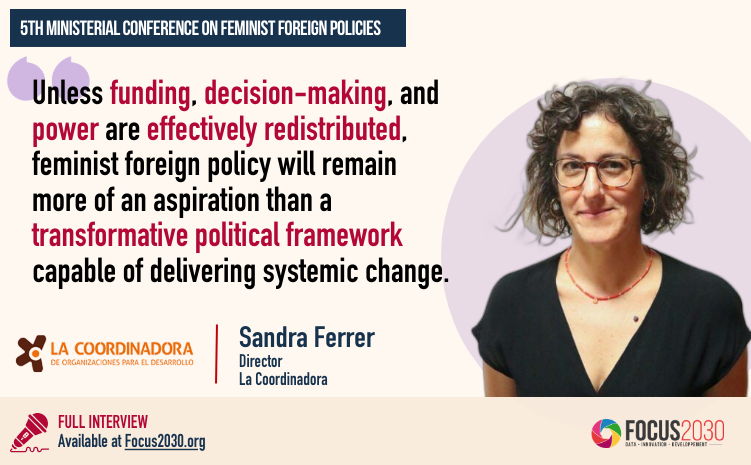
    Interview with Sandra Ferrer, Director of la Coordinadora, on the Fifth Ministerial Conference on Feminist Foreign Policies.

    As civil society organizations face growing restrictions and funding cuts worldwide, Sandra Ferrer examines the role Feminist Foreign Policy can play in protecting civic space, supporting feminist movements, redistributing power and resources and advancing more equitable and inclusive forms of international cooperation.
    Special Edition - 29 May 2026

    5th Ministerial Conference on Feminist Foreign Policies: Building Peace and Promoting Democracy

    Spain will host the 5th Ministerial Conference on Feminist Foreign Policies on June 2–3, 2026, a major gathering focused on strengthening international alliances, defending existing achievements, and turning political commitments into concrete funding and accountability mechanisms.
    Gender equality - 28 May 2026

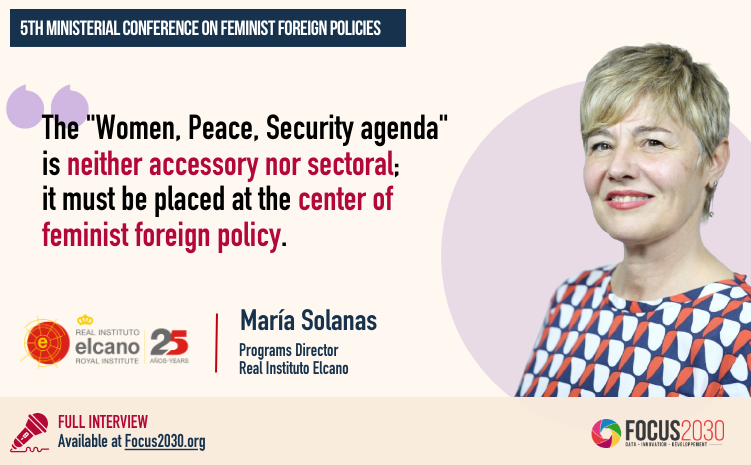
    Interview with María Solanas, Programs Director, Real Instituto Elcano, ahead of the 5th ministerial conference on feminist foreign policies

    Against an international backdrop marked by geopolitical tensions and a rise in violations of women’s rights, María Solanas analyzes the challenges facing feminist foreign policy today, as well as the tools needed to strengthen the “Women, Peace, and Security” agenda.
    Gender equality - 28 May 2026

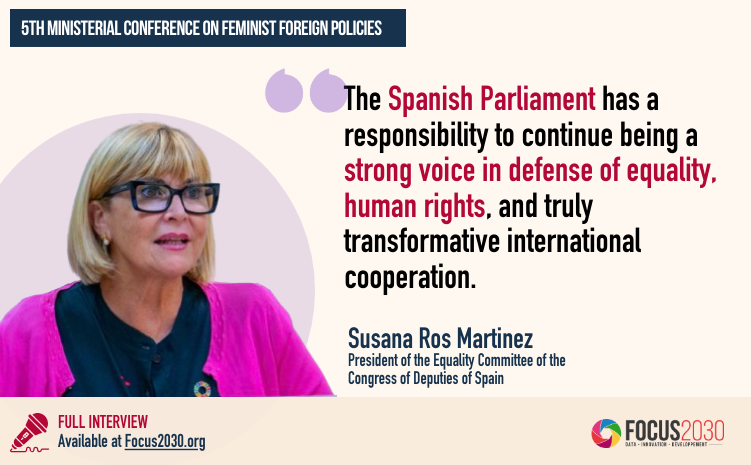
    Interview with Susana Ros Martinez, President of the Equality Committee of the Congress of Deputies of Spain, ahead of the Fifth Ministerial Conference on Feminist Foreign Policies.

    At a time marked by setbacks in women’s rights and the rise of anti-gender narratives, Susana Ros Martinez discusses the priorities of Spain’s feminist foreign policy, the challenges of ensuring its long-term sustainability, and the role of Parliament and international institutions in defending equality and human rights.
    Gender equality - 08 April 2026

    Gender equality in philanthropy in France: assessing a still limited level of engagement

    Why is gender equality persistently underfunded by the philanthropic sector? To answer this question, the Coalition for Feminist Philanthropy, a group of twelve funders, commissioned Agence Phare to analyze the role of gender equality in French philanthropy. Published in 2025, this study aims to identify, quantify, and analyze the funding allocated to this cause. Summary of key findings and recommendations for action.
    Gender equality - 02 April 2026

    CSW70: UN Women’s rights negotiations marked by deepening divisions

    The 70th session of the Commission on the Status of Women (CSW70), held in New York from March 9 to 19, 2026, adopted conclusions focused on ensuring access to justice for all women and girls. For the first time, the outcome was adopted by vote rather than consensus, highlighting growing divisions among states on key issues such as gender equality and sexual and reproductive rights. Analysis.