Around the world, crises are multiplying and democratic institutions are under growing strain. Protracted armed conflicts, political polarization, challenges to multilateralism, and attacks on sexual and reproductive rights are often accompanied by a rollback of women’s rights during periods of democratic backsliding.
This is happening at a time when no country has yet achieved gender equality. According to the United Nations, at the current pace of progress, it would still take nearly 300 years to end discrimination against women worldwide.
Conflicts, climate crises, inflation, debt, and food insecurity are exacerbating existing inequalities and disproportionately affecting women and girls, in a context where social protection mechanisms and inequality-reduction policies remain insufficient. At the same time, funding for gender equality and international cooperation is declining, while though an additional $420 billion per year would be needed to achieve equality in low- and middle-income countries. By contrast, global military spending reached a record high of US$2.887 trillion in 2025.
Meanwhile, anti-women’s rights movements are strengthening their coordination internationally and expanding their presence in political, media, digital, and multilateral spaces.
Against this backdrop, feminist foreign policies are gaining visibility as tools for defending human rights, democracy, and multilateralism. By placing gender equality at the heart of foreign policy, development policy, and peace processes, they seek to address crises that now extend beyond gender issues alone.
It is in this context that Spain will host the 5th Ministerial Conference on Feminist Foreign Policies on June 2–3, 2026, a major gathering focused on strengthening international alliances, defending existing achievements, and turning political commitments into concrete funding and accountability mechanisms.
One year after the Paris conference, which brought together 31 states to adopt a joint declaration, the Madrid meeting marks a new milestone. In a fragmented international context, it raises a central question: how can feminist foreign policies help defend rights, peace, international cooperation, and democratic institutions?
This analysis examines the conference’s main issues: the current state of feminist foreign policies, financing gender equality, the rise of anti-rights offensives, and the key sessions of the 5th Ministerial Conference.
Table of contents
- The 5th Ministerial Conference on Feminist Foreign Policies: at the crossroads of democratic and geopolitical crises
- Ministerial Conferences on Feminist Foreign Policies
- What is Feminist foreign policy ?
- Financing gender equality: commitments remain largely insufficient
- Which donor countries integrate gender equality into their development aid?
- Anti-rights backlash: a transnational political offensive
- Madrid : a test for feminist foreign policies
- Learn more
The 5th Ministerial Conference on Feminist Foreign Policies: at the crossroads of democratic and geopolitical crises
On June 2–3, 2026, Madrid will host the 5th Ministerial Conference on Feminist Foreign Policies, an international gathering dedicated to the role of gender equality in defending democracy, peace, and multilateralism.
The conference will bring together countries committed to feminist foreign policies, international organizations, financial institutions, feminist movements, civil society organizations, researchers, and philanthropic foundations.
The agenda will combine plenary sessions, multi-stakeholder roundtables, and side events focused on several priorities:
- the role of women in peace processes and conflict prevention;
- defending the rule of law and human rights in the face of democratic crises;
- financing gender equality and feminist organizations;
- promoting more inclusive and representative multilateralism;
- topics related to sexual and reproductive rights, care, and economic justice.
Alongside the Ministerial Conference, several events will be organized to build momentum and encourage dialogue among experts, policymakers, and civil society:
- Monday, June 1: Civil Society Forum, whose conclusions will feed into the conference discussions.
- Tuesday, June 2: Parliamentary Dialogue: “A Feminist Foreign Policy Led by Parliaments: Rights, Equality and Global Justice,” organized by the Spanish Parliamentary Group on Population, Development and Reproductive Health, UNFPA, and the European Parliamentary Forum for Sexual and Reproductive Rights.
Since feminist foreign policies first emerged in the late 2010s, the international context has changed profoundly. Armed conflicts are multiplying, global military spending is reaching record levels, and multilateral institutions are increasingly deadlocked.
According to the Stockholm International Peace Research Institute (SIPRI), global military spending reached US$2.887 trillion in 2025, marking the 11th consecutive year of increase. At the same time, UN agencies are warning of stagnation, and in some cases regression, in indicators related to poverty, hunger, and gender equality, while humanitarian needs continue to rise and funding remains stagnant.
These policies now appear less as sector-specific policies then as tools for responding to systemic crises: protracted conflicts, rising authoritarianism, economic inequality, climate crises, and the erosion of human rights.
This shift also reflects changing understandings of foreign policy. Gender issues are no longer associated solely with social or development policies. Gender issues are now presented as indicators of democratic resilience, social cohesion, and prevention of violence.
In this context, these conferences also play a role in strategic coordination among states, multilateral agencies, and feminist organizations to prevent the erosion of international human rights norms.
One year after the Paris conference, the challenge for Madrid is now to move from political commitments to tangible implementation.
See the conference program and concept note.
Ministerial Conferences on Feminist Foreign Policies
Since 2022, the ministerial conferences on feminist foreign policies have brought together States, international organizations and feminist movements each year to strengthen international cooperation on gender equality, women’s rights and a human rights–based multilateralism.
Spain is one of the driving forces behind feminist foreign policies in Europe. After adopting a feminist foreign policy in 2021 , Madrid strengthened this commitment in December 2025 with the adoption of a new Feminist Cooperation Strategy ddesigned to guide all its international cooperation efforts. This strategy builds on a longer-standing trajectory: for several years, Spain has played an active role in the UN Women, Peace and Security agenda and notably contributed to the adoption of UN Security Council Resolution 2242 in 2015.
The strategy promotes a political, intersectional, and transformative approach to gender equality. It views inequalities as structural and linked to other forms of discrimination (economic, racial, territorial, or related to disability, migration status, or sexual orientation). Its objective is to transform the power relations that perpetuate these inequalities, including in international cooperation practices.
The document emphasizes in particular:
- sexual and reproductive rights;
- combating the feminization of poverty;
- an ecofeminist approach to climate policies;
- women’s participation in peace processes;
- support for feminist organizations and human rights movements.
What is Feminist foreign policy ?
Initiated in 2014 by Sweden under the leadership of its Foreign Minister Margot Wallström, and since adopted by fifteen countries, feminist foreign policy refers to an approach to foreign affairs that places gender equality and human rights at the center of international action.
This approach goes beyond women’s representation within diplomatic institutions. It seeks to transform the priorities of foreign policy (official development assistance, international trade, climate, security, migration, economic governance, and conflict prevention) through a more systemic understanding of inequalities.
A feminist foreign policy is also based on the principle of policy coherence: commitments to gender equality and human rights cannot be separated from the trade, climate, migration, security, or economic policies pursued by states.
These policies generally rest on several principles:
- promoting human rights;
- redistributing power and resources;
- ensuring the participation of feminist organizations in decision-making processes;
- preventing conflicts and violence;
- addressing structural inequalities in international policies.
They are also rooted in existing international frameworks:
- the Beijing Platform for Action;
- the Convention on the Elimination of All Forms of Discrimination against Women (CEDAW);
- the UN Women, Peace and Security agenda;
- the 2030 Agenda and the Sustainable Development Goals.
However, they do not constitute a single model. While several European countries have primarily structured their strategies around development aid, women’s representation, and human rights, several Latin American countries such as Mexico, Colombia, and Chile have developed broader approaches that incorporate racial inequalities, colonial legacies, Indigenous peoples’ rights, environmental protection, and the social and environmental consequences of extractive industries.
These approaches also rely on a critique of historical imbalances in global governance: the underrepresentation of countries from the Global South in decision-making forums, the concentration of international funding, and the limited access of local feminist organizations to multilateral resources.
In multilateral forums, these policies also seek to preserve multilateral negotiation spaces grounded in human rights and scientific evidence, at a time when disinformation strategies and anti-rights offensives are gaining ground.
Financing gender equality: commitments remain largely insufficient
In 2015, all United Nations Member States committed to achieving the 17 Sustainable Development Goals (SDGs) by 2030, including SDG 5 on gender equality. Yet with only four years remaining until the deadline, the funding required to achieve these goals remains largely insufficient.
Official development assistance (ODA) is an essential source of funding for access to healthcare, education, sexual and reproductive rights, and feminist organizations in the world’s most vulnerable countries. Cuts to aid budgets directly affect funding for public services, global health, access to contraception, maternal and child health services, as well as services for the prevention of and response to gender-based violence.
Members of the OECD Development Assistance Committee (DAC) and the European Union disbursed an average of $60.7 billion per year in 2023 and 2024 (latest available data) for projects supporting gender equality, representing 44% of their bilateral ODA.
Which donor countries integrate gender equality into their development aid?
Distribution of bilateral ODA from OECD DAC by gender equality objective (2023–2024 amounts)
for projects where gender equality is a significant objective
(44.1% of bilateral ODA)
for projects where gender equality is the principal objective
(4.1% of bilateral ODA)
of bilateral ODA supports gender equality.
International target: 85%
Only the Netherlands and Spain allocated at least 20% of their ODA directly to promoting gender equality: 25% for Spain and 25% for the Netherlands.
Bilateral ODA amounts allocated to organizations and movements defending women’s rights and to government institutions.
Source: OECD , data updated in February 2026.
➜ Learn more about funding dedicated to gender equality
Note: Amounts, in millions of US dollars, allocated to development aid projects according to the OECD DAC gender marker: marker 2 (gender is the principal objective) or marker 1 (gender is a significant objective). The definition of the markers can be found here .
Source: OECD , last updated in February 2026.

Countries that allocate the largest share of their aid to gender equality, such as the Netherlands, Spain, Iceland, Ireland, or Sweden, are not necessarily the largest donors in terms of total ODA volume. This gap illustrates the collective shortfall in meeting the international target of directing at least 85% of aid toward gender equality.
This decline in funding comes at a time when feminist organizations and human rights defenders are facing growing political pressure in many countries. For several years, movements opposed to women’s rights and gender equality have strengthened their coordination internationally and growingly invested in political, media, and multilateral spaces.
Anti-rights backlash: a transnational political offensive
The term “backlash” refers to an organized reaction against social or political progress perceived as threatening by certain political, religious, or ideological actors. In the case of women’s rights, it refers to strategies aimed at slowing, restricting, or reversing gains related to gender equality, LGBTQIA+ rights, and sexual and reproductive health and rights.
The pushback against women’s rights is no longer limited to isolated national debates. It is now part of coordinated transnational networks and strategies backed by structured political, financial, media, and digital networks. This is taking place within a broader context of democratic decline worldwide. According to the Freedom in the World 2026 report, 2025 marked the 20th consecutive year of declining freedoms worldwide: 54 countries experienced deterioration in political rights and civil liberties, compared with 35 countries that recorded improvements.
Anti-rights (or “anti-gender”) movements, opposing women’s rights and gender equality, share strategies, narratives, and arenas of influence, often organized around the defense of “traditional values,” rejection of multilateralism, or opposition to human rights. In Europe, according to The Next Wave report by the European Parliamentary Forum for Sexual and Reproductive Rights, 275 anti-rights actors have been identified, compared with around 50 in 2018. Their combined funding reached $1.18 billion between 2019 and 2023.
In many countries, attacks on against sexual and reproductive rights, including restrictions on access to abortion, contraception, or sexuality education, as well as attacks against feminist movements or LGBTQIA+ people are accompanied by a broader erosion of civil liberties and democratic checks and balances. Attacks targeting feminist organizations and human rights defenders are becoming one of the warning signs of broader democratic fragility.
Anti-rights movements are now expanding their presence in all multilateral forums to challenge references to human rights, social justice, and gender equality. Some actors use so-called “norm spoiling” strategies, aimed at gradually weakening international norms by challenging their language, scope, or legitimacy rather than openly opposing them.
Digital platforms now play a central role in spreading anti-rights campaigns and disinformation strategies targeting feminist organizations, human rights defenders, and international institutions. Misogynistic and anti-gender content is also gaining visibility, contributing to the polarization of public debate and the normalization of sexist violence.
In this context, feminist foreign policies ever more appearing as tools for defending democracy, human rights and multilateralism.
Recent sessions of the Commission on the Status of Women (CSW70) and the Commission on Population and Development (CPD59) have illustrated the intensification of anti-rights pushbacks within multilateral forums.
At the
CSW70
, dedicated to women’s and girls’ access to justice, negotiations were marked by repeated attempts to weaken language relating to gender, sexual and reproductive rights, and the role of civil society. The United States notably opposed several references that had long been considered established in UN texts.
For the first time in the Commission’s history, the agreed conclusions could not be adopted by consensus and had to be put to a vote. The text was ultimately adopted by a large majority, despite the opposition of the United States.
The
CPD59
confirmed this growing polarisation. Member States failed to adopt a consensual final text, revealing deep divisions over sexual and reproductive rights and gender equality.
These tensions reflect a broader shift in international negotiations. In several multilateral forums, the objective is no longer only to advance human rights, but also to
preserve existing gains in the face of rollback attempts
.
Madrid : a test for feminist foreign policies
The 5th ministerial feminist foreign policy conference is taking place at a moment of major reshaping of the international order.
The acceleration of climate crises, protracted armed conflicts, the rise of authoritarian regimes, and tensions surrounding multilateralism are raising questions about states’ ability to build collective responses grounded in human rights and international cooperation.
From this perspective, these policies appear as much more than a thematic agenda: they propose a political vision of the world based on cooperation rather than confrontation, representation rather than exclusion, and rights rather than power politics.
The Madrid conference will be an important test: can states committed to feminist foreign policies succeed in turning their political commitments into sustainable funding, accountability mechanisms, and concrete reforms?
The question now goes beyond gender equality alone. Defending women’s rights today also means defending democracy, multilateralism, and the very possibility of a shared future.
Learn more
Analysis & news
- 🔗Report “Where is the money ?” | AWID
- 🔗Gender Equality in Foreign Policy Index | ICRW
- 🔗Assessment of Financing for Development and Gender Equality | ICRW
- 🔗Women, Peace and Security in a changing global order: rethinking participation, protection and mediation practice | Elcano Royal Institute
- 🔗Financing for Gender Equality 2025 | Feminist Foreign Policy Collaborative
- 🔗Defining Feminist Foreign Policy 2025 | Feminist Foreign Policy Collaborative
- 🔗Feminist Foreign Policy Repository
Publications of Focus 2030
- 🔗Historic drop in Official Development Assistance in 2025| Focus 2030
- 🔗Which G7 countries consider gender equality in their foreign aid? | Focus 2030
- 🔗Special edition: The state of gender inequalities around the world 2026 | Focus 2030
- 🔗The G7 and Gender Equality : A Fluctuating Commitment| Focus 2030
- 🔗 Special report : 4th Feminist foreign policies conference: resisting, uniting and acting | Focus 2030
- 🔗CSW70 : UN Women’s rights negotiations marked by deepening divisions| Focus 2030


ALSO READ
Feminist Foreign Policies: Key Takeaways from the 5th Ministerial Conference in Madrid
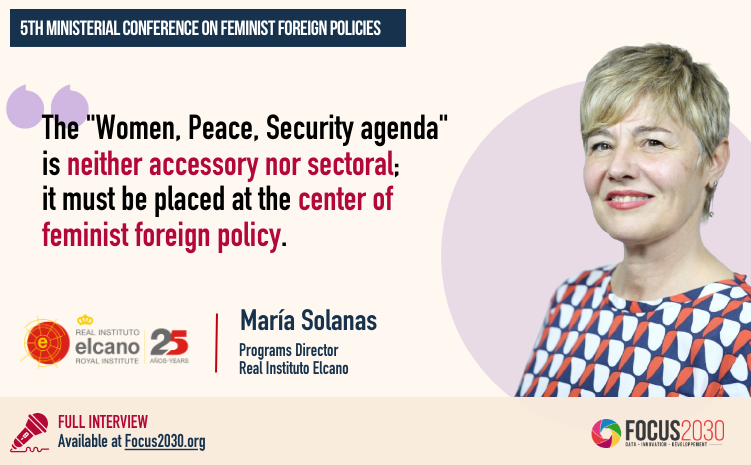
Interview with María Solanas, Programs Director, Real Instituto Elcano, ahead of the 5th ministerial conference on feminist foreign policies
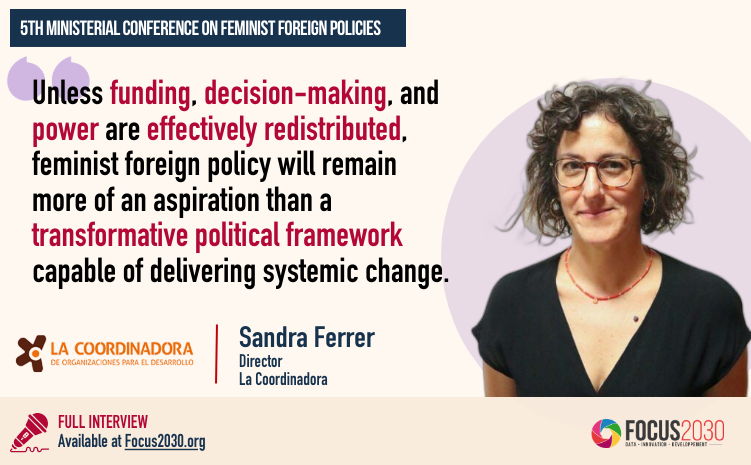
Interview with Sandra Ferrer, Director of la Coordinadora, on the Fifth Ministerial Conference on Feminist Foreign Policies.