G7 2026: A summit marked by consensus but without major progress on development issues

During its meeting in Évian-les-Bains from June 15 to 17, 2026, under the French presidency, the G7 issued three declarations related to global health and development issues, focusing on international partnerships, the response to the Bundibugyo Ebola outbreak, and the fight against cancer. These declarations focus on blended finance, private-sector engagement, and international health cooperation. However, they also reflect a marked political setback: under the influence of U.S. positions, climate change and gender equality have disappeared from the official rhetoric, while reform of the international financial architecture continues to struggle to gain traction as a response to the sharp decline in official development assistance.
This publication is part of Focus 2030’s Special Edition dedicated to the French G7 Presidency
This Special Edition brings together interviews, analysis, key figures and resources to understand the priorities of the French G7 Presidency, follow the main milestones of 2026 and analyse issues related to development, international solidarity and global governance.
Explore the Special EditionA Summit Focused on Partnerships, Global Health, and Economic Security
The G7 heads of state and government issued three documents directly related to global health and development issues: a declaration on mutually beneficial international partnerships, a call for a coordinated response to the Bundibugyo Ebola outbreak, and a call to action on the fight against cancer. Five other declarations address smuggling, geopolitical issues, critical minerals, and economic growth. A specific declaration also addresses the protection of minors online. The declarations were adopted unanimously by the G7 member states.
Texts published following the G7 Summit in Évian
Development and global health
International security, economic and geopolitical issues
Online safety for minors
International Partnerships: Cooperation Refocused on Investment and Mobilizing Private Capital
The G7 declaration on “mutually beneficial international partnerships” is the summit’s key document on the future of development cooperation. Adopted by the G7 members, along with Kenya and South Korea, it builds on the 2023 Paris Summit for a New Financial Pact and the 2026 Africa Forward Summit co-hosted by France and Kenya. The text acknowledges that development policies and the current international financing architecture have produced results, while affirming that these tools must be updated to meet current and future needs.
In it, the G7 advocates for an evolution of the cooperation framework based on several principles: shared interests, national ownership, accountability, economic sovereignty, and resilience. This approach marks a shift from the traditional language of aid toward that of investment, co-financing, and long-term self-financing capacity. Concessional financing and aid are still presented as strategic, particularly for the least developed and most vulnerable countries, but the text emphasizes that public resources alone cannot meet global development needs.
“The traditional system is shifting its philosophy, and that’s a fact.”
— Emmanuel Macron, Press conference at Évian on June 17, 2026
This approach places a central emphasis on domestic resource mobilization, strengthening tax administrations, private capital, and risk-sharing instruments. In particular, the G7 welcomes the commitment made in March 2026 in Tokyo by the Platform for Collaboration on Tax Issues to strengthen cooperation on domestic resource mobilization. The G7 also calls for the use of concessional finance in a more targeted and catalytic manner, by making greater use of multilateral development banks, development finance institutions, guarantees, and blended finance. The aim is to enable private investment on a larger scale, particularly in countries where the perceived level of risk limits access to financing.
This statement confirms a shift in the approach to international cooperation: less focused on official development assistance as the primary lever, and more structured around investment, guarantees, domestic resource mobilization, and private capital. While this shift may strengthen certain financing tools, it raises a key question for the most vulnerable countries: private financing and bankable projects do not always address essential social needs, particularly when the investments are not expected to generate a direct financial return.
The press release cites several stakeholders and instruments expected to play a role in this new approach: the African Trade and Investment Development Insurance (ATIDI), the African Development Bank, the World Bank Group, the Multilateral Investment Guarantee Agency (MIGA), and the G20’s Compact with Africa. These tools aim to reduce investment risks, improve the business environment, and develop so-called “bankable” projects, particularly in Africa. The priority sectors mentioned include infrastructure, economic corridors, energy, digital systems, critical mineral value chains, food security, health, education, early childhood development, and nutrition.
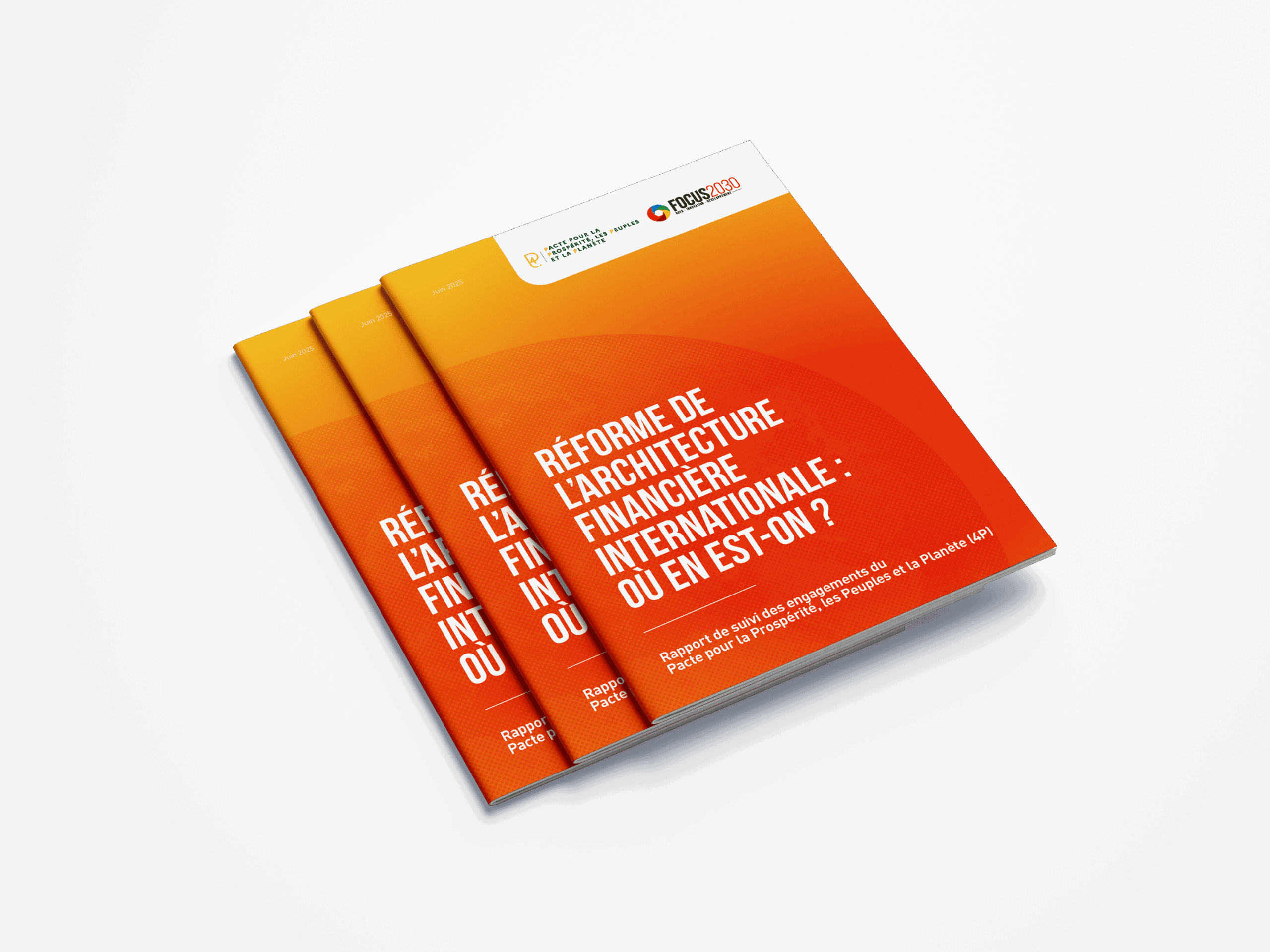
Discover the report published by Focus 2030 ahead of the G7 Summit
Focus 2030 tracks the progress of commitments made at the Summit for a New Global Financing Pact and analyzes the progress, obstacles and setbacks observed in reforming the international financial architecture.
Read the report →Debt is another important aspect of the text. The G7 calls for progress, within the G20 framework, toward a common approach to debt restructuring for vulnerable middle-income countries that are not eligible for the Common Framework. It also supports strengthening the implementation of the G20 Common Framework so that debt treatments occur in a more predictable, rapid, orderly, and coordinated manner. This wording acknowledges one of the major obstacles to development financing: in many countries, debt service reduces the resources available for health, education, social protection, food security, and climate adaptation. However, at this stage, it is not accompanied by a binding mechanism that includes all creditors, particularly private ones.
This statement therefore confirms a shift in the focus of international cooperation: away from official development assistance as the primary lever, and toward a model structured around investment, guarantees, and the mobilization of private capital. While this shift may strengthen certain financing tools, it raises a key question for the most vulnerable countries: private-sector mobilization does not always address essential social needs, particularly when the projects in question do not generate direct financial returns.
This approach comes at a time when G7 members have a direct impact on the level of funding available for international solidarity: they account for approximately 69% of global official development assistance. This responsibility is also reflected in recent cuts: according to the OECD, the five leading providers of official development assistance within the Development Assistance Committee (all G7 members) account for 96% of the total decline recorded in 2025. The United States alone accounts for three-quarters of this decline, with official development assistance down 57% compared to 2024.
Finally, the G7 presents this reorientation as a program intended to extend beyond the summit itself. The declaration mentions several initiatives designed to help expand this approach with partner countries: the Africa Forward summit, the UK’s Global Partnerships Conference, the Mattei Plan for Africa, the Tokyo International Conference on African Development, and the EU’s Global Gateway initiative. G7 members indicate their intention to mobilize a broader coalition involving partner countries, new donors, the private sector, philanthropic organizations, and civil society organizations.
The text also recognizes the importance of the United Nations system as a development actor and encourages its reform, particularly through the UN80 initiative.
In this context, the recognition of the strategic role of concessional finance does not offset the absence of new, quantified and additional commitments on official development assistance. It comes, on the contrary, at a time when bilateral resources, grants, contributions to the United Nations system, humanitarian assistance, and financing for least developed countries and sub-Saharan Africa are all recording marked declines.
Ebola and cancer : health commitments more concrete than development finance commitments
Global health forms the most operational component of the texts published in Évian. The G7 call on the Ebola Bundibugyo outbreak focuses on the Democratic Republic of the Congo and Uganda. The text presents the outbreak as a regional humanitarian crisis and a global health security risk, in a context where the virus is circulating in isolated areas affected by conflict and significant logistical constraints.
The G7 calls for a coordinated response combining contact tracing, infection prevention, quarantine, isolation, laboratory testing, border surveillance, cross-border preparedness and community engagement. The text also underlines that the available vaccines, diagnostics and treatments do not fully address the viral strain concerned, which justifies support for the development and delivery of adapted medical tools.
The financial announcements associated with this declaration include several envelopes : more than 370 million US dollars (USD) in health and humanitarian resources announced by the United States for the region, up to an additional 500 million USD dedicated to the Ebola response, 650 million USD in humanitarian assistance for the Great Lakes region, and 493 million euros in European Union support for the Great Lakes region and Uganda, including 84 million euros identified for immediate humanitarian assistance, development and research linked to the outbreak. The Continental Preparedness and Response Plan also mobilizes 518 million USD to strengthen preparedness, detection and response capacities across African countries.
The text does not, however, always specify the recipient organizations, disbursement timelines or the share of announced funding that is genuinely additional. These elements will determine the response’s capacity to support health systems, medical teams, local communities and regional coordination mechanisms.
The second health-related text focuses on the fight against cancer. The G7 emphasizes scientific cooperation, access to data, research on pediatric cancers, cancers affecting adolescents and young adults, and cancers with poor prognosis. It also calls for stronger prevention, screening, clinical trials, early diagnosis and access to quality cancer care.
The communiqué recalls that cancer causes nearly 10 million deaths worldwide each year and that the number of new cases could increase by 80 % by 2050. This projected increase highlights the issue of access to care, particularly in countries where health systems have limited screening, treatment and follow-up capacities. The emphasis on data, interoperability, artificial intelligence and scientific cooperation can strengthen international research, but the effect of this declaration will depend on its translation into funding, health infrastructure and effective access to treatments.
The other texts : security, critical minerals, growth and digital technology
Beyond the three texts directly linked to development and global health, the G7 summit produced six other declarations. They focus on combating drug trafficking, geopolitical issues, migrant smuggling, securing critical mineral supply chains, more balanced, sustainable and resilient growth, and the protection of minors online.
These texts broaden the scope of the summit to issues of international security, economic stability and technological sovereignty. The declaration on critical minerals occupies a specific place : these resources are presented as strategic for the energy and digital transitions. The G7 calls for reducing excessive dependencies, strengthening transparency, developing traceability, supporting recycling and mobilizing public and private financing, including with emerging and developing countries.
The economic declaration emphasizes macroeconomic imbalances and tensions linked to energy, agricultural inputs, fertilizers and supply chains. It refers to the role of the International Monetary Fund, the Organisation for Economic Co-operation and Development, the World Trade Organization and multilateral development banks. It also addresses the risks and opportunities associated with artificial intelligence and quantum technologies.
Finally, the call on the digital space aims to strengthen the protection of minors online. It promotes digital services that are safe by design, privacy-preserving age-assurance mechanisms, parental control tools, greater content transparency and measures against child sexual abuse, grooming, non-consensual intimate images, exposure to violent extremism and recruitment by criminal networks.
Civil society organizations’ call for structural reforms left unanswered
Civil society organizations brought together within the Civil 7 and Women 7 point to a gap between the scale of current crises and the scope of the announcements. CCFD-Terre Solidaire considers that several structural issues were pushed into the background : the debt crisis, inequalities, tax evasion, declining official development assistance, the food crisis, the climate crisis and gender inequalities. The organization underlines that the summit reaffirms the priority given to the most vulnerable countries without announcing a financial or political shift commensurate with the crises.
On climate, Réseau Action Climat considers that dependence on fossil fuels was not addressed directly, while critical minerals occupied an important place in the discussions. The organization recalls that these decisions directly concern producer countries. It calls for countries and populations affected by these decisions to be more closely involved in decisions on the extraction, processing and use of these resources.
Gender equality does not appear among the structuring priorities of the texts devoted to international partnerships either. For the organizations mobilized through the Women 7, this absence limits the scope of a development agenda that states its intention to better address vulnerabilities, without explicitly integrating one of the major drivers of inequalities.
The Évian summit therefore confirms a compromise-based approach : preserving G7 unity around common language, while leaving aside several issues that shape the credibility of its commitments on international solidarity. Follow-up will now focus on the effective implementation of the announcements, but also on the G7’s capacity to treat fiscal, climate and gender equality issues as central priorities rather than peripheral dimensions of international cooperation.
A mixed outcome for international solidarity
The Évian summit confirms a shift in the G7’s discourse on international cooperation. Partnerships are now expected to rely more heavily on investment, domestic resource mobilization, the attraction of private capital and financial risk reduction. This approach can help finance infrastructure, energy projects, digital systems and value chains. It only partially addresses, however, needs that primarily require stable, predictable and concessional public financing.
While the declaration on international partnerships does mention health, education, nutrition, food systems and early childhood development as priority areas, it includes neither new and quantified financial commitments for these sectors, nor a timeline. It also contains no explicit references to climate change or gender equality, even though both constitute central dimensions of the 2030 Agenda and the Sustainable Development Goals.
In the short term, the Ebola announcements form the summit’s most operational component, provided they are effectively implemented. In the medium term, three elements will make it possible to assess the real scope of the texts adopted : the disbursement of announced funding, the role granted to partner countries in the governance of initiatives, and the G7’s capacity to connect its economic, health and security priorities to international solidarity objectives.
This publication is part of Focus 2030’s Special Edition dedicated to the French G7 Presidency
This Special Edition brings together interviews, analysis, key figures and resources to understand the priorities of the French G7 Presidency, follow the main milestones of 2026 and analyse issues related to development, international solidarity and global governance.
Explore the Special Edition