Contact

  • English
  • Español
  • Surveys

    What do European citizens think of official development assistance?

    Publié le 14/12/2018, modifié le 26/08/2019.

    In Europe, public opinion varies from one country to the next in terms of views of whether official development assistance (ODA) should increase or not.

    The variation in views can be attributed to several different factors. One, each country’s individual history or links with developing countries. Two, the strength and influence of its civil society (and their campaigns). Three, whether the media is interested and (if so) how it portrays development issues. Four, the extent to which local or national politicians talk about development or poverty, either in their campaigns or during their terms in office.

    Whatever the reason, there is a clear difference in public opinion about whether developed countries should be giving more to developing countries.

    We see the highest support for an increase in ODA from Spanish people (44%), followed closely by Northern or high-income European countries: Germans (38%) are second, followed by Sweden (36%), Denmark (33%) and Holland (32%), all of whom are above the average (29%).

    French and British people fall under the average, with 26% and 29% respectively agreeing that ODA should be increased toward developing countries.

    Opinion poll carried out on line by TNS Opinion and Social for the European Commission – Directorate General for International Cooperation and Development. This study was also coordinated by the European Commission Directorate General for Communication.

    Eurobarometer Special 476 – wave EB89.3. Carried out between 21 June and 6 July 2018. Published Septembre 2018.

    Opinion poll based on answers from 27732 respondents from all 28 countries, representative of the adult population of each country, ie 1035 people in Spain. Source: ec.europa.eu

    À LIRE AUSSI

    Official development assistance - 01 July 2025

    Increase or decrease development aid? Evolution of opinions in France, Germany, the United Kingdom and the United States

    In partnership with University College London (UCL) and Birmingham University, Focus 2030 is conducting a research-action program to analyze the perceptions, attitudes, behaviors and feelings of citizens on international solidarity issues in four countries: France, Germany, United States and United Kingdom. This research programme Development Engagement Lab (DEL), aims at providing various actors in charge […]
    Official development assistance - 20 June 2025

    The impact of Donald Trump’s presidency on international development. An analysis.

    As Donald Trump is sworn in for a second term, what are the consequences for the international solidarity sector and the global fight against poverty and inequality? Analysis.
    Official development assistance - 19 June 2025

    A majority of French people support an increase in development aid

    56% of French people want to maintain or increase official development assistance to the poorest countries.
    News - 30 April 2025

    France reneges on its Official Development Assistance commitments

    A few months after a first setback in official development aid, the French government has announced a new budget cut for 2024. Analysis.
    - 16 April 2025

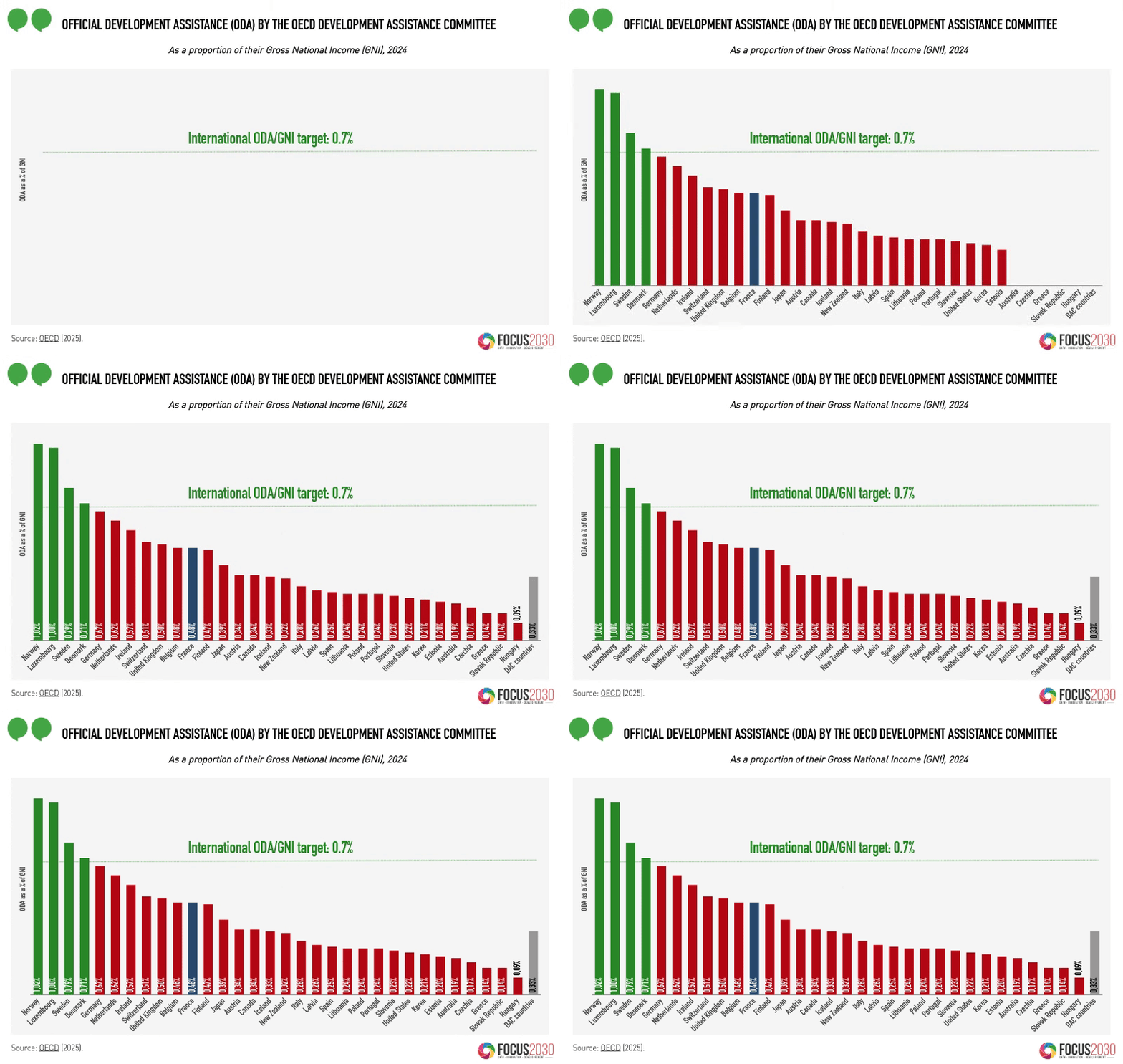
    Historic drop in Official Development Assistance in 2024

    ODA decreased by 7.1% in real terms between 2023 and 2024, reaching USD 212 billion, or 0.33% of the combined GNI of DAC members.
    Official development assistance - 16 January 2025

    Slight increase in Official Development Assistance in 2023

    ODA rose by 1.6% in real terms between 2022 and 2023, totalizing USD 223 billion and 0.37% of the combined GNI of DAC members.
    X

    Formulaire d'abonnement à la newsletter de Focus2030

    * indicates required

    Focus 2030 vous transmettra sa newsletter sur l'email fourni dans ce formulaire.

    Je comprends que je peux me désabonner facilement à tout moment en cliquant sur le lien en bas de page de nos lettres d'information. Vos données personnelles collectées resteront strictement confidentielles. Elles ne seront ni vendues ni échangées conformément à nos mentions légales. Pour plus d'informations sur notre politique de confidentialité, consultez notre site web.

    We use Mailchimp as our marketing platform. By clicking below to subscribe, you acknowledge that your information will be transferred to Mailchimp for processing. Learn more about Mailchimp's privacy practices here.