Contact

  • Français
  • Español
  • Surveys - Analysis
    Français    

    What do European citizens think of official development assistance?

    Published on 14/12/2018.

    In Europe, public opinion varies from one country to the next in terms of views of whether official development assistance (ODA) should increase or not.

    The variation in views can be attributed to several different factors. One, each country’s individual history or links with developing countries. Two, the strength and influence of its civil society (and their campaigns). Three, whether the media is interested and (if so) how it portrays development issues. Four, the extent to which local or national politicians talk about development or poverty, either in their campaigns or during their terms in office.

    Whatever the reason, there is a clear difference in public opinion about whether developed countries should be giving more to developing countries.

    We see the highest support for an increase in ODA from Spanish people (44%), followed closely by Northern or high-income European countries: Germans (38%) are second, followed by Sweden (36%), Denmark (33%) and Holland (32%), all of whom are above the average (29%).

    French and British people fall under the average, with 26% and 29% respectively agreeing that ODA should be increased toward developing countries.

    Opinion poll carried out on line by TNS Opinion and Social for the European Commission – Directorate General for International Cooperation and Development. This study was also coordinated by the European Commission Directorate General for Communication.

    Eurobarometer Special 476 – wave EB89.3. Carried out between 21 June and 6 July 2018. Published Septembre 2018.

    Opinion poll based on answers from 27732 respondents from all 28 countries, representative of the adult population of each country, ie 1035 people in Spain. Source: ec.europa.eu

    ALSO READ

    Development financing - 04 June 2026

    Reforming the international financial architecture: where do we stand?

    Focus 2030 Reforming the international financial architecture: where do we stand? Focus 2030 independently tracks the commitments made at the Summit for a New Global Financing Pact in 2023. Updated on an ongoing basis, this tracker documents progress towards reforming the international architecture for development and climate finance. Access the tracker Download the report · […]
    G7 - 02 June 2026

    Financing international development: the decisive role of G7 countries in a context of disengagement

    Special feature: French G7 Presidency Explore our special report to understand the issues related to the French G7 Presidency in 2026, gain insight into the key policy priorities, and follow the latest updates. Access the special report ➔ In 2026, France’s G7 Presidency aims to bring development financing back to the forefront of the international […]
    Analysis - 18 May 2026

    In Nairobi, the Africa Forward Summit signals a shift toward a new Franco-African development finance doctrine

    Co-hosted by France and Kenya on 11-12 May 2026, the Africa Forward Summit marked an attempt to redefine relations between France and the African continent around a new narrative: one centered on equal partnership, private investment, and strategic autonomy. Behind the €23 billion in announced commitments, the summit also reflects a deeper transformation: the explicit […]
    Development financing - 09 April 2026

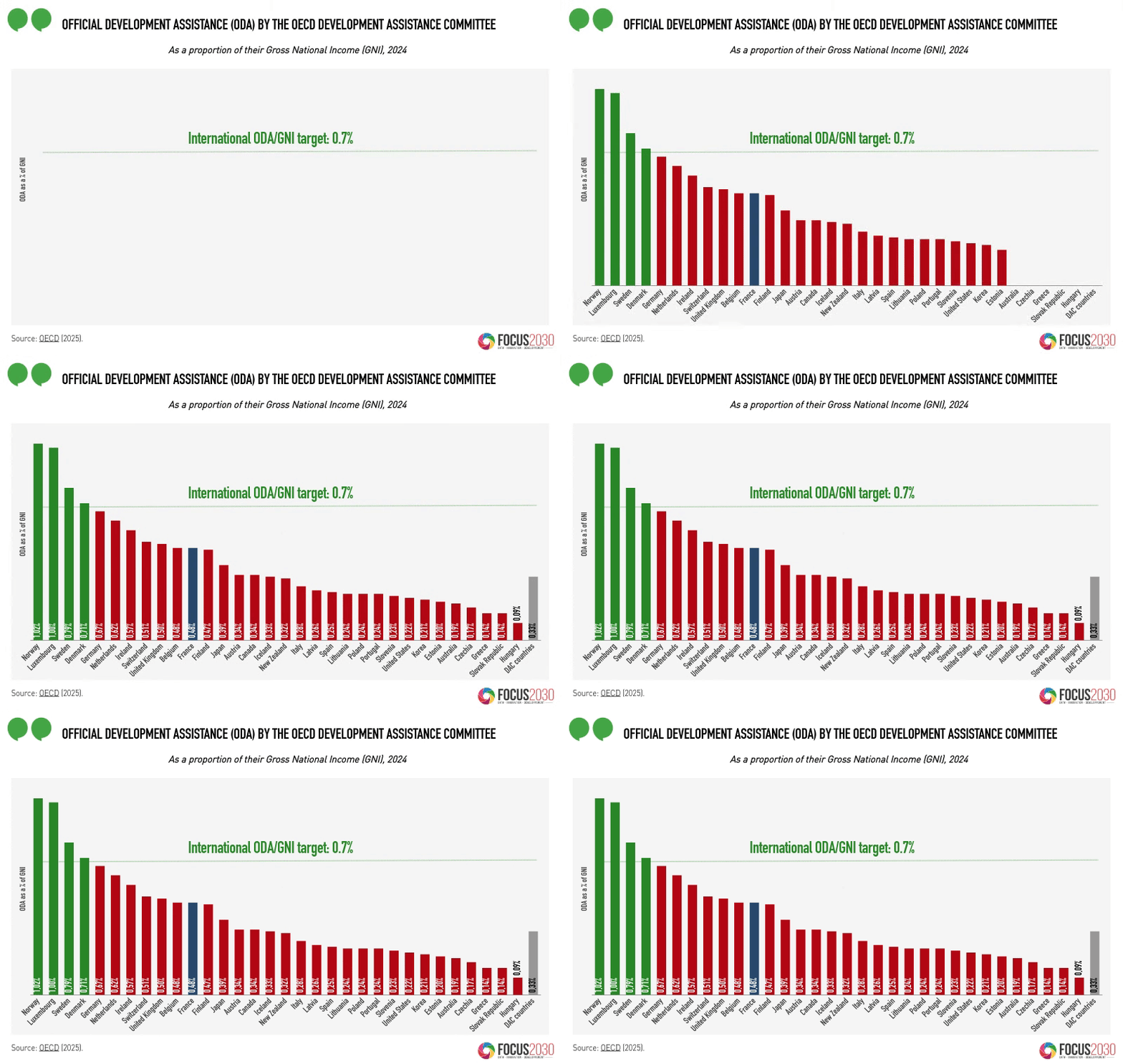
    Historic drop in Official Development Assistance in 2025

    ODA from DAC members fell to 174.3 billion USD in 2025, a 23.1% drop from 2024 (-50 billion USD in real terms), representing 0.26% of their income. It is the highest fall on record. 
    Development financing - 30 March 2026

    The African Development Fund: allocating concessional resources to the 37 most vulnerable countries on the continent

    As the 17th replenishment of the African Development Fund (ADF-17), held on 15-16 December 2025 in London, draws to a close, expressed financing needs from beneficiary countries have reached USD 25 billion. In a context of mounting budgetary pressures among traditional donors, a central question emerges : will international mobilization be sufficient to meet the challenges ?
    G7 - 09 February 2026

    G7 France 2026 : focus on development matters, key challenges, debates and emerging priorities

    In 2026, France holds the presidency of the G7, with the Heads of State Summit scheduled to take place in Evian from June 15 to 17. Keep up with the latest news.