68th United Nations Commission on the Status of Women (CSW): challenges and mobilization of civil society organizations
Publié le 05/03/2024.
The United Nations regularly monitors women’s rights through the meetings of a dedicated commission, which is the focus of particular attention from feminist movements. Here’s how it works.
| Special edition on the state of gender inequality around the world in 2024 :
This overview focusing on the access to contraception around the world is one of the components of a special report dedicated to gender inequalities in the world in 2024. |
The 68th Commission on the Status of Women (CSW), takes place from March 11 to 22, 2024 in New York. This annual event, which plays a critical role in promoting women’s rights on the international stage, will focus this year on strengthening institutions and funding to accelerate the advancement of gender equality. What is the CSW and how does it work ? What can we expect from this 68th session ? How are civil society organizations mobilizing within this framework ? Analysis.
The United Nations Commission on the Status of Women : objectives and organization
The Commission on the Status of Women is a functional commission of the United Nations Economic and Social Council (ECOSOC). Created in 1946 and composed of 45 members, it is the world’s leading intergovernmental body dedicated exclusively to the promotion of gender equality and the empowerment of women. Since 1996, the CSW has also played a role in monitoring the implementation of the Beijing Declaration and Platform for Action, adopted by the United Nations in 1995, which to date forms the most progressive international agenda for advancing women’s rights and gender equality.
Each year, the CSW meets in New York to discuss a priority theme, take stock of progress made, identify challenges ahead, stimulate public policy and set global standards to promote gender equality and the rights of women and girls. Discussions culminate in “agreed conclusions”, negotiated and adopted by all member states. Civil society organizations accredited to ECOSOC are also invited to participate in the Commission’s sessions, and to organize their own discussion sessions on the sidelines of the event.
The CSW notably focuses on the protection of sexual and reproductive health and rights (SRHR). In 2014, during its 58th session, the Commission affirmed “to ensure the promotion and protection of the human rights of all women and their sexual and reproductive health, and reproductive rights (…) recognizing that human rights include the right to have control over and decide freely and responsibly on matters related to their sexuality, including sexual and reproductive health, free from coercion, discrimination and violence”. These rights include, among others, access to safe and modern methods of contraception, emergency contraception and safe abortion.
Focus on the 68th CSW : strengthening institutions and funding to achieve gender equality
A group of experts met in October 2023 to take stock of this issue and prepare for the Commission’s discussions. Their recommendations include the comprehensive reform of the international financial architecture to mobilize the public financing needed to eradicate poverty among women and provide debt relief to countries in need ; greater international tax cooperation to generate new resources for developing countries ; and the mainstreaming of gender in debt sustainability frameworks.
The provisional agenda and Zero Draft conclusions of the 68th CSW are already public. These call on governments to integrate a gender perspective into all development financing, notably through the adoption of gender-sensitive budgets and the equal participation of women and men in decision-making processes. The expansion of national fiscal space to favor investments aimed at eliminating poverty among girls and women is also encouraged, particularly through the reform of multilateral development banks, the strengthening of national and international tax policies, and the fulfillment of the commitment to allocate 0.7% of the gross national income of industrialized countries to official development assistance.
For the first time, a large delegation of some fifteen French MPs will be in New York for the CSW. The trip will be an opportunity to make France’s voice heard on sexual and reproductive health and rights (SRHR), particularly in the context of the inclusion of abortion in the Constitution. The French Minister for Equality between Women and Men, Aurore Bergé, will also be present.
How will civil society organizations take part ?
Each year, civil society organizations mobilized to promote women’s rights take an active part in the CSW, both by mobilizing their expertise during the Commission’s formal discussions and by enabling the creation of an open debate outside the official sessions. Focus 2030, which will be represented on this occasion, has identified several of these initiatives :
- Monday, March 11th :
-
- 10am-1pm : Opening conference at the UN
- 14pm : event sponsored by France on sexual violence and rape as a weapon of war (TBC venue)
- Tuesday, March 12th :
-
- 2.30pm-3.30pm : Action Against Hunger side event “Closing the Gender Nutrition Gap – a key feminist approach to fight hunger and undernutrition” (at the UN’s Salvation Army Auditorium)
- 2.30pm : Side event organized by Ipas on “Financing Safe abortion to accelerate Gender Equality” (Room AACY Armenian Convention Center, 630 2nd Avenue, New York)
- Wednesday, March 13th :
-
- 8:30-10am : Side event organized by Planning Familial organization and the French National Assembly’s Delegation for Women’s Rights and Equal Opportunities for Men and Women (SA Auditorium, UN)
- 8:30am-10am : Side event organized by the International Coalition of Women Human Rights Defenders with Amnesty International, dedicated to feminist activists (at the Plaza)
- 10:30am : Side event organized by Ipas and the ODAS center on Building feminist political power for access to abortion in French-speaking Africa (TBC venue)
- Thursday, March 14th :
-
- 12:30 pm-2:30 pm : event organized by CARE, under the auspices of the Government of Benin, on “Women’s Political Participation : Accelerating Equality and Empowerment” (at the African Union Observer Mission, Nelson Mandela Room – 305 East 47th Street, 5th Floor)
- 4.45pm : Femmes Santé Climat side event on “Feminist Climate Justice, Poverty and Environmentally Sustainable Systems : How Governments and Organizations are Taking Innovative Action at the Nexus of these Issues” (TBC venue)
- 5pm : Side event by Fondation BATONGA on “Feminist Accountability : Perspectives and Strategies for Shifting Power and Resources to Movements”. Registration (Ford Foundation Center for Social Justice 320 E 43rd St, New York, NY 10017).
- Saturday, March 16th :
-
- 2pm-3.30pm : Action Against Hunger side event : “Feminist reflections on the Voluntary Guidelines on Gender equality of the Committee on world Food Security and ways forward for social protection and climate action” (Venue TBC)
- Every year, the CSW/NY NGO coalition organizes a free forum open to the public (registration required) on the sidelines of the CSW, hosting more than 750 events by civil society organizations, which formulate recommendations to influence the CSW conclusions
- For this 68th Commission, CSW/NY prepared an advocacy toolkit for civil society representatives and feminist activists, and mobilized an advocacy research group to formulate recommendations for inclusion in the CSW conclusions
Find out about all the side-events on the official CSW68 website.
| How to take part in CSW ?
Registration for NGOs in consultative status with ECOSOC closed on January 26, 2024. Nevertheless, access to the NGO forum is free and open to the public upon registration at this link. All official discussion sessions will be broadcast live on the UN website. |
What can we learn from CSW68 ?
Two heads of state, three vice-presidents, more than 100 ministers, 4,800 representatives of civil society organizations took part in the 68th CSW in New York from March 11 to March 22 around more than 1,000 official and parallel events.
According to the report presented by the Secretary-General of the United Nations on this occasion, 10.3% of the women in the world currently live in conditions of extreme poverty, i.e. on less than $2.15 per day. António Guterres stressed that progress towards poverty eradication would need to be 26 times faster to achieve the Sustainable Development Goals by 2030.
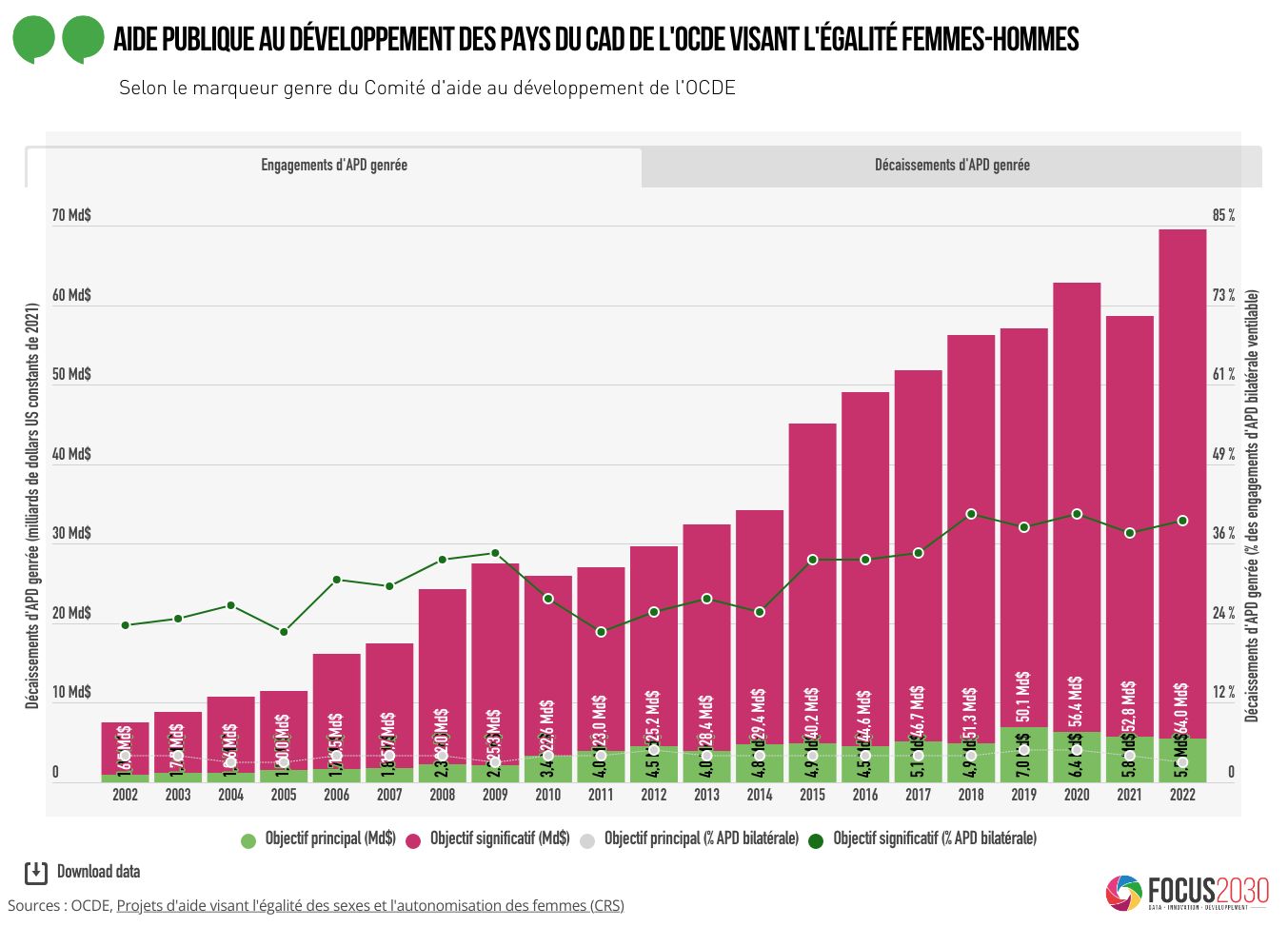
At the same time, the OECD released its latest data. The bad news is that since 2020, there has been a significant drop in financial commitments to promoting gender equality. The share of official development assistance from the 30 Development Assistance Committee (DAC) countries with gender equality as a primary objective (marker 2) has fallen by a further 5% in 2022 (after -8% in 2020 and -10% in 2021).
In this context, the CSW68 adopted, by consensus on March 22, a plan to strengthen financing and institutions to eradicate poverty among women and girls. In a press release, UN Women welcomed the adoption of this “robust action plan to end women’s poverty”.
Decrypting the results of CSW68
The Commission recognizes that women and girls living in poverty become “shock absorbers” in times of crisis, and that further efforts will be needed to increase resources to combat this poverty. More broadly, the Commission calls on Member States and all relevant stakeholders to take action in the following areas :
- Sexual and Reproductive Health and Rights (SRHR): guarantee universal access to SRHR, aligned with the commitments of the International Conference on Population and Development as well as the Beijing Platform for Action.
- International financial architecture: implement bold reforms for a more adapted, equitable and rapid international financial architecture to meet the needs of developing countries and women and girls living in poverty.
- Debt and taxation: initiate reforms to enable countries to mobilize resources for gender equality, notably through debt relief and progressive taxation.
- Financing gender equality: respect existing commitments to gender equality financing and integrate a gender perspective into development financing initiatives.
- Official Development Assistance: increase ODA to fight poverty among women and girls and urge developed countries to fully respect their commitments, in particular that of allocating at least 0.7% of gross national income to ODA, dating from 1970.
- Financing women’s organizations: financially support women’s organizations that play a crucial role in the fight against poverty.
- Social protection and health: strengthen gender-sensitive social protection systems and increase investment in the care economy.
- Emergency assistance: providing emergency aid to women and girls living in situations of armed conflict, guaranteeing vital services.
- Women’s representation: ensure the participation and representation of women at all levels of public life, allocating the necessary resources to support this participation.
- Strengthening international cooperation : strengthen international and regional cooperation, including North-South, South-South and triangular partnerships.
Decrypting reactions from civil society organizations
Amina Hersi, head of women’s rights and justice at Oxfam International notes that the 68th session of the CSW did not mark a clear step backwards, but neither did it achieve significant progress.
The Family Planning welcomes the recommendations in the final text, especially the increased investment in digital health and support for feminist organizations. However, it is disappointed by the lack of consideration for the human rights of LGBTQIA+ individuals. The association highlights that sexual and reproductive health and rights (SRHR) remain highly contested, as evidenced by the substantial mobilization of anti-choice movements, which are becoming more organized and deploying significant resources to amplify their presence at international events.
According to Plan International, positive outcomes emerged from CSW68, with for the first time a recognition of the importance of investing in girls’ needs to break cycles of discrimination, violence and poverty.
Equipop emphasizes the importance of the adopted recommendation, urging governments and private donors to enhance their support for civil society organizations through sustainable, flexible, and multi-year funding. According to the association, this support is crucial for countering backlash, as demonstrated by the significant presence of anti-rights movements at side events and negotiations during the CSW.
CARE France welcomes the call for more funding for feminist organizations and the recognition of the need for greater participation by women and girls in the transition to sustainable economies. The NGO calls for these commitments to be put into practice.
According to analysis by the online media Devex, the negotiations failed to strengthen a provision on sexual and reproductive health and rights (SRHR) and “Western governments failed to explicitly promote protections for LGBTQI+ people”. In addition, Saudi Arabia’s ambassador to the United Nations, Abdulaziz Alwasil, was appointed on Wednesday March 27, to head the CSW to chair the 69th session on promoting gender quality in the world in 2025, raising concerns due to the country’s history of restricting women’s rights.
| The 69th session of the CSW will be held from 10 to 21 March 2025 in New York. |