Contact

  • English
  • Español
  • Surveys - Analysis Articles

    Are economic and health problems in developing countries unavoidable for women?

    Published on14/12/2018.

    For 60% of French respondents, it seemed obvious that women and girls in developing countries are more likely to face economic and health problems than men and boys. Only 8% of French people disagreed.

    These figures demonstrate the view held by French people that women and girls in developing countries are disadvantaged, or at greater risk, compared to the men and boys in the same countries. This views appears be held so strongly that it represents a perception of gender inequality as a status quo, taken for granted.

    Women are slightly more likely than men to agree, as are those aged under 25 (60%) or over 50 (69%), whereas the age groups in between were more reluctant to agree, or happier to fall back on “I don’t know” or “neither agree nor disagree” answers.

    Right-wing voters were unsurprisingly less in agreement with this statement than center- and left-wing voters.

    This data comes from our survey conducted by the YouGov Institute and piloted by the research team at University College London and the University of Birmingham as part of the project Aid Attitudes Tracker which measures the evolution of opinions and behaviors on issues of international solidarity in four countries.

    To learn more
  • Retrouvez la méthodologie du projet Aid Attitudes Tracker
  • Baromètre de la Solidarité Internationale n°3 - Perception des français sur l’égalité entre les sexes, en France et dans les pays en développement
  • ALSO READ

    G7 en - 12 February 2026

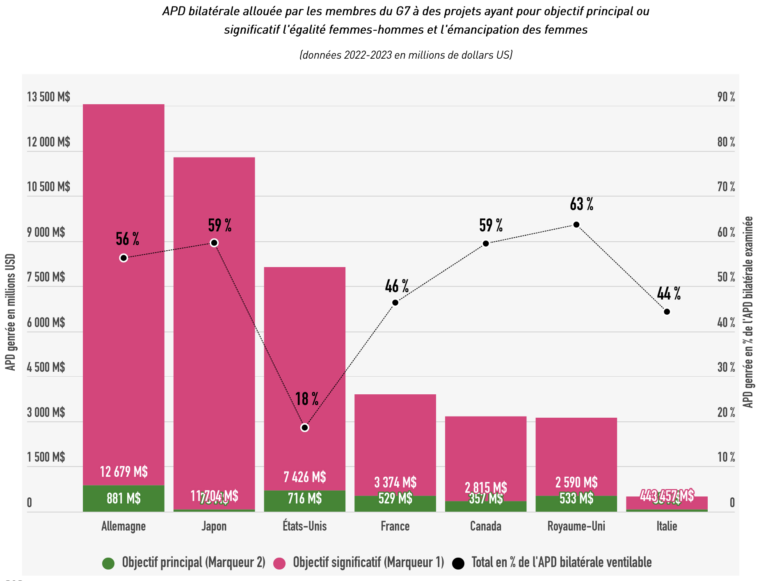
    Which G7 countries consider gender equality in their foreign aid?

    At-a-glance: discover the OECD’s Development Assistance Committee (DAC) assessment of G7 member states' financial support for gender equality around the world.
    Gender equality - 26 January 2026

    Spain’s new Feminist cooperation strategy : Scope and orientations

    Spain unveils its new Feminist Cooperation Strategy, designed to structure and operationalize the integration of gender equality throughout its international cooperation policy. Rooted in multilateralism and the 2030 Agenda, this strategy proposes a feminist, intersectional, and transformative approach aimed at addressing the structural causes of inequality and transforming power relations. Analysis.
    News - 12 March 2025

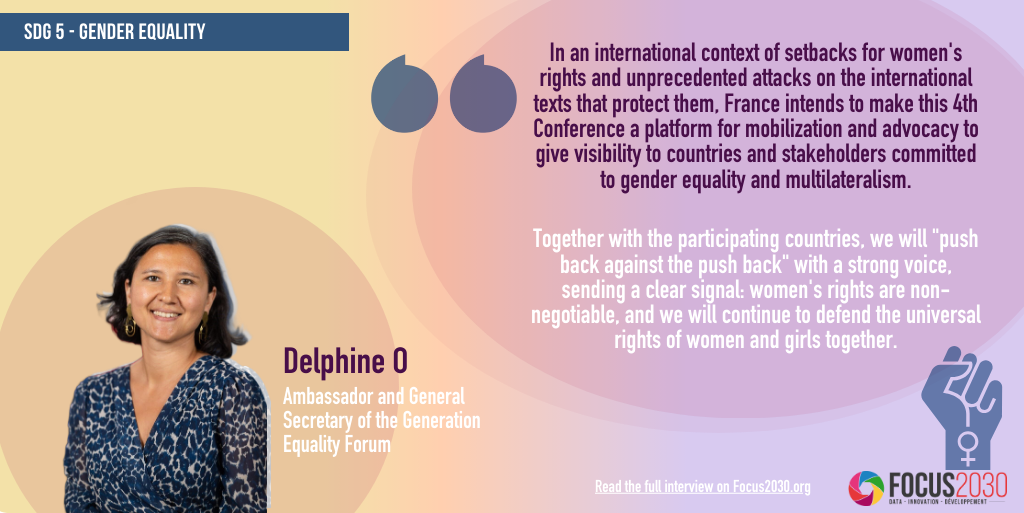
    3 questions to Delphine O, Ambassador and General Secretary of the Generation Equality Forum

    As part of its special edition on the state of inequality in the world in 2025, Focus 2030 wants to put forward the stakeholders who work to help achieve gender equality on a daily basis.       3 questions to Delphine O, Ambassador and General Secretary of the Generation Equality Forum Focus 2030 : In […]
    Gender equality - 07 March 2025

    State of gender inequality in the world – 2025 edition

    What is the state of gender inequality in the world in 2025? Discover our special report.
    Interviews en - 07 March 2025

    3 questions to Neil Datta, Executive Director and Founder, European Parliamentary Forum for Sexual and Reproductive Rights

    As part of its special edition on the state of inequality in the world in 2025, Focus 2030 wants to put forward the stakeholders who work to help achieve gender equality on a daily basis.   The European Parliamentary Forum for Sexual and Reproductive Rights a network of Members of Parliament throughout Europe who are committed […]
    Gender equality - 16 February 2025

    Overview of data resources on gender equality across the world

    Overview of the resources to understand gender inequalities around the world in key areas.