Contact

  • Français
  • Español
  • Surveys - Analysis
    Français    

    Can we end global poverty without first solving gender inequality?

    Published on 14/12/2018.

    50% of French people think that solving global poverty will not be possible without gender equality.

    This implies that, setting aside the economic aspects most often associated with development in poor countries, most French people also seem to think that poverty is also caused by social issues such as gender inequality.

    These results offer an interesting insight into how gender equality is perceived in France. Instead of a ’progressive’ or social justice issue, gender equality seems to be an essential pre-cursor of society with multiple consequences and impact, including poverty and development.

    Women are more likely than men to agree with the statement that it is not possible to solve poverty without first solving gender inequality. But the biggest factor which impacts opinions is for those aged over 50, 59% of whom agree, compared to only 41% for those aged 25-49.

    Those on the left and in the center seem to coalesce around similar responses, notably compared to those on the right.

    This data comes from our survey conducted by the YouGov Institute and piloted by the research team at University College London and the University of Birmingham as part of the project Aid Attitudes Tracker which measures the evolution of opinions and behaviors on issues of international solidarity in four countries.

    To learn more
  • Retrouvez la méthodologie du projet Aid Attitudes Tracker
  • Baromètre de la Solidarité Internationale n°3 - Perception des français sur l’égalité entre les sexes, en France et dans les pays en développement
  • ALSO READ

    Gender equality - 18 June 2026

    Feminist Foreign Policies: Key Takeaways from the 5th Ministerial Conference in Madrid

    Held in Madrid on June 2 and 3, 2026, the 5th Ministerial Conference on Feminist Foreign Policy brought together approximately 700 participants, including representatives from around 60 countries and 140 civil society organizations. The 28 signatory states to the final political declaration linked gender equality, democracy, peace, human rights, and accountability, in a context marked by conflicts, democratic setbacks, and anti-rights movements.
    Gender equality - 17 June 2026

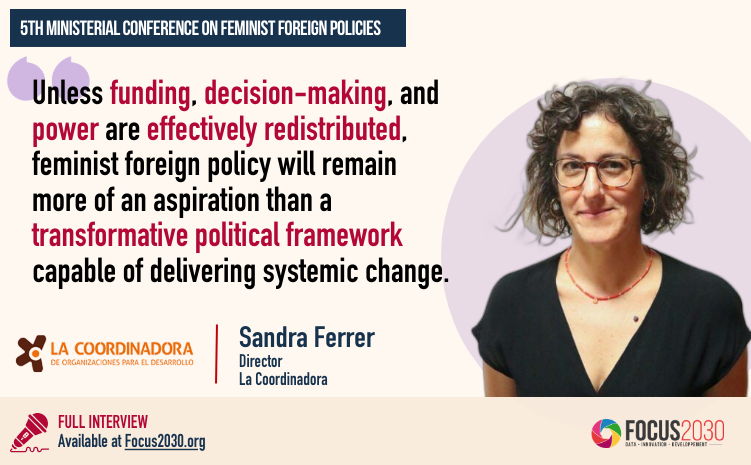
    Interview with Sandra Ferrer, Director of la Coordinadora, on the Fifth Ministerial Conference on Feminist Foreign Policies.

    As civil society organizations face growing restrictions and funding cuts worldwide, Sandra Ferrer examines the role Feminist Foreign Policy can play in protecting civic space, supporting feminist movements, redistributing power and resources and advancing more equitable and inclusive forms of international cooperation.
    Special Edition - 29 May 2026

    5th Ministerial Conference on Feminist Foreign Policies: Building Peace and Promoting Democracy

    Spain will host the 5th Ministerial Conference on Feminist Foreign Policies on June 2–3, 2026, a major gathering focused on strengthening international alliances, defending existing achievements, and turning political commitments into concrete funding and accountability mechanisms.
    Gender equality - 28 May 2026

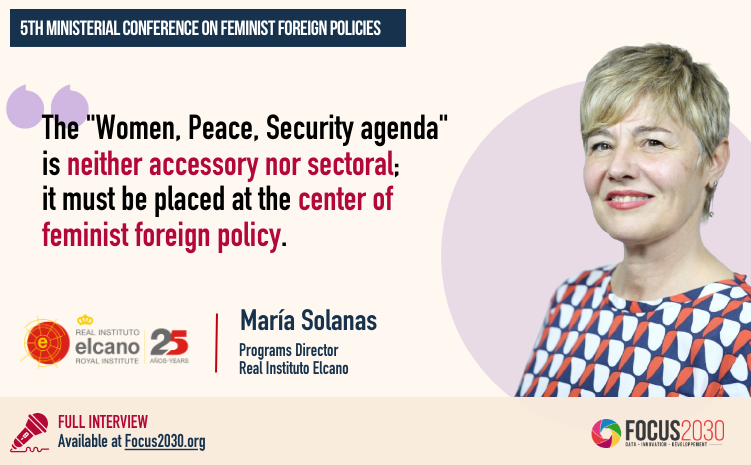
    Interview with María Solanas, Programs Director, Real Instituto Elcano, ahead of the 5th ministerial conference on feminist foreign policies

    Against an international backdrop marked by geopolitical tensions and a rise in violations of women’s rights, María Solanas analyzes the challenges facing feminist foreign policy today, as well as the tools needed to strengthen the “Women, Peace, and Security” agenda.
    Gender equality - 28 May 2026

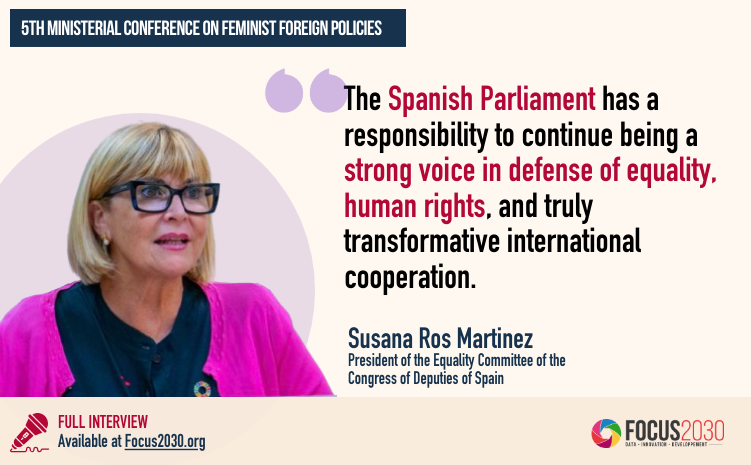
    Interview with Susana Ros Martinez, President of the Equality Committee of the Congress of Deputies of Spain, ahead of the Fifth Ministerial Conference on Feminist Foreign Policies.

    At a time marked by setbacks in women’s rights and the rise of anti-gender narratives, Susana Ros Martinez discusses the priorities of Spain’s feminist foreign policy, the challenges of ensuring its long-term sustainability, and the role of Parliament and international institutions in defending equality and human rights.
    Gender equality - 08 April 2026

    Gender equality in philanthropy in France: assessing a still limited level of engagement

    Why is gender equality persistently underfunded by the philanthropic sector? To answer this question, the Coalition for Feminist Philanthropy, a group of twelve funders, commissioned Agence Phare to analyze the role of gender equality in French philanthropy. Published in 2025, this study aims to identify, quantify, and analyze the funding allocated to this cause. Summary of key findings and recommendations for action.