France Redefines Its Approach to International Partnerships
On April 6, 2025, the last meeting of the Presidential Council for International Partnerships was held, a body whose mission is to set guidelines for France’s development and international solidarity policy. The Council’s conclusions reveal new ambitions for France’s international action, envisaging nothing less than a paradigm shift in official development assistance. The change of name alone illustrates this desire. Analysis.
A New Policy for France’s International Partnerships?
The Presidential Council for International Partnerships, formerly “for development”, unveils France’s new strategic priorities, with the aim of moving away from “dependencies on development aid” by tackling the reform of the international financial architecture and the structural causes of poverty and inequalities.
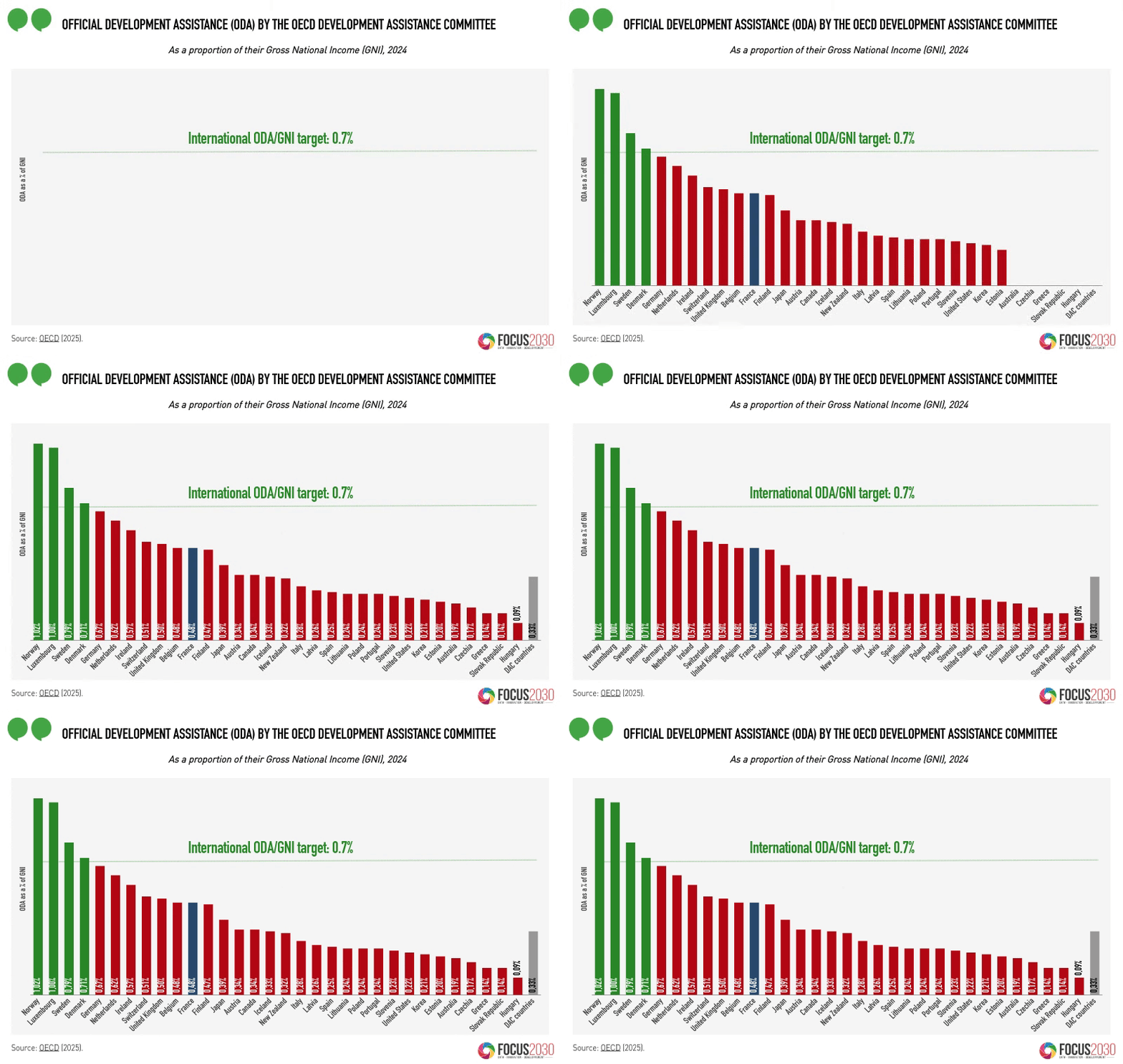
At a time when France is facing an unprecedented contraction of its fiscal space (with public deficit and public debt respectively at 6% and 113% of GDP at the time of writing), the conclusions of the Presidential Council are unequivocal: it will be necessary to do better with less by maximizing organizational efficiency, leverage and impact in the field.
A Concentration of Financial Support on the Most Vulnerable Countries That Deserves Further Elaboration
Despite these constraints, the French government is now committed to devoting at least 60 % of its grants to the most vulnerable countries, understood as the least developed countries, or LDCs , and countries that are particularly vulnerable to climate change or in situations of great financial fragility according to the UN’s Multidimensional Vulnerability Index (MVI). The list of countries selected according to these criteria has not yet been made public. France also reaffirms its support for conflict-affected countries, particularly Ukraine.
This aim to concentrate the country’s financial efforts on the most vulnerable countries is welcome, insofar as France’s action is designed to meet the challenge of poverty in the most fragile countries, thus respecting the spirit of Agenda 2030, which aims to “leave no one behind”.
Towards New Geographic and Thematic Priorities?
However, the implementation of such an ambition raises questions. To date, the LDCs include no less than 44 States, to which France intends to add a series of vulnerable countries as defined by the new United Nations indicator. Considering that France has reduced its budget for official development assistance by 37 % (which funds most grants) between 2024 and 2025, expanding the number of recipient countries is likely to have the mathematical consequence of increasing the dispersal of France’s ODA, which runs counter to the desired effect…
The geographical priorities are focused on the African continent, the Indo-Pacific region, and the European neighborhood.
France’s action in the field of international solidarity remains focused on 10 sectoral objectives, including environmental and climate protection, education, health, entrepreneurship, strategic infrastructure, youth, food sovereignty, human rights, gender equality and the fight against illegal immigration.
These objectives must apply to all operators, instruments and financing.
In the context of bilateral relations, three of these objectives should be given priority in each country strategy (with the notable exception of the fight against illegal immigration, which may be included in addition).
At the multilateral level, France now intends to review its commitments to international organizations in light of those ten strategic priorities and the influence it holds within those organizations.
Towards an Explicitly Transactional Approach?
These new directions now unapologetically assume the search for a “return on investment”, from a diplomatic as well as an economic and security angle. However, this approach needs to be carefully scrutinized to ensure that “tied aid”, a practice prohibited by the OECD, does not resurface, nor other transactional approaches currently popular across the Atlantic…
These broad guidelines will be translated into operational terms by the Interministerial Committee for International Cooperation and Development, to be held under the authority of the Prime Minister between now and June 2025.