Contact

  • Français
  • Español
  • AnalysisReports
    Français    Español    

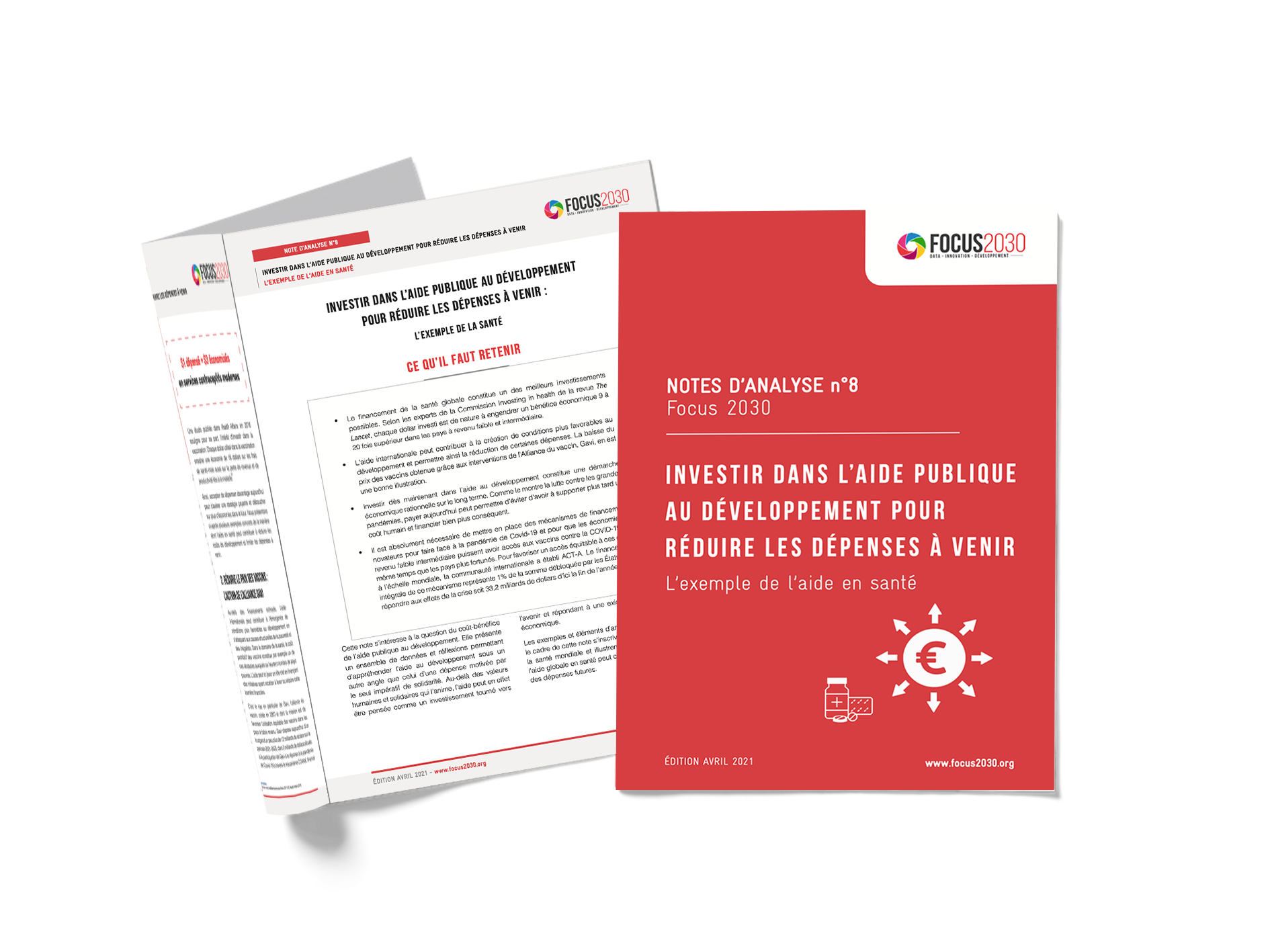
    Policy Brief n°8: How investing today can reduce the need for aid tomorrow: health as a case study

    Published on 08/05/2021.

    Official development assistance (ODA) is regularly criticised for being unnecessary, or ineffective. However, when it comes to addressing health challenges in developing countries, there is widespread support for the provision of funding to the poorest.

    In this way, the perception of effectiveness or “value for money” can be correlated to certain sectors where ODA is seen as a worthwhile investment now, to reduce further spending in the future. This is the case for global health aid, which is one of the best possible investments in terms of a cost-benefit assessment.

    According to the experts of The Lancet’s “Investing in Health” commission, every dollar invested generates an economic return of of 9-20 dollars in developing and middle-income countries.

    An excellent example is the fall in costs for vaccinations thanks to donor investment in a new global vaccine initiative, GAVI.

    The same is true of global pandemics, where investing now in prevention and treatment of diseases (such as HIV) can help avoid much higher human and economic costs further down the line. Or polio: according to figures from the Global Polio Eradication Initiative (GPEI), completely eradicating polio would save between 40 and 50 billion USD in health costs and from loss of productivity. And yet, according to the World Health Organisation, a lack of political will for a final push might mean that the few dozen remaining cases of polio a year could rise to 200,000 annually within the next ten years.

    You can download the Policy Brief n°8 in French here. An English translation is forthcoming.
    To learn more
  • Note d’analyse n°8 : Investir dans l’aide publique au développement pour réduire les dépenses à venir, l’exemple de l’aide en santé
  • ALSO READ

    Development financing - 04 June 2026

    Reforming the international financial architecture: where do we stand?

    Focus 2030 Reforming the international financial architecture: where do we stand? Focus 2030 independently tracks the commitments made at the Summit for a New Global Financing Pact in 2023. Updated on an ongoing basis, this tracker documents progress towards reforming the international architecture for development and climate finance. Access the tracker Download the report · […]
    G7 - 02 June 2026

    Financing international development: the decisive role of G7 countries in a context of disengagement

    Special feature: French G7 Presidency Explore our special report to understand the issues related to the French G7 Presidency in 2026, gain insight into the key policy priorities, and follow the latest updates. Access the special report ➔ In 2026, France’s G7 Presidency aims to bring development financing back to the forefront of the international […]
    Analysis - 18 May 2026

    In Nairobi, the Africa Forward Summit signals a shift toward a new Franco-African development finance doctrine

    Co-hosted by France and Kenya on 11-12 May 2026, the Africa Forward Summit marked an attempt to redefine relations between France and the African continent around a new narrative: one centered on equal partnership, private investment, and strategic autonomy. Behind the €23 billion in announced commitments, the summit also reflects a deeper transformation: the explicit […]
    Development financing - 09 April 2026

    Historic drop in Official Development Assistance in 2025

    ODA from DAC members fell to 174.3 billion USD in 2025, a 23.1% drop from 2024 (-50 billion USD in real terms), representing 0.26% of their income. It is the highest fall on record. 
    Development financing - 30 March 2026

    The African Development Fund: allocating concessional resources to the 37 most vulnerable countries on the continent

    As the 17th replenishment of the African Development Fund (ADF-17), held on 15-16 December 2025 in London, draws to a close, expressed financing needs from beneficiary countries have reached USD 25 billion. In a context of mounting budgetary pressures among traditional donors, a central question emerges : will international mobilization be sufficient to meet the challenges ?
    G7 - 09 February 2026

    G7 France 2026 : focus on development matters, key challenges, debates and emerging priorities

    In 2026, France holds the presidency of the G7, with the Heads of State Summit scheduled to take place in Evian from June 15 to 17. Keep up with the latest news.