Spain’s new Feminist cooperation strategy : Scope and orientations
Published on26/01/2026.
This commitment is part of a long-term dynamic that goes beyond political alternations. As early as October 2015, Spain played a key role by bringing United Nations Security Council Resolution 2242 on women, peace and security onto the agenda, marking an important milestone in its international commitment to gender equality. This orientation was progressively consolidated over the years, before being formalized and strengthened through the adoption of a Feminist Foreign Policy in 2021, which made gender equality a structuring priority of Spain’s diplomatic action.
This commitment, however, unfolds within an international context increasingly marked by resistance to equality policies. In many countries, organized movements are undermining the rights of women and LGBTQIA+ persons, as well as policies promoting gender equality, diversity, and inclusion. These actors, often referred to as “anti-rights” or “anti-gender” movements, have growing financial resources and increasing influence over public debates and political decision-making processes.
According to the report The Next Wave by the European Parliamentary Forum (EPF), Spain is identified as one of the countries from which funding supporting anti-gender initiatives was provided between 2019 and 2023, from non-state actors, including private, religious, or civil society organizations. In this context of heightened polarization, and despite growing resistance to gender equality policies internationally, a broad and lasting consensus has persisted within Spain’s institutions and across successive governments regarding the importance of gender equality in its external action.
Against this backdrop the adoption of the new Feminist Cooperation Strategy of Spanish Cooperation in December 2025 carries a strong political dimension, reaffirming the State’s commitment to human rights, gender equality, and multilateralism.
This new strategy serves as the reference framework for the entire scope of Spanish international cooperation. It aims to translate political commitments into concrete operational guidelines applicable across all cooperation instruments, including development cooperation, humanitarian action, multilateral cooperation, and financial cooperation.
The strategy reflects Spain’s commitment to multilateralism, the United Nations Sustainable Development Goals (SDGs), and international frameworks for the protection of human rights and gender equality. It builds on the framework established by the Feminist Foreign Policy Guide (2021) and the Action Plan for Feminist Foreign Policy (2023–2024), and is embedded within a strengthened legal and strategic context established by Law 1/2023 on Cooperation for Sustainable Development and Global Solidarity, which enshrines gender equality and women’s rights as central objectives of Spanish cooperation policy.
The adoption of this strategy also takes place within a proactive international dynamic : Spain is hosting this year’s upcoming international conference on feminist foreign policies.
Beyond a statement of principles, the strategy offers a political, intersectional, and transformative approach to gender equality. It recognizes inequalities as structural and intertwined with other forms of discrimination, and emphasizes the need to transform power relations, both within partner countries and within the very practices of international cooperation.
This analysis provides a synthesis of the new strategy, outlining its political framework, priorities, action pillars, and the mechanisms established for its implementation, monitoring, and evaluation.
Feminist cooperation as a tool for transformation
« We define feminist development cooperation as an approach that addresses structural gender inequalities through an intersectional lens, by transforming the power structures that sustain them in order to achieve equitable and sustainable redistribution.»
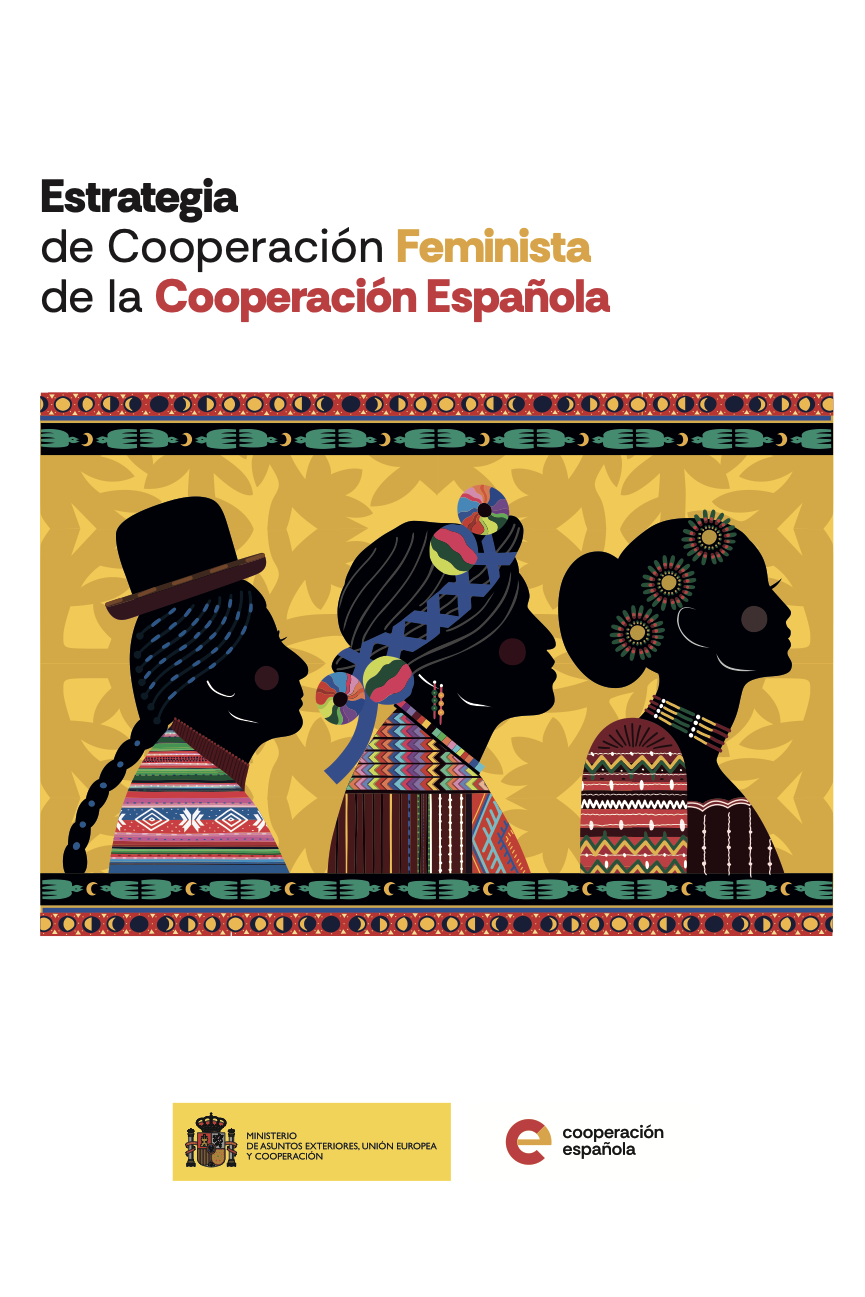
The strategy moves beyond an approach limited to so-called “gender projects.” It puts forward a political definition of feminist cooperation : focused on addressing the root causes of inequalities and the power relations that sustain them. Feminist cooperation is defined as cooperation that:
- places human rights at the center, explicitly including women, girls, and LGBTQIA+ persons;
- targets structural inequalities (social norms, access to decision-making, control over resources, violence and discriminations)
- seeks a lasting transformation of power relations, rather than technical adjustments.
The strategy adopts an intersectional approach, recognizing that gender inequalities are compounded when combined with other factors (age, disability, origin, migratory status, or sexual orientation). The strategy draws attention to groups that are particularly exposed to these intersecting forms of discrimination, including girls and adolescent girls, LGBTQIA+ persons, women with disabilities, older women, and Indigenous and Afro-descendant women.
Cross-cutting approaches
The strategy calls for the integration of several cross-cutting perspectives across all actions, from the design phase through implementation and monitoring:
- Human rights, with a particular emphasis on sexual and reproductive rights, understood both as a public health issue and as a central component of gender equality.
- The fight against poverty and inequalities, acknowledging the “feminization of poverty” (the burden of unrecognized care work, precarious employment, informal work, discrimination in labor markets, and limited access to resources).
- Climate justice and environmental sustainability, through an ecofeminist perspective attentive to the differentiated impacts of crises.
- Cultural diversity, with attention to multilingualism and intercultural dialogue.
- Peace and security, through the “humanitarian–development–peace” nexus and the “Women, Peace and Security” Agenda, highlighting in particular the use of sexual violence as a weapon of war and the importance of women’s participation in peace processes.
The four pillars guiding Spain’s international action on gender equality
The strategy is structured around four pillars: rights, representation, resources, and alliances.
Pillar 1 – Rights
This pillar aims to ensure that all women, adolescents, and girls, in all their diversity, can live free from violence and fully exercise their rights. It includes :
- preventing and responding to all forms of gender-based violence (sexual, economic, and digital) as well as harmful practices (child marriage, female genital mutilation);
- strengthening the protection of victims and survivors (access to services, support mechanisms, and legal frameworks);
- addressing trafficking and exploitation, particularly in crisis and conflict settings;
- ensuring access to justice and the strengthening of judicial systems;
- promoting economic and workers’ rights, including access to higher-paid sectors;
- recognizing care as a central issue : the right to provide care, to receive care, and to care for oneself.
Pillar 2 – Representation
This pillar aims to facilitate women’s participation in political, economic, cultural, and social decision-making, as well as to promote their leadership.
It includes:
- promoting civil and political rights and meaningful participation;
- strengthening public policies and institutional mechanisms for gender equality;
- fostering empowerment and leadership in spaces of social, economic, and cultural dialogue;
- recognizing and redistributing care work (both paid and unpaid);
- developing health systems;
- ensuring women’s participation in humanitarian action, crisis management, and peacebuilding.
Pillar 3 – Ressources
The strategy recognizes that there can be no credible feminist cooperation without sufficient human and financial resources.
It foresees :
- institutionalizing a feminist approach across all levels of Spanish cooperation institutions;
- training for staff and the prevention of sexual exploitation and abuse;
- increasing funding dedicated to gender equality and women’s rights, including flexible, multi-year, and accessible funding adapted to the realities of local feminist organizations;
- improving access to funding for feminist organizations, including smaller ones;
- supporting gender-sensitive budgeting and the production of knowledge on the care economy;
- encouraging access to credit and productive resources, especially for rural women and those working in the informal economy.
The strategy also identifies a past limitation: gender equality has been primarily funded through projects and international organizations. It therefore calls for the diversification of instruments, such as sectoral budget support or debt relief, and the development of a long-term, better-coordinated vision.
Focus on the Compromiso de Sevilla: A Turning Point for Gender-Responsive Development Finance
Adopted at the International Conference on Financing for Development in Seville, the Compromiso de Sevilla strengthens the integration of gender equality into the sustainable development financing agenda. The document explicitly affirms:
- the recognition of women’s rights as a prerequisite for sustainable development;
- the feminization of poverty;
- the need to invest in the care economy;
- a clear commitment to eradicate gender-based violence.
The Compromiso de Sevilla sets out concrete policy orientations across several key areas:
- Taxation : the promotion of gender-responsive budgeting and tax systems;
- Private finance : support for women’s economic empowerment and access to finance;
- Trade : enhanced integration of women-led enterprises into global value chains;
- Economic governance : a call for gender parity within international financial institutions;
- Science, innovation, and digitalization : targeted measures to reduce the gender digital gap;
- Data: strengthened production, availability, and use of sex-disaggregated data.
Pillar 4 – Alliances
Alliances are a central pillar of the strategy : voluntary partnerships in which actors share objectives, responsibilities, resources, and risks. The strategy seeks to foster more horizontal partnerships that are better suited to collaborate with feminist organizations.
The priorities include :
- strengthening partnerships with feminist and women’s organizations, particularly at the local level;
- moving beyond a “donor–beneficiary” logic and promote the expertise and leadership of local actors;
- supporting women human rights defenders, including those working on land and environmental rights;
- developing cooperation with universities and research centers to produce and share feminist knowledge;
- mobilizing local and regional authorities and the private sector around SDG 5, with clear requirements related to social standards and human rights.
The text also highlights the specific role of parliaments and parliamentarians, as well as the potential of parliamentary diplomacy, in building political consensus and supporting cooperation policies.
The mobilization of all cooperation instruments
The strategy applies across all modalities of Spanish cooperation: bilateral, multilateral, humanitarian, financial cooperation, development education, and decentralized cooperation. It emphasizes coherence, calling for the integration of the feminist approach from the design phase through implementation, and into monitoring and evaluation.
At the international level, Spain relies on European partnerships (DG INTPA, ECHO), multilateral partnerships (UN Women, UNFPA, ECLAC), and the OECD (Development Assistance Committee, GENDERNET network, SIGI Index, EPIC Coalition). The strategy also highlights cooperation with countries that have adopted a feminist foreign policy, networks of feminist and women’s organizations, and the specific role of an Ambassador for Feminist Foreign Policy within the Spanish Ministry of Foreign Affairs.
At the national level, governance is based on a broad ecosystem of actors coordinated by the Ministry of Foreign Affairs, European Union and Cooperation (MAUC), particularly through the Secretary of State for International Cooperation (SECI), the Directorate-General for Sustainable Development Policies (DGPOLDES), and the Spanish Agency for International Development Cooperation (AECID). This framework is complemented by several ministries, including the Ministries of Equality, Inclusion and Migration, Health, Interior, Social Rights, and Justice, as well as judicial institutions such as the General Council of the Judiciary and the Office of the Prosecutor General.
Monitoring, evaluation, and knowledge management
Spanish Law 1/2023 requires Spanish cooperation to establish a structured system for monitoring its actions. This monitoring has to be carried out by the entities implementing the projects and should combine a quantitative dimension, covering funding, resources mobilized, and results achieved; with a qualitative dimension aimed at analyzing progress, coherence, and the transformative and intersectional nature of the strategy. Evaluation constitutes another central pillar of the system. It is coordinated by the newly established Office of Evaluation of Spanish Cooperation (OECE), under the responsibility of the Secretary of State for International Cooperation.
Data is a core priority : the strategy promotes the use of sex-disaggregated indicators, as well as indicators able to measure deeper changes (power relations, redistribution of care, and reductions in rights gaps) across all Spanish cooperation actions, not only projects explicitly dedicated to gender.
Gender-responsive ODA: where does Spain stand?
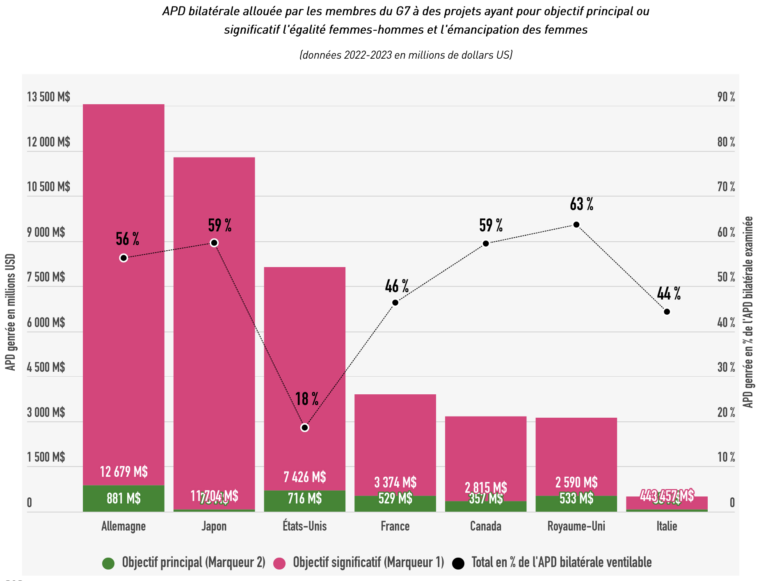
Spain is one of only two countries, alongside the Netherlands, to allocate at least 20% of its official development assistance (ODA) to the direct promotion of gender equality. On average, over the 2022-2023 period, 50% of its bilateral aid contributed to gender equality, including 23% with gender equality as the principal objective (USD 291 million) and 28% as a significant objective (USD 353 million).
Spain ranks as the 6th largest donor in terms of funding to women’s rights organizations and movements, as well as governmental institutions, providing an average of USD 47 million over the 2022–2023 period.
The strategy sets a quantitative target for the integration of gender into interventions, establishing a clear benchmark: at least 60% of new interventions should generate development outcomes that are clearly positive for gender equality, as a first step toward the 85% target established by the European Union Gender Action Plan (GAP III).
However, this target focuses on the quality and orientation of interventions, not on the financial volumes mobilized. The strategy does not define a dedicated budget trajectory or set quantitative targets for the proportion of official development assistance allocated to gender equality. The realization of its ambitions will therefore depend largely on financial decisions, the ability to align resources with stated priorities, and the effective implementation of monitoring mechanisms.