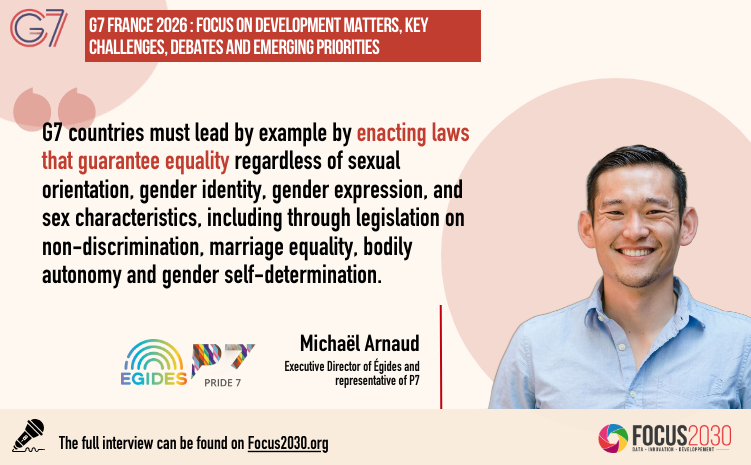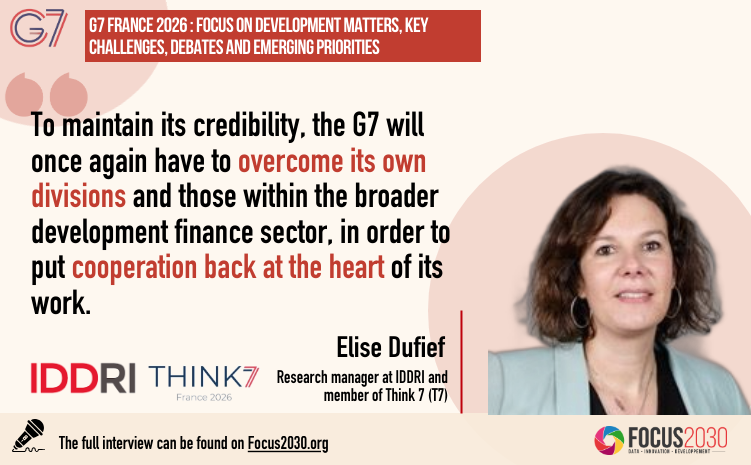
Interview with Michaël Arnaud, Executive Director of Egides and P7 representative on the occasion of the French Presidency of the G7.
Published on .
This interview is part of Focus 2030’s G7 France 2026 Special Edition
Explore Focus 2030’s Special Edition on the French G7 Presidency, with background information, analysis and resources to follow development issues, international financing, global public goods and the main milestones of the 2026 G7 agenda.
Read the Special Edition →Interview with Michaël Arnaud, Executive Director of Egides and P7 representative on the occasion of the French Presidency of the G7M
Focus 2030: The recent expansion of the “Global Gag Rule” by the U.S. administration could have significant consequences for funding dedicated to the health and rights of LGBTQIA+ people in Global South countries. In this context, what responses does the Pride 7, the official G7 engagement group dedicated to promoting and protecting LGBTQIA+ rights, intend to bring to G7 members?
Michaël Arnaud: Concretely, what this policy means is that today, in several countries in West Africa and Southeast Asia, health organizations can no longer legally inform their trans patients about the care they need. They can no longer mention certain treatment options. Not because the care is prohibited in their countries, but because one word spoken could cost them the U.S. funding that keeps their organizations alive.
This is what the expansion of the “Global Gag Rule” does. It is not just a budgetary restriction. It is a political weapon. It fuels the stigmatization of trans people, encourages the return of “conversion therapies,” and silences organizations that provide vital, evidence-based care. By targeting freedom of expression, it paves the way for the adoption of anti-rights legislation targeting trans and non-binary communities, without any countervailing power able to oppose it. It also constitutes an explicit attempt by the U.S. administration to export its anti-DEI agenda to other countries around the world.
In response, Pride 7 is calling on the G7—and particularly the French presidency—to take three concrete actions.
First, to publicly condemn this expansion and acknowledge its impact on public health, gender equality, and the rights of LGBTQI+ people, particularly trans, non-binary, and intersex individuals.
Second, to protect multilateral mechanisms and the sovereignty of aid-recipient states against the political, ideological, and financial pressure exerted by the United States, as reforming international aid cannot come at the expense of censorship or the rollback of human rights.
Third, to mobilize additional and predictable financial resources to make up for the deficit created by the massive withdrawal of U.S. aid and to ensure the continuity of essential services.
International aid must remain a tool of solidarity, grounded in human rights, and must not become an instrument of political coercion.
Focus 2030: In a context marked by the massive withdrawal of U.S. aid and the risks it poses to the continuity of essential services, what avenues can the G7 support to mobilize additional, predictable, and rapidly accessible financial resources for the most affected countries, as well as for LGBTQIA+ organizations that play a crucial role in service provision and rights advocacy?
Michaël Arnaud: Here is one figure that, on its own, captures the scale of the problem: between 2021 and 2022, according to the Global Philanthropy Project, the three largest anti-gender organizations in the world raised one billion U.S. dollars. That is more than what the 8,000 leading LGBTQI organizations worldwide were able to raise collectively over the same period.
In other words, the financial balance of power is entirely skewed—and it already was before the U.S. withdrawal. Today, the weakening of the international aid system is further exacerbating this asymmetry, directly benefiting extremely well-organized, globally coordinated anti-rights movements.
The concrete effects are already visible. More and more countries are adopting or strengthening laws criminalizing same-sex relationships—Uganda, Mali, Niger, Burkina Faso, Senegal, Ghana, among others. Some are going even further by actively shrinking civic space, banning the promotion and funding of any activities related to protecting LGBTQI rights.
Pride 7 has welcomed the French presidency’s prioritization of reforming official development assistance. However, we regret that this reflection does not sufficiently address the protection of democracy, the rule of law, and human rights, nor does it fully recognize—commensurate with their role—the civil society actors who make this aid effective on the ground.
In line with Women 7 and Civil 7, Pride 7 emphasizes one principle: supporting civil society is not a charitable option—it is a condition for democracy. Without adequate, sustained, and predictable funding, and without genuine recognition of the role of LGBTQI organizations in decision-making processes, hundreds of structures risk disappearing in the coming months—and with them, services that save lives every single day.
Focus 2030: In an international context marked by a growing backlash against LGBTQIA+ rights on the global stage, what levers is Pride 7 using to secure concrete commitments on protection, equality, and access to essential services within multilateral institutions?
Michaël Arnaud: During this Pride Month, as hundreds of marches take place around the world, it is useful to recall what they are for. Pride marches are not just celebrations—theyare civic spaces. Visible moments where communities assert their right to exist, to speak, and to gather. They are also, increasingly, spaces under threat.
The backlash against LGBTQI rights is not a spontaneous phenomenon. It is a coordinated attack, driven by powerful anti-gender movements at every level—local, national, and global. In recent months, we have witnessed a rapid deterioration in multilateral spaces such as the Commission on the Status of Women and the Commission on Population and Development. In these forums, which were designed to protect peace, democracy, and human rights, there are now efforts to erase the existence of LGBTQI communitiesaltogether.
In response, Pride 7 acts on three fronts:
- First, national leadership. G7 countries must lead by example by adopting laws that guarantee equality regardless of sexual orientation, gender identity and expression, and sexcharacteristics—particularly through non-discrimination legislation, marriage equality, bodily autonomy, and gender self-determination.
- Second, leadership in multilateral spaces. This domestic commitment must translate into firm positions within international institutions to protect multilateral mechanisms from political and financial pressure from the United States, and to reaffirm that international aid is a tool of solidarity grounded in human rights.
- Finally, the protection of civic spaces. Pride marches—and more broadly, the spaces occupied by LGBTQI movements—serve as safeguards against authoritarian drift. Today, thesespaces are under threat of disappearance. If we allow them to vanish, the void they leave will inevitably be filled by the far right and anti-gender hatred.
Note: The views expressed in this interview do not necessarily reflect those of Focus 2030.
This interview is part of Focus 2030’s G7 France 2026 Special Edition
Explore Focus 2030’s Special Edition on the French G7 Presidency, with background information, analysis and resources to follow development issues, international financing, global public goods and the main milestones of the 2026 G7 agenda.
Read the Special Edition →