Interview with Her Excellency Betty Cherwon, Ambassador of Kenya to France, on the occasion of the French Presidency of the G7
Published on .
This interview is part of Focus 2030’s G7 France 2026 Special Edition
Explore Focus 2030’s Special Edition on the French G7 Presidency, with background information, analysis and resources to follow development issues, international financing, global public goods and the main milestones of the 2026 G7 agenda.
Read the Special Edition →Interview with Her Excellency Betty Cherwon, Ambassador of Kenya to France, on the occasion of the French Presidency of the G7
Focus 2030: The Africa Forward Summit, held in Kenya in May, brought together African and French partners around innovation and growth, with conclusions intended to feedinto the preparation of the G7 Summit. Which discussions initiated in Nairobi will be continued in Évian?
Betty Cherwon: The Africa Forward Summit was held in Nairobi, Kenya on 11th and 12th May 2026 and brought together African and French partners to deliberate on global economic issues. The discussions in Nairobi are expected to dovetail into the G7 summit of which Kenya has been invited as a partner country and has had the opportunity to sit at the discussion table, deliberate issues on the global agenda, and help shape outcomes.
The discussions initiated in Nairobi recognize the profound transformations shaping the global economic, technological, environmental and geopolitical landscape. President Ruto will carry Africa’s voice to the summit taking issues initiated in Nairobi that include;
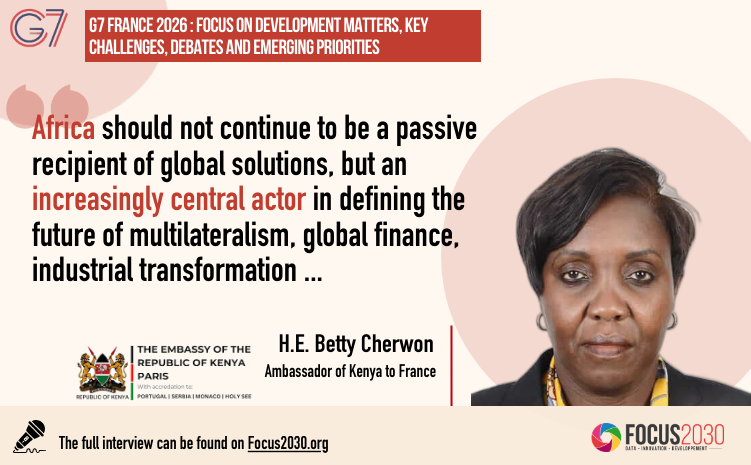
A call for action on tackling the consequences of global excessive imbalances for Africa, Renewal of International partnerships and solidarity with Africa and a declaration for peace in Africa. A clear message from the Africa Forward Summit was that the existing international order no longer adequately reflects contemporary realities and therefore Africa must play a central role in shaping a more just, representative, and effective global system. Africa should not continue to be a passive recipient of global solutions, but an increasingly central actor in defining the future of multilateralism, global finance, industrial transformation, peace and security as well as climate and development cooperation.
Focus 2030: As Kenya participates in the G7 as an invited country, what priorities does it intend to bring into the discussions, particularly on development financing, debt, climate, and food security, and how does it aim to contribute to a stronger consideration of African positions beyond its status as an invited participant ?
Betty Cherwon: Kenya outlines priorities to include, development financing – Enhanced coordination among Multilateral development Banks including World Bank to harmonize financingapproaches and reduce inefficiencies therefore increasing resource allocation for Africa’s development challenges.,
Debt sustainability to be supported by responsible lending and borrowing practises There is need to strengthen debt resolution mechanisms by improving efficiency and predictability
climate – There is need to scale up predictable and affordable climate finance, including climate and disaster risk financing and insurance mechanisms to enable vulnerable countries to respond effectively to shocks without exacerbating debt vulnerabilities. Climate finance needs to be rebalanced toward grant-based and concessional instruments, particularly for adaptation purpose. An investment ni food systems, agro-processing and supply chains wil reduce external dependency, simplification of access to climate and developments finance standardization, and reduction of approval timelines to improve disbursement speed for vulnerable countries and food security.
Focus 2030: France has positioned mutually beneficial international partnerships as a core priority of the G7 agenda. What, in your opinion, are the key conditions required to build such partnerships ?
Betty Cherwon: Mutually beneficial International partnerships requires restoring balance in the global economy by empowering nations to build sovereignty through sustainable debt management and long-term investment. Africa’s economic sovereignty is constrained by debt. A reformed approach to sovereign debt must be guided by transparent comparability of treatment among creditors. Debt- for-development and debt-for-climate swaps coupled with reforms of credit rating methodologies that systematicallypenalize developing country borrowers are to be prioritized.
Conditions for mutually beneficial partnership include increasing resource flows which are directed through channels that build local institutional capacity rather thansubstituting for it and a new partnership that moves beyond aid relationships towards equal co-investment partnerships.
Fair opportunities, equitable partnerships and a seat where global economic decisions are made will ensure mutually beneficial international partnerships.
Note: The views expressed in this interview do not necessarily reflect those of Focus 2030.
This interview is part of Focus 2030’s G7 France 2026 Special Edition
Explore Focus 2030’s Special Edition on the French G7 Presidency, with background information, analysis and resources to follow development issues, international financing, global public goods and the main milestones of the 2026 G7 agenda.
Read the Special Edition →