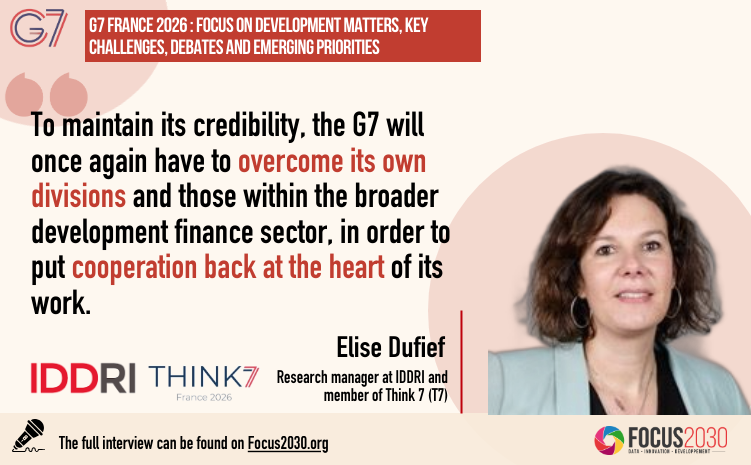
Interview with Élise Dufief, research manager at IDDRI and member of Think 7 (T7) in the occasion of French presidency of the G7.
Published on .
This interview is part of Focus 2030’s G7 France 2026 Special Edition
Explore Focus 2030’s Special Edition on the French G7 Presidency, with background information, analysis and resources to follow development issues, international financing, global public goods and the main milestones of the 2026 G7 agenda.
Read the Special Edition →Interview with Élise Dufief, research manager at IDDRI and member of Think 7 (T7) in the occasion of French presidency of the G7.
Focus 2030: The international financial architecture for development reform is a priority of the G7 this year. Facing persistent vulnerabilities and the multiplication of crises in several countries, what recommendations does the Think 7 propose for sustainable financing of development?
Élise Dufief : The G7 is committed in pursuing the reform about international financial architecture for development, which started under the precedent presidencies of the G7 (Italy, India, Brazil). Progress has been accomplished, but the application is still partial. These reforms are facing a historic environmental change; the G7 countries are making budget cuts in official development assistance andare reinforcing a transactional logic with partner countries who are mobilizing their progress elsewhere.
In the context of questioning the actual international financing system for development, the T7 investigated the role of , institutions at the crossroads of solidarity and investment issues. Major pilar of an evolving ecosystem, aiming to integrate actors and exceed simple ODA. These banks represent indispensable resources but are underutilized because of the fragmentation. In this perspective, the T7 calls for a more efficient integrated system of the banks.
It implies pursuing the reforms engaged by multilateral banks for development, while involving a larger network of public banks for development, allowing international, European, regional and nationals measures. Two principal recommendations are formulated, aiming for the application: 1/ enhance collaboration on the preparation of projects and their application; 2/ develop an integrated financing offer to reduce the risk costs.
These measures aimed to mobilize, in a more coordinated way, financing actors by mobilizing adequate financing in response to countries’priorities. The T7 propose that the G7 countries, at the same time as ‘holders’ of national banks for development and major shareholders of regional and multilateral banks (G7 countries hold 40% in average of votes as shareholders of multilateral banks for development, which gives them an important weight in the strategical governance of these institutions), are taking holds of this agenda to complete the G20and support the dynamic carried by the FICS banks network.
Focus 2030: In regards of growing needs of financing development and climate action, which political, institutional or financial obstacles does the Evian Summit could erase?
Élise Dufief : The ministerial statement for development gives many indicators on the engagements and G7 deliverables, among them the application of the approach of the financing of development that exceeds simple ODA to integrate other dimensions and types of resources including private sectors or interior resources. The statement affirms the structure of relations between countries around mutually beneficial partnerships, whose principals are laid down, but their applications are still to be defined in practice. These engagements are accompanied by a return to the aid efficiency agenda with an issue of adequate use of rare public resources (under the pressure of national electoral topic quite far from international solidarity issues). The G7 countries committed targeting more efficiently (not explicitly increasing) the concessional funds in destination of vulnerable countries who don’t dispose of an alternative solution.
At this point, the issue is not particularly to multiply engagements but ensure their efficient application, which implicates taking political responsibilities and release of matters allowing the coherence of public politics as well as clear allocation funds mechanisms. To be credible, the G7 must overcome its own fragmentation and those of the financial world for development to reinstitute cooperation at the heart of the action. The multiplication of world tensions and crises in various parts of the globe reminds the fundamental interdependence that is influencing the international scene and emphasizes the need for cooperation at a larger scale.
This cooperation and articulation of the actors’ issues are not made by themselves. The G7, in reduction of its economic and political influence, observes its pertinence reconsidered and tormented by opposite forces. The little desire that the United States are showing on issues of international solidarity and fight against climate change, also other states counting (like BRICS and other regional continental leaders) but doesn’t find their place in actual formal spaces and are creating their own around their priorities (access to the development financing, resilience to climate change mechanisms, by going through the creation of principles in the process of production chains). By capitalizing on these processes that overcome the G7 and propose other ways to apprehend the topics, to regional scales, satisfactory answers can be brought. The Evian Summit offers the possibility to these country groups to report their capacity to give and create bridges with others to be more representative of the actual world dynamics and to shaping it actively, or to risk to became obsolete, incapable to adapt to actual imbalances.
Focus 2030: Surpassing the new financial mobilizations, Think 7 reminds the importance of aligning the sustainable development global financing. How to promote profitable and compatible with economic, social and environmental ambitions financing?
Élise Dufief: The historical reduction of ODA announced for the next years and the global restraints that weight public finance are imposing to start afresh practices of development financing. Every dispersion and incoherence has a price. The dynamic isn’t to examine the mobilized finance quality, to maintain a global ambition embodied by the sustainable development goals and the Paris Agreement, andto respond to the needs of countries identified by themselves.
The actual process that investigates the future of international cooperation and its financing must integrate a better awareness of countries needs. The future cannot be without them, at the risk of facing rejection (Sahel), to reproduce extraversion logic and power imbalances (health deals/mines), or reinforce non sustainable situations (dept crises) that contribute to the actual impasses.
We can identify multiples injunctions, sometimes contradictory ones in calls to the mobilization of profitable financing and investment, rooted on countries’ realities, at the same time being capable to answer social – environmental ambitioned requirements. The articulation of these priorities needs several steps. Firstly, it goes with a better knowledge of countries needs. Public and private investments have more chances to produce a sustainable effect when they are integrated into national plans with several long-time issues. It goes with a reflection on the identification of financial channels suitable for its needs. This approach limits the relevance of the aid and open possibilities to direct financing to important sectors for countries who are difficult to finance. Profitability is not only economic (in the private sector sense) but also developmental. It implies to bring funds predictability against disbursment logics or short-term projects, on the contrary to thinking about long-term and structural transformations. Some public banks of development integrate sustainable development goals into their long-term project and adopt an approach aiming to integrate suitable and fair social-economic dimensions with climate into their financial decisions and their project cycles, but only some are doing it in their intervention country. A better financing and investment quality for development couldn’t save on control mechanisms and reinforced follow-up enabling to measure the impact in the field and for funders. Demands of better comprehension of mobilized financial efficacity seem legitimate but can be done only if prioritization processes on the funds and follow-up and evaluation methods are known, shared and supported. These dimensions are a test of efficiency logic and mutually beneficial partnerships advocated by G7 countries, who have the occasion to show the example.
NB: The expressed opinion in this interview doesn’t necessarily reflect Focus 2030 positions.
This interview is part of Focus 2030’s G7 France 2026 Special Edition
Explore Focus 2030’s Special Edition on the French G7 Presidency, with background information, analysis and resources to follow development issues, international financing, global public goods and the main milestones of the 2026 G7 agenda.
Read the Special Edition →