Contact

  • English
  • Español
  • Surveys

    Can we end global poverty without first solving gender inequality?

    Publié le 14/12/2018, modifié le 07/08/2019.

    50% of French people think that solving global poverty will not be possible without gender equality.

    This implies that, setting aside the economic aspects most often associated with development in poor countries, most French people also seem to think that poverty is also caused by social issues such as gender inequality.

    These results offer an interesting insight into how gender equality is perceived in France. Instead of a ’progressive’ or social justice issue, gender equality seems to be an essential pre-cursor of society with multiple consequences and impact, including poverty and development.

    Women are more likely than men to agree with the statement that it is not possible to solve poverty without first solving gender inequality. But the biggest factor which impacts opinions is for those aged over 50, 59% of whom agree, compared to only 41% for those aged 25-49.

    Those on the left and in the center seem to coalesce around similar responses, notably compared to those on the right.

    This data comes from our survey conducted by the YouGov Institute and piloted by the research team at University College London and the University of Birmingham as part of the project Aid Attitudes Tracker which measures the evolution of opinions and behaviors on issues of international solidarity in four countries.

    Pour aller plus loin
  • Retrouvez la méthodologie du projet Aid Attitudes Tracker
  • Baromètre de la Solidarité Internationale n°3 - Perception des français sur l’égalité entre les sexes, en France et dans les pays en développement
  • À LIRE AUSSI

    Gender equality - 26 January 2026

    Spain’s new Feminist cooperation strategy : Scope and orientations

    Spain unveils its new Feminist Cooperation Strategy, designed to structure and operationalize the integration of gender equality throughout its international cooperation policy. Rooted in multilateralism and the 2030 Agenda, this strategy proposes a feminist, intersectional, and transformative approach aimed at addressing the structural causes of inequality and transforming power relations. Analysis.
    Gender equality - 07 March 2025

    State of gender inequality in the world – 2025 edition

    What is the state of gender inequality in the world in 2025? Discover our special report.
    Gender equality - 16 February 2025

    Overview of data resources on gender equality across the world

    Overview of the resources to understand gender inequalities around the world in key areas.
    Gender equality - 09 December 2024

    2025 International feminist agenda: major upcoming events and meetings

    Discover in this timeline or “feminist agenda”, all the major international events in 2025 related to the achievement of the Sustainable Development Goal #5 – “Achieve gender equality and empower all women and girls“.     Click on the button on the top-right to view the timeline in full-screen, or to download it.   What […]
    - 22 October 2024

    France’s Official Development Assistance in a world of uncertainty: a fading ambition? Review 2017-2024 and outlook

    Where do we stand on the evolution of France's ODA policy since 2017? With figures to back it up, Focus 2030 takes a closer look, at a time when France's ambitions may be coming to an end.
    Gender equality - 13 March 2024

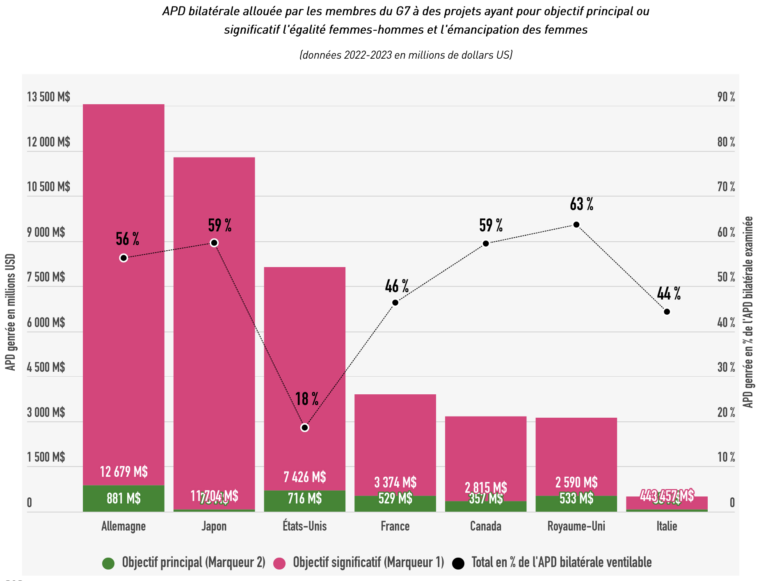
    Which countries support gender equality in their Official Development Assistance?

    Discover the ranking of OECD donors' financial support for gender equality and women's empowerment around the world.