Historic drop in Official Development Assistance in 2025
Published on 09/04/2026.
On April 9 2026, the OECD released the preliminary figures on Official Development Assistance (ODA) provided by donor countries in 2025.
For the second consecutive year, the 33 members of the OECD’s Development Assistance Committee (DAC) made historic cuts to their budgets dedicated to international solidarity.
ODA from DAC members fell to USD 174.3 billion in 2025, a decrease of 23.1% compared with 2024 (-USD 50 billion in real terms), representing 0.26% of their combined income. This marks the steepest drop on record.
In particular, 26 donor countries reduced their contributions to international solidarity, despite rising global needs. The five largest DAC donors alone account for 96% of the overall decline: the United States (-57%), Germany (-17%), France (-11%), the United Kingdom (-11%) and Japan (-6%).
This downward trend is expected to continue in 2026, with the OECD forecasting a further 5.8% decrease.
Analysis.
In 2025, ODA records the sharpest decline in its history
Following a first drop in 2024 (down 6% from the 2023 peak), ODA from DAC countries continued to fall sharply in 2025, reaching USD 174.3 billion, a 23.1% decline in real terms compared with 2024. As a result of the historic withdrawal of the United States, Germany became the largest donor (USD 29.1 billion), followed by the United States (USD 29 billion), the United Kingdom (USD 17.2 billion), Japan (USD 16.2 billion) and France (USD 14.5 billion).
The decline in ODA in 2025 affected all types of financing. Bilateral ODA recorded the steepest fall (-26.4%), particularly bilateral grants (-29.1%). Multilateral ODA declined for the second consecutive year (-12.6%), notably core contributions to the United Nations (-27%).
Humanitarian aid fell by 35.8%, while bilateral ODA allocated to development programmes, projects and technical cooperation decreased by 26.3%. Spending on hosting refugees in donor countries, which can be counted as ODA during the first year, fell by 22.1%, but still accounted for 13.2% of total ODA.
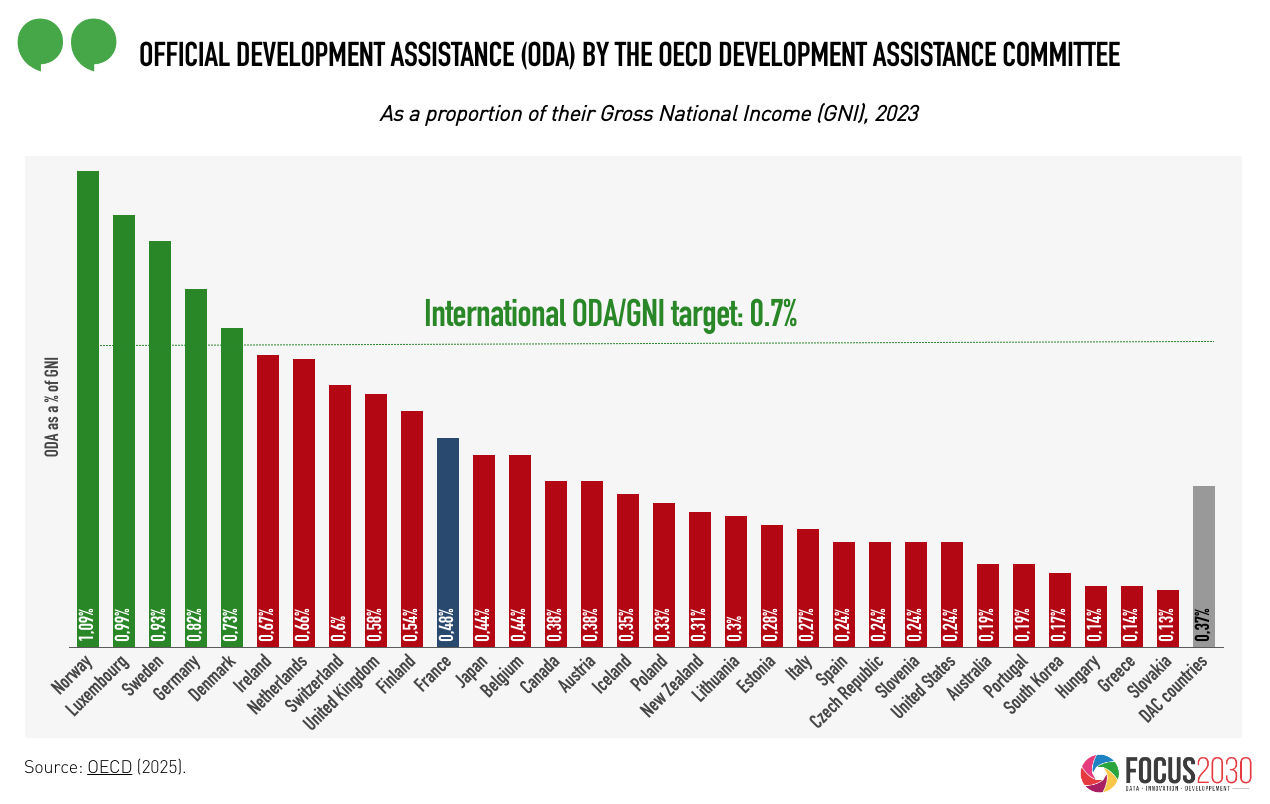
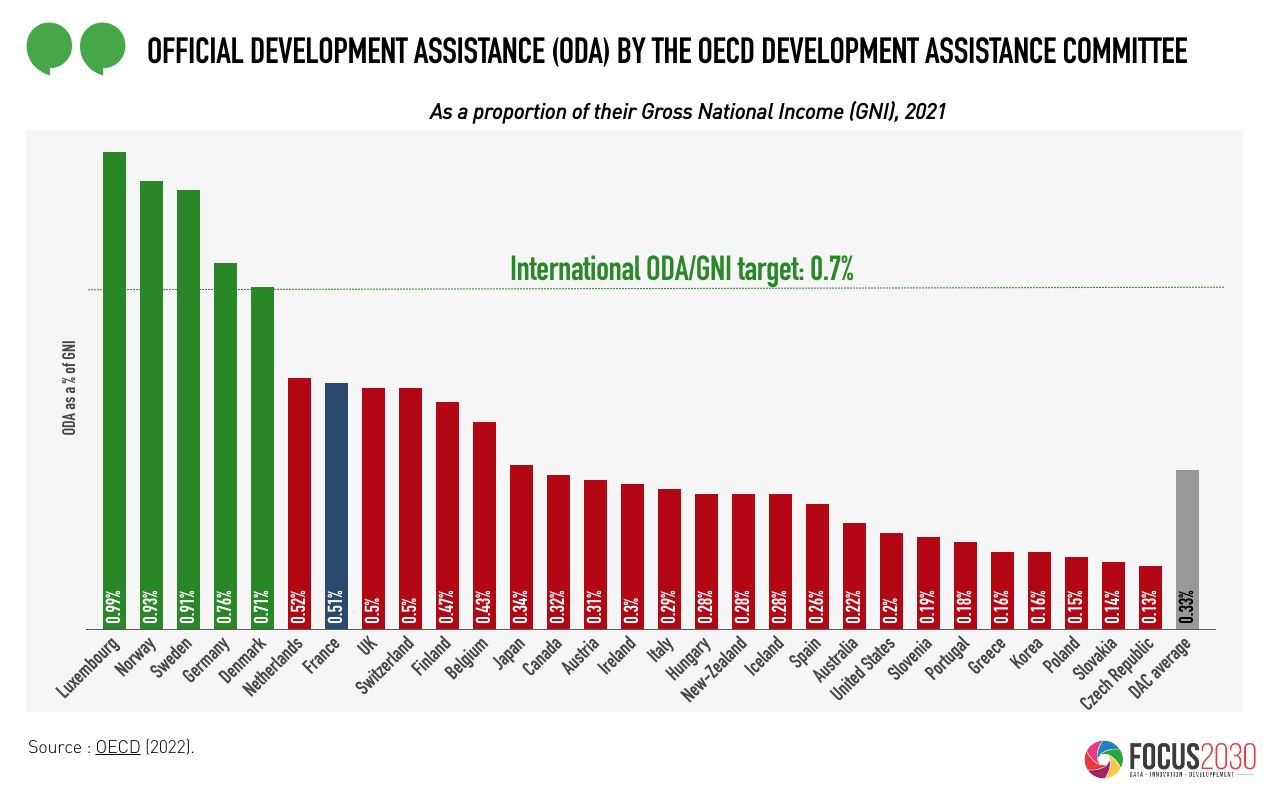
Overall, ODA represented 0.26% of the DAC countries’ combined gross national income (GNI), down from 0.34% in 2024 and 0.37% in 2023. Only four countries met the 1970 UN target of allocating 0.7% of GNI to ODA: Norway, Luxembourg, Sweden, and Denmark.
In 2025, global ODA returned to its 2015 level, the year the Sustainable Development Goals were adopted.
For the second year in a row, the least developed countries and sub-Saharan African countries were the most affected, with declines of 25.8% and 26.3%, respectively. Although 23 countries increased their support to Ukraine, this was not enough to offset the sharp reduction in US contributions (-91%), leading to a 38.2% drop in bilateral ODA to Ukraine, to USD 10.3 billion.
France falls short of its own commitments
France’s ODA amounted to USD 14.5 billion in 2025, a decrease of 10.9% compared with 2024 (-USD 1.7 billion in real terms). While France remains the fifth-largest donor in volume, it is widening the gap with the fourth position.
This amount represents 0.42% of its GNI, falling short of the trajectory set out in the 2021 law on inclusive development and the fight against global inequalities, which aimed to reach 0.7% by 2025. France ranks 11th among donor countries relative to their respective national income.
Prospects for 2026 offer no sign of recovery: the Finance Law enshrines a further EUR 803 million cut to the ODA budget.
FURTHER READING
OECD: International aid fell sharply in 2025, says OECD