Increase of Official Development Assistance in 2022

| This article presents the official development assistance figures for the main OECD donors in 2022. For the latest available statistics, please consult this article |
On January 22, 2024, the OECD published the final figures for the amounts allocated by donor countries to Official Development Assistance (ODA) in 2022.
ODA issued by members of the OECD’s Development Assistance Committee (DAC) reached a historical level of USD 211 billion in 2022 or 0.37% of the combined gross national income of DAC countries. This is the highest level ever. Latest intel and analyses.
ODA REACHES A NEW HIGH IN 2022
In 2022, ODA from DAC countries amounted to USD210,7 billion (about EUR 200 billion at 2022 exchange rates), an increase of 17% in real terms over 2021.
However, this increase is largely due to increased spending on refugees in donor countries, which reached USD 31 billion (up from USD 13 billion in 2021, an increase of 147% in real terms), or 14.6% of total DAC member country ODA in 2022, a record high. Excluding these expenditures, total ODA increased by 7.3 percent in real terms compared to 2021, and decreased in ten countries.
The increase in ODA in 2022 is also driven by the surge in support for Ukraine following its invasion by Russia (8.4% of total ODA, or USD 17,6 billion, compared to USD 922 million the previous year). On the other hand, while spending to support activities to combat the Covid-19 pandemic has declined by 33% from 2021, it still accounts for 6.8% of total ODA (14.4 billion).
In addition, support for the world’s poorest countries (Least Developed Countries or LDCs) has fallen by 4% between 2021 and 2022, mainly due to reduced support for these countries’ response to Covid-19. On average, support for LDCs has fallen from an average of 31% of total ODA between 2010 and 2021 to 23% in 2022. Despite the target of allocating 0.08% of DAC members’ GNI to LDCs, only four countries are meeting this commitment.
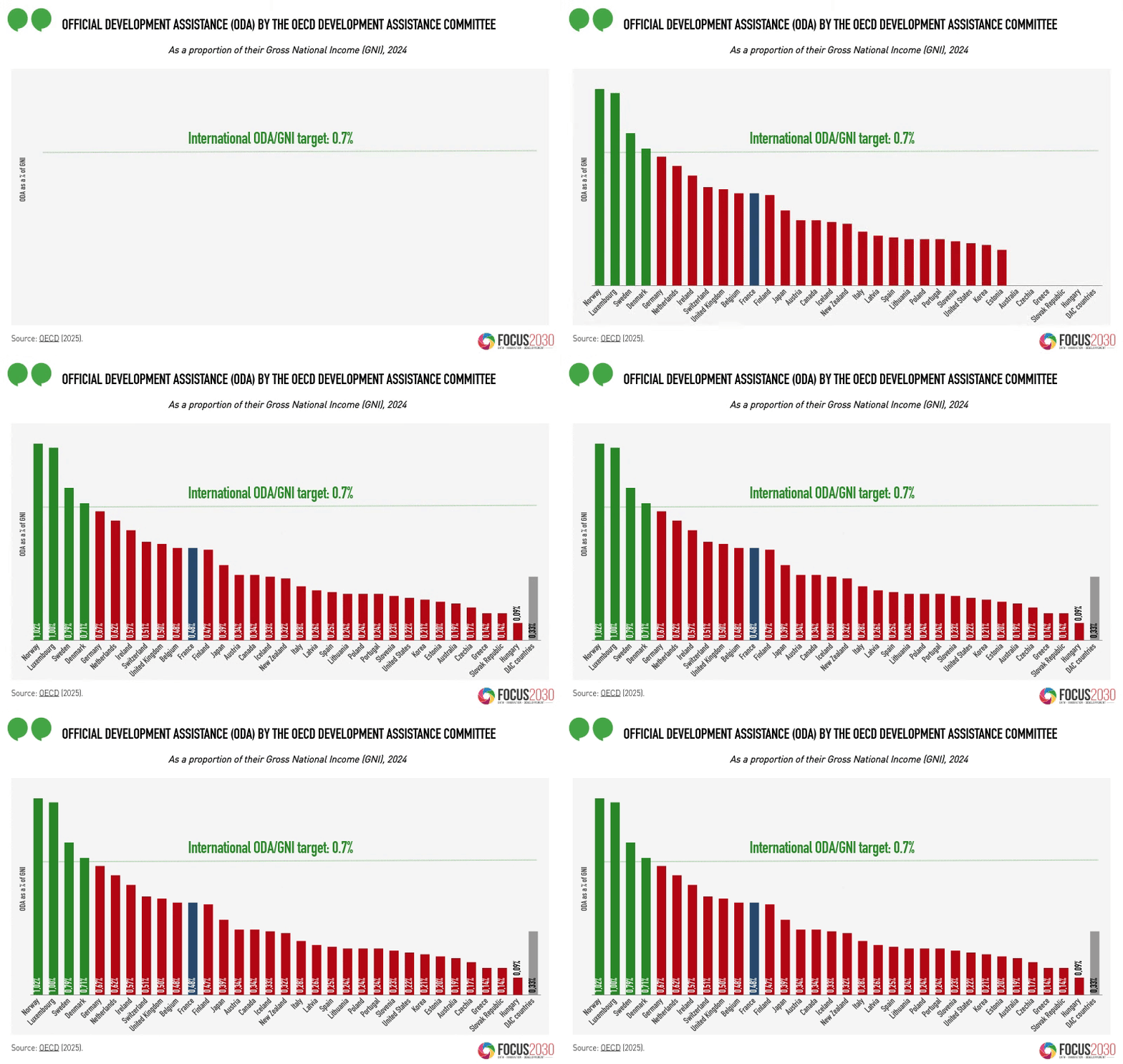
This amount represents 0.37% of the combined gross national income of DAC countries in 2022. Although this ratio had not been reached since 1982, it remains far below the 0.7% GNI/ODA target, which was adopted back in… 1970 by industrialized countries the United Nations.
Only Luxembourg, Sweden, Norway, Germany allocate at least 0.7% of their national wealth to international solidarity. However, it should be noted that 21 of the 30 DAC countries (in 2022) have increased their ODA compared to 2021, some of them significantly: Poland and Ireland (+268% and +121%, respectively, due to a sharp increase in the cost of hosting refugees on their territories, but also due to an increase in their contributions to international organizations), or Lithuania (+173%, due to hosting refugees on its territory as well as its support to Ukraine).
Overall, ODA for bilateral projects and programs and technical cooperation increased by 19% compared with 2021, while DAC members’ contributions to the budgets of multilateral organizations fell by 5%.
An increase in ODA since the adoption of the Sustainable development goals
Since 2017, net ODA has increased by 35%. ODA budgets increased steadily between 2013 and 2016, when it first peaked, driven in particular by the influx of refugees into Europe, and the associated in-country refugee costs. In 2017, 2018, and 2019, it decreased due to the decline in refugee-related expenditures. In 2020 and again in 2021 and 2022, ODA reached its highest level on record, driven in part by support in the context of the Covid-19 crisis as well as the war in Ukraine and its consequences for the displaced populations.
France, fourth largest donor country in volume
France’s aid rose by 13% in 2022 compared to 2021, totalizing USD 16 billion (approximately EUR 15,2 billion), or 0.56% of France’s GNI, in line with the financial trajectory adopted by France in 2018.
According to the OECD, this increase in French aid is mainly due to a large increase in aid to sub-Saharan Africa, as well as the cost of hosting refugees on its territory (which represents 9.6% of French ODA in 2022). France has also allocated 2.9% of its ODA to support Ukraine. In addition, the sharing of vaccine doses in excess of its domestic supply represents 1.7% of the total.
Despite this increase, France is still far from the 0.7% target. While it ranks fourth among donor countries in terms of volume after the United States, Germany and Japan, it has fallen to 10th place in terms of the proportion of its gross national income.
Find out more about the final figures for ODA in 2022.