Official Development Assistance in 2022: A Record $204 Billion
In 2022, official development assistance (ODA) from donor countries reached a new all-time high. Yet behind the record, in-donor refugee costs and support for Ukraine mask a more complex reality for the world’s poorest countries.
$204.0 bnTotal ODA from DAC countries in 2022
+13.6%Increase in real terms year on year
0.36%ODA as a share of donors’ GNI
$16.1 bnNet ODA provided to Ukraine
Download the full report (PDF)
Read the analysis
In this article
- A fourth consecutive record
- Refugees and Ukraine: the drivers of the rise
- The largest donor countries
- The 0.7% of GNI target
- Where does France stand?
- Points to watch
- How ODA is measured
A fourth consecutive record
In 2022, official development assistance (ODA) from the OECD’s Development Assistance Committee (DAC) reached USD 204.0 billion. Remarkably, this was the fourth year running that ODA broke its own record. It also posted one of the highest growth rates in its history: +13.6% in real terms versus 2021. That figure is adjusted for both inflation and exchange-rate movements.
Measured against donors’ wealth, ODA represented 0.36% of their combined gross national income (GNI), up from 0.33% in 2021. In fact, such a level had not been seen since 1982. To grasp how this indicator is calculated and why it anchors international commitments, see our reference page on official development assistance.
Refugees and Ukraine: the drivers of the rise
However, two exceptional factors drove the rise. First, in-donor refugee costs jumped to USD 29.3 billion (14.4% of total DAC aid); strip them out, and ODA grew by just +4.6%.
The second driver is support for Ukraine following Russia’s invasion. Net ODA to Ukraine amounted to USD 16.1 billion, or 7.8% of total ODA, including USD 1.8 billion in humanitarian aid. The European Union institutions alone channelled USD 10.6 billion to Kyiv.
Key takeaway: excluding in-donor refugee costs, ODA rose by only 4.6%. Much of the “additional” aid mobilised for the crises of 2022 did not necessarily reach the poorest developing countries.
The largest donor countries
By volume, the United States remained by far the largest DAC provider, with USD 55.3 billion — more than a quarter of total aid. It was followed by Germany (USD 35.0 billion), Japan (USD 17.5 billion), France (USD 15.9 billion) and the United Kingdom (USD 15.7 billion).
ODA rose in twenty-six of the thirty DAC member countries, often driven by in-donor refugee costs. Collectively, the G7 provided 75% of total aid and the EU members of the DAC, 45%. Aid from the twenty EU countries that are DAC members reached USD 91.6 billion, an increase of 18.6%.Top 5 donors in 2022 (grant-equivalent, USD billion): United States 55.3 · Germany 35.0 · Japan 17.5 · France 15.9 · United Kingdom 15.7. Source: OECD.
The 0.7% of GNI target
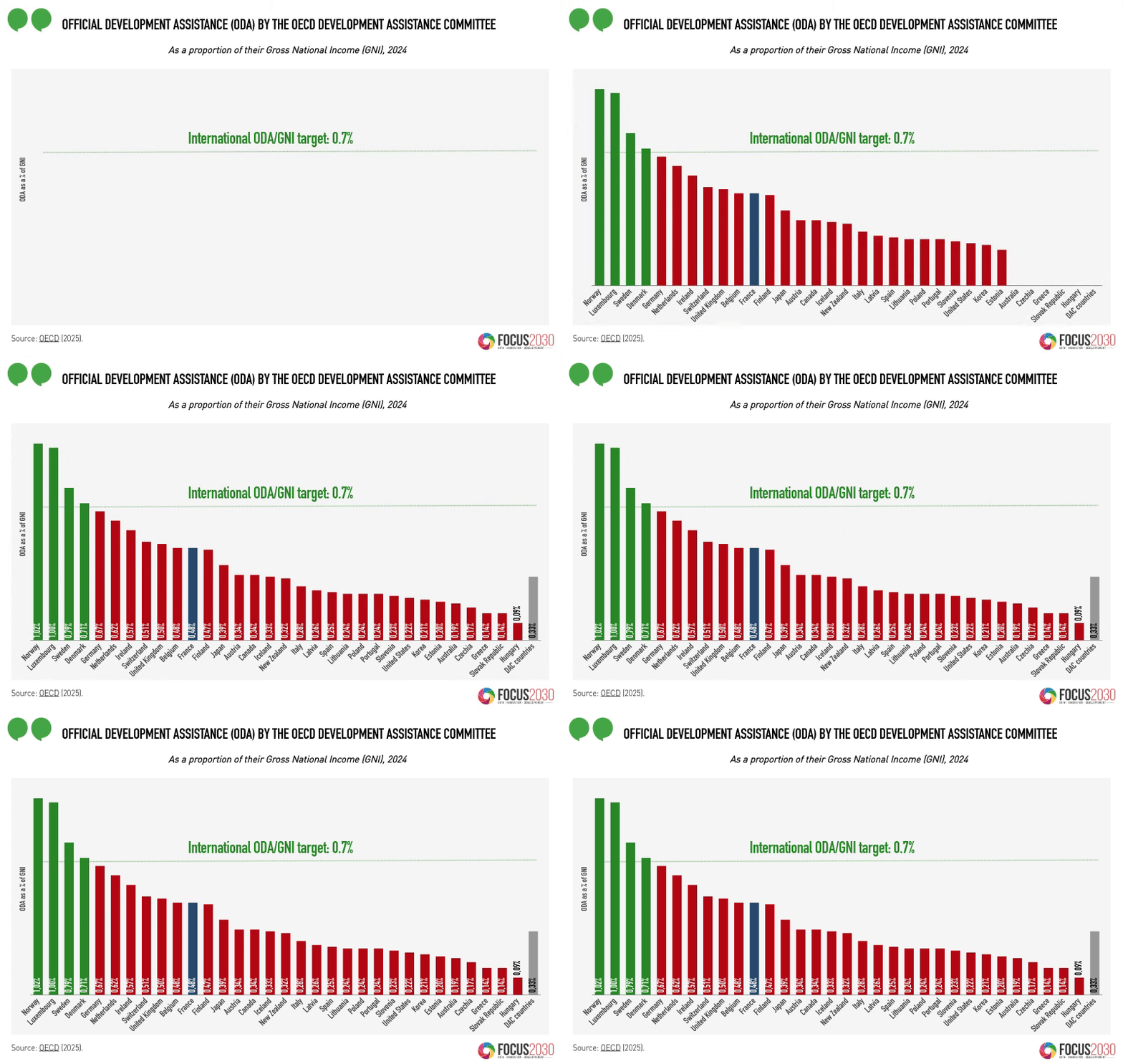
Since 1970, wealthy countries have committed to devoting 0.7% of their gross national income to development aid. In 2022, only five DAC members met or exceeded this United Nations target: Denmark (0.70%), Germany (0.83%), Luxembourg (1.00%), Norway (0.86%) and Sweden (0.90%).
Beyond the DAC, preliminary data show Türkiye (0.79%) and Saudi Arabia (0.74%) also topped the 0.7% threshold. Yet the “average country effort” — the unweighted mean of national ratios — stood at just 0.45%, showing most donors fall short of their commitments. Follow the latest tracking of these commitments in our global solidarity barometer.
Where does France stand?
France provided USD 15.9 billion in ODA in 2022, placing it fourth worldwide. Its aid represented 0.56% of its GNI, up from 2021 (+12.5% in real terms). According to the OECD, this increase was driven mainly by a sharp rise in aid to sub-Saharan Africa, as well as by in-donor refugee costs (USD 1.5 billion).
France nonetheless remains well short of the 0.7% target, an objective it set for itself in its 2021 programming law. It is also among the countries that rely most heavily on loans: 22% of its bilateral aid takes the form of sovereign loans, compared, for example, with 60% for Japan. To explore France’s trajectory further, see our dossier on French development policy.
Points to watch
Behind the global record, several signals call for caution — starting with aid to Africa. Net bilateral flows from DAC countries to the continent fell by 7.4% to USD 34 billion; aid to sub-Saharan Africa dropped by 7.8% (USD 29 billion). Aid to the least developed countries also edged down (-0.7%). In other words, the global rise in ODA mainly benefited donors’ domestic spending and lower-middle-income countries, pulled up by flows to Ukraine (+52.8%).
Another notable shift: COVID-19-related support fell by 45% to USD 11.2 billion, and vaccine donations collapsed by 74% (USD 1.5 billion). Humanitarian aid, meanwhile, held broadly steady at USD 22.3 billion (+1.0%).
Aid that remains resilient in the face of crises
The OECD stresses that ODA remains a remarkably stable source of financing in times of crisis, as it already proved after the 2008 financial crisis. Between 2019 and 2022, humanitarian aid grew by 22% in real terms. These figures nonetheless remain preliminary and partial: final, detailed data — notably on Ukraine and COVID-19 — were published in December 2023.
Want to understand the stakes of development finance and the fight against extreme poverty? Explore our analyses and publications and our open-access data.
How ODA is measured
Comparing donors requires a common yardstick, and here the accounting method matters. Since the 2018 figures, the OECD’s headline ODA total has been calculated on a grant-equivalent basis. Instead of the older “cash-flow” approach, it counts only a loan’s “gift portion” — the concessional effort from below-market rates and generous terms, valued in today’s money.
It aims to capture each donor’s real effort and favour grants and concessional loans over loans dressed up as aid.. The shift matters because loans weigh heavily in some portfolios: bilateral sovereign loans rose by 36.1% in 2022 and made up 9.3% of bilateral ODA, with especially high shares in Japan (60%), Korea (32%) and France (22%). To keep things transparent, the OECD continues to publish parallel figures on a cash basis. On that basis, total net ODA reached USD 206.0 billion in 2022. Because the two series are no longer directly comparable, it is always worth checking which basis a headline figure refers to.
Further reading
- OECD summary note: Development Assistance Committee (DAC)
- Detailed ODA data: oe.cd/dac-oda
- Reference framework: Sustainable Development Goal 17 (partnerships)