Contact

  • Français
  • Español
  • AnalysisReports

    Policy Brief n°4: Migration and Development

    Published on 02/09/2019.

    Conflict, poverty, climate change and political instability contribute to migration. An increase in the numbers of those making their way to Europe in search of a better life has also sparked a new debate on the role of development aid in migration.

    In this context, international migration has become a recurring feature when it comes to defining public development aid, something which worries many development actors who are concerned about the political nature of the debate and how development aid might become either the scapegoat or go-to fund for solving migratory issues.

    This is especially true given a lack of clear understanding on both migration and development aid by the general public, and the emotive responses that either can generate.

    For example, even though the number of refugees has risen in OECD and European countries since 2015, it is in fact developing countries themselves who continue to absorb 85% of refugees throughout the world.

    The percentage of official development assistance (ODA) allocated to receiving refugees in host donor countries has doubled since 2014, to 14.2 million USD in 2017 or around 10% of total OECD aid.

    This is troubling when donors or international organisations use ODA as a way to control migration, contrary to the Sustainable Development Goals, and is massively contested by NGOs who reject any form of making ODA conditional on a reduction in migration from the recipient country. And yet this sort of condition is increasingly supported by politicians.

    Migration is also a victim of negative connotations. Far from seeing it as a security or economic risk, migration is also a factor of development for host countries as well as those of origin and transit. For example, once they have found employment, many migrants send back funding to their families which enables a better standard of life and local economic development in their original communities. In 2017, these transfers – known as “remittances” represented 466 billion USD – a record high, and three times the amount of ODA.

    You can download Policy Brief n°4 in French here. An English translation is forthcoming.

    To learn more
  • oldNote d’analyse n°4 : Développement et migrations, quel rôle pour l’aide publique au développement
  • ALSO READ

    Development financing - 04 June 2026

    Reforming the international financial architecture: where do we stand?

    Focus 2030 Reforming the international financial architecture: where do we stand? Focus 2030 independently tracks the commitments made at the Summit for a New Global Financing Pact in 2023. Updated on an ongoing basis, this tracker documents progress towards reforming the international architecture for development and climate finance. Access the tracker Download the report · […]
    G7 - 02 June 2026

    Financing international development: the decisive role of G7 countries in a context of disengagement

    Special feature: French G7 Presidency Explore our special report to understand the issues related to the French G7 Presidency in 2026, gain insight into the key policy priorities, and follow the latest updates. Access the special report ➔ In 2026, France’s G7 Presidency aims to bring development financing back to the forefront of the international […]
    Analysis - 18 May 2026

    In Nairobi, the Africa Forward Summit signals a shift toward a new Franco-African development finance doctrine

    Co-hosted by France and Kenya on 11-12 May 2026, the Africa Forward Summit marked an attempt to redefine relations between France and the African continent around a new narrative: one centered on equal partnership, private investment, and strategic autonomy. Behind the €23 billion in announced commitments, the summit also reflects a deeper transformation: the explicit […]
    Development financing - 09 April 2026

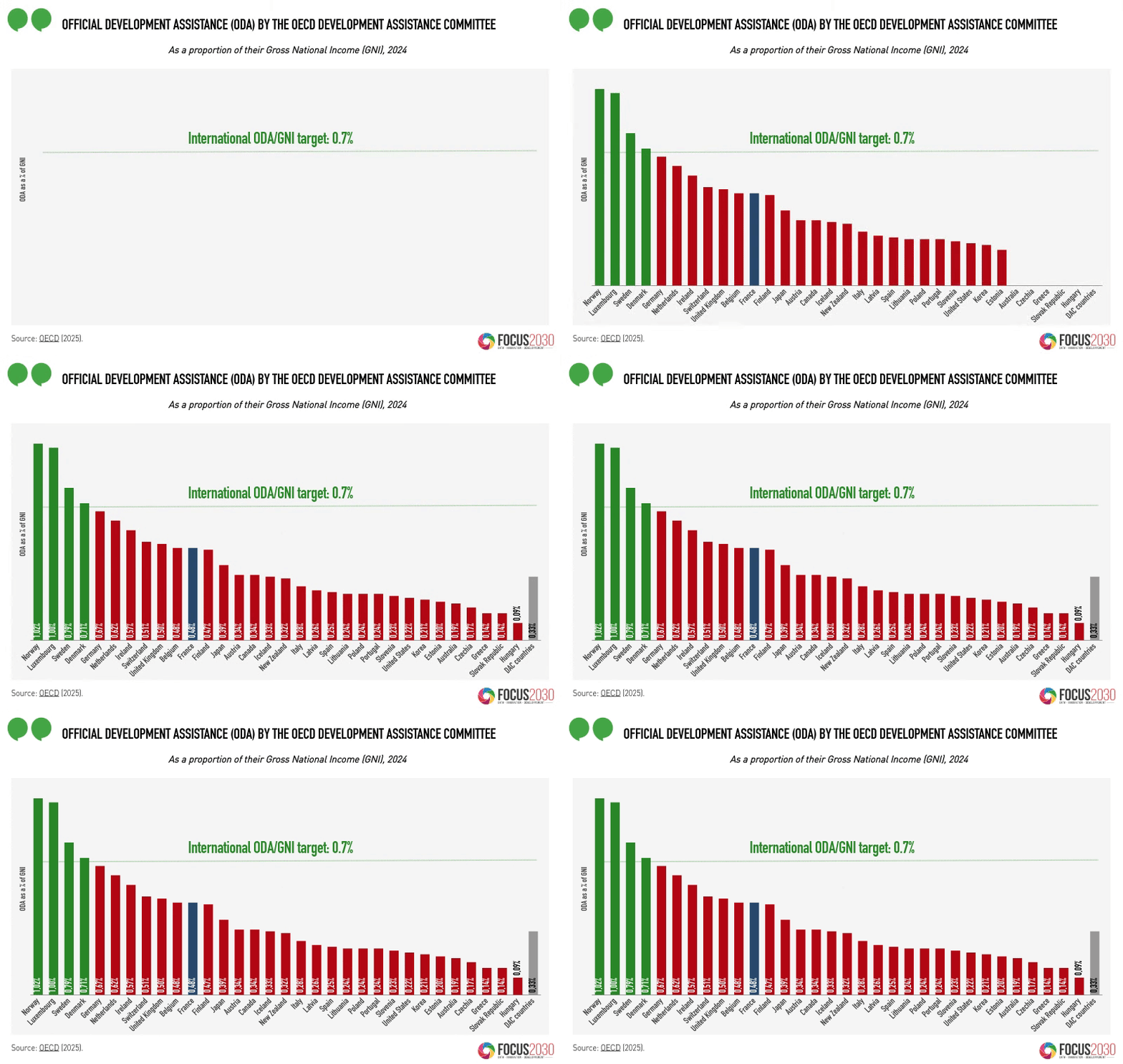
    Historic drop in Official Development Assistance in 2025

    ODA from DAC members fell to 174.3 billion USD in 2025, a 23.1% drop from 2024 (-50 billion USD in real terms), representing 0.26% of their income. It is the highest fall on record. 
    Development financing - 30 March 2026

    The African Development Fund: allocating concessional resources to the 37 most vulnerable countries on the continent

    As the 17th replenishment of the African Development Fund (ADF-17), held on 15-16 December 2025 in London, draws to a close, expressed financing needs from beneficiary countries have reached USD 25 billion. In a context of mounting budgetary pressures among traditional donors, a central question emerges : will international mobilization be sufficient to meet the challenges ?
    G7 - 09 February 2026

    G7 France 2026 : focus on development matters, key challenges, debates and emerging priorities

    In 2026, France holds the presidency of the G7, with the Heads of State Summit scheduled to take place in Evian from June 15 to 17. Keep up with the latest news.