The G7 and gender equality: a fluctuating commitment
Special report: French G7 Presidency
Explore our special report to understand the issues related to the French G7 Presidency in 2026, gain insight into the key policy priorities, and follow the latest updates.
Access the special report ➔In 2026, France holds the G7 presidency, seven years after the summit hosted in Biarritz in 2019. This milestone comes in a transformed context : the rise of conservative regimes, a growing backlash against the rights of women and girls, the weakening of multilateralism, and the questioning of official development assistance.
This presidency also coincides with the fifth anniversary of the Generation Equality Forum, held in Paris in 2021 to accelerate global commitments to gender equality.
In line with its commitment to feminist diplomacy, reaffirmed during the fourth Ministerial Conference on Feminist Foreign Policies in October 2025, the French G7 presidency takes place amid shifting international priorities and changes in how development funding and international cooperation are structured. In this context, France is expected to demonstrate its ability to frame this presidency within a strategic perspective, leveraging the G7 as a tool for coordinated action in response to the backlash against women’s and girls’ rights and the decline in dedicated funding. Analysis.
The evolution of gender equality within the G7
Gender equality is a recent pillar of the G7 agenda. It was officially established as a policy priority in 2018 under Canada’s presidency, with the creation of the Gender Equality Advisory Council (GEAC), tasked with issuing recommendations to Heads of State and Government. In 2019, France carried this momentum forward during the 45th G7 Summit by renewing the GEAC and making gender equality a transversal priority across all areas of work. Emphasis was placed on strengthening legal frameworks, improving access to education, promoting women’s economic empowerment, and combating gender-based violence.
Subsequent presidencies (United Kingdom in 2021, Germany in 2022, Japan in 2023, Italy in 2024, and Canada in 2025) have maintained the issue on the agenda, albeit with varying levels of ambition. In 2026, the approach appears to be increasingly structured around transversal integration, particularly through discussions on development policies, rather than through a dedicated ministerial meeting on gender.
Since 2009, the G7 has published a comprehensive triennial report assessing progress on all its development commitments, including those related to gender equality. Within this framework, the French G7 presidency in 2019 coordinated the publication of the Biarritz Report on G7 development commitments, which provides an overview of progress achieved.
Since 2022, monitoring mechanisms have also been strengthened on gender equality issues with the introduction of the G7 Dashboard on Gender Gaps. Developed by the OECD at the G7’s request and published annually, this tool is the first monitoring and accountability mechanism dedicated specifically to the G7’s gender commitments. Each year, it provides a set of internationally comparable indicators to assess gender inequalities across various socio-economic fields. Several reports feed into this system, including the G7 Gender Equality Implementation Report 2023, as well as the Gender Dashboard on Gender Gaps 2024 and 2025.
The G7 and funding gender equality
The members of the G7 remain key actors in development financing. Together, in 2025, they account for more than two-thirds of global official development assistance (ODA) and play a driving role in mobilizing public and private finance in support of the Sustainable Development Goals. Their influence has been demonstrated through their decisive contributions to multilateral mechanisms such as the Global Fund to Fight AIDS, Tuberculosis and Malaria and the Global Partnership for Education.
The OECD monitors the integration of gender equality into bilateral ODA through the gender marker of the DAC. Each activity is scored according to whether gender equality is a principal objective, a significant objective, or whether it is not targeted.
This indicator makes it possible to identify funding that incorporates a gender perspective, but it does not measure impact: it primarily reflects the extent to which gender equality is integrated into project design.
OECD source: understanding the DAC gender marker .
The significant contraction in official development assistance since 2024 poses a systemic risk to the global financing of gender equality. G7 countries account for 63% of OECD DAC gender-related ODA commitments, representing an average of USD 44.9 billion per year over the 2023–2024 period (prior to the United States’ disengagement in 2025). These actors are the main providers of international financing for women’s rights and autonomy. They account for 65% of funding dedicated to sexual and reproductive health, 85% to family planning, 66% to feminist movements, and 66% to efforts to combat violence against women and girls.
The substantial cuts announced in European ODA, combined with the United States’ disengagement from international solidarity and the reactivation of the Global Gag Rule, point to a major disruption for these essential sectors. The withdrawal, or even disappearance, of major donors risks triggering a domino effect, leading to a historic decline in funding for gender equality and directly undermining the achievement of the Sustainable Development Goals (SDGs) and the eradication of poverty.
As France holds the G7 presidency in 2026, civil society actors are calling for a strong and explicit political commitment. Under its feminist foreign policy, France has pledged to assume a particular responsibility in mobilizing the international community and, by extension, the G7, around the preservation and strengthening of funding for gender equality, particularly in the field of sexual and reproductive health and rights. However, gender equality is not the subject of dedicated work streams this year and may, at best, be addressed in a cross-cutting manner.
Women 7 and civil society
Within the G7 framework, several “engagement groups” bring together civil society and a range of non-governmental actors in governmental discussions. Among them, Women 7 (W7) is the official engagement group dedicated to gender equality. It brings together feminist organizations, civil society networks, researchers, and experts from G7 countries and beyond, with the aim of formulating policy recommendations for Heads of State and Government.
W7 promotes the priorities of women’s rights movements within the G7 agenda, advancing concrete commitments on gender equality, economic justice, sexual and reproductive health and rights, and gender-responsive development financing.
In its statement to G7 members, W7 emphasizes the central role of feminist organizations, both as grassroots actors and as pillars of democratic resilience, and calls for a substantial increase in their funding, which is currently in decline. It also urges states to mobilize all actors, public, private, and civil society to make gender equality a political priority.
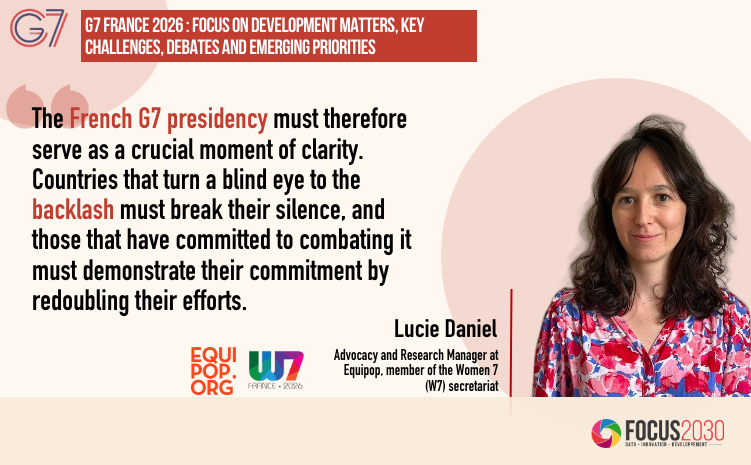
In an uncertain international context and ahead of the United States’ G7 presidency in 2027, W7 calls for the French presidency to be seized as a window of opportunity to consolidate commitments, prevent any backlash, and structure a collective response to attacks on women’s rights.
Read the W7 statement : “Defending Gender Equality and International Solidarity to Address Global Imbalances”
Capitalising on best practices: lessons from France’s 2019 G7 presidency
The 2019 French G7 presidency made gender equality a central diplomatic priority. France structured its action around three main objectives: combating violence against women, improving girls’ access to education, and supporting women’s entrepreneurship.
One of the key initiatives was the Biarritz Partnership, which was launched during the summit in Biarritz. Conceived as a “policy package,” it presented 79 best practices in legislation aimed at promoting gender equality across four main areas: combating violence, economic empowerment, education and health, and the fight against discrimination. G7 members and other partner countries were encouraged to commit themselves to adopting at least one of these legislative measures or to take inspiration from them. In this context, several states, including Chile, Australia, and Senegal, made voluntary commitments.
The French presidency also led to the adoption of the Declaration on Gender Equality and Women’s Empowerment, which reaffirms the importance of women’s participation at all levels of society, particularly in peace and security processes, in line with United Nations Security Council Resolution 1325 on Women, Peace and Security. This priority was also reflected in the Dinard Declaration on Women, Peace and Security, adopted during preparatory ministerial meetings.
In addition, several financial initiatives were supported or launched within the framework of the 2019 G7. A funding package of USD 251 million, including USD 135 million from France, was allocated to the African Development Bank’s Affirmative Finance Action for Women in Africa (AFAWA) initiative, aimed at improving African women entrepreneurs’ access to finance and reducing the gender financing gap on the continent.
The French presidency also contributed to the launch of the Global Fund for Survivors of Conflict-Related Sexual Violence. France was the first state to support this fund with a contribution of EUR 6 million, ahead of its official launch at the United Nations in New York in September 2019, with the aim of mobilizing between USD 50 and 100 million.
Finally, France also placed particular emphasis on the role of civil society organizations and women human rights defenders, notably through the creation of the Support Fund for Feminist Organizations (FSOF), endowed with EUR 120 million. This fund aims to support feminist civil society organizations in countries covered by France’s international solidarity policy. It seeks to strengthen their technical, financial, and organizational capacities in order to promote gender equality and support local initiatives advancing the rights of women and girls.
Despite these advances, many observers stress that progress on gender equality remains fragile. The rise of movements opposing women’s rights and gender equality in particular represents a growing challenge for feminist foreign policy approaches. To better understand these dynamics and provide an updated overview of global gender inequalities, Focus 2030 has produced a special report on the state of gender inequalities in the world in 2026, bringing together analyses, key data, and expert contributions.