Official Development Assistance: The Trend in Budget Cuts in France

A longstanding player in official development assistance and international solidarity, France has, since 2023, undertaken an unprecedented rollback of its commitments. After postponing by five years its target of allocating 0.7% of national income to international solidarity, it made five successive cuts to its official development assistance budget. Funding for the “Official Development Assistance” budget programme was cut by 40% between 2024 and 2026, a reduction of nearly €2.4 billion, and could be cut again in 2027. Analysis and reactions from civil society actors.
| History of France’s budget cuts to official development assistance: 2023: the Interministerial Committee for International Cooperation and Development (CICID) postponed from 2025 to 2030 the target of allocating 0.7% of France’s gross national income (GNI) to official development assistance. According to OECD data, France’s total ODA fell by 13% compared with 2022. 2024: a decree cancelled €10 billion in appropriations from the general government budget, including €742 million from the “Official Development Assistance” budget programme. It was the budget programme most affected in proportional terms. According to OECD data, France’s total ODA remained stable compared with 2023. 2025: the Finance Act confirmed a 37% cut to the ODA programme budget compared with 2024. In April, a decree increased the cut to 39%, a reduction of nearly €2.3 billion. France’s total ODA fell by 11% to €12.9 billion, or 0.42% of GNI, its lowest level since 2017. 2026: the draft Finance Bill presented in autumn 2025 proposed a €704 million reduction. The Finance Act adopted on 2 February 2026 added €99 million to this cut: ODA programme appropriations therefore fell by €803 million compared with 2025, a decrease of 18%. In two years, funding for the programme was cut by 40, excluding the abolition of innovative financing mechanisms. In June 2026, two decrees cancelled a further €21 million in payment appropriations (-0.6%). 2027: the July 2026 budget framework proposes reducing the ODA programme’s payment appropriations to approximately €3.3 billion in 2027, €300 million or 8% less than in 2026. If this ceiling were confirmed in the Finance Bill and then by Parliament, the programme’s funding would have fallen by 44% compared with 2024. Commitment appropriations for programmes 110 and 209 could also decline by €917 million, reducing France’s ability to launch new projects. |
2023: a 50-year-old unfulfilled promise postponed for another five years
France is currently the world’s fifth-largest donor of official development assistance (ODA). In 2025, it allocated 0.42% of its gross national income (GNI), or €12.9 billion, to this public policy. However, it has never met the international commitment adopted by industrialised countries at the United Nations in 1970 to devote 0.7% of their income to ODA.
In 2021, a new law marked a historic step forward by providing for ODA to reach 0.7% of GNI by 2025. However, the government quietly backtracked on this commitment in summer 2023, postponing the target until 2030, at a meeting of the Interministerial Committee for International Cooperation and Development (CICID). Since this reversal was confirmed in 2023, France’s ODA has continued to decline.
According to Focus 2030 projections, postponing this target from 2025 to 2030, together with the various ODA budget cuts, will result in a shortfall of nearly €23 billion for international development between 2027 and 2030, at a time when the most vulnerable countries face an unprecedented squeeze on their fiscal space, undermining their ability to meet their populations’ essential needs and complete their climate transitions.
These cuts could have major human consequences. According to modelling published by the Barcelona Institute for Global Health (ISGlobal), cuts to French aid could lead to more than 3.5 million additional deaths by 2030, compared with a scenario in which funding had been maintained.
2024: a first cut to the official development assistance programme
On 21 February 2024, a decree cancelled €10 billion in appropriations from the general government budget, including €742 million from the “Official Development Assistance” programme alone.
This reduction represented 12.5% of the programme’s appropriations, compared with an average reduction of 1.3% across the entire government budget. ODA was therefore affected ten times more, proportionally, than other public policies.
These decisions already contrasted with France’s international commitments, notably at the Summit for a New Global Financing Pact, held in Paris in June 2023, where France launched a call to increase concessional financing for the most vulnerable countries.
2025: abolition of earmarked taxes and a historic reduction in ODA
The initial Finance Act for 2025 enacted a historic reduction in the “Official Development Assistance” programme, with a cut of more than €2.1 billion. A decree dated 25 April 2025 cancelled a further €134 million.
The year 2025 also marked the abolition of the longstanding Solidarity Fund for Development mechanism. Until 2024, part of the revenue from the financial transaction tax and the solidarity tax on airline tickets was allocated directly to it. This revenue provided €738 million each year to finance multilateral instruments such as the Global Fund to Fight AIDS, Tuberculosis and Malaria, Gavi, Unitaid, the Green Climate Fund and the Global Partnership for Education.
Since 2025, the revenue from these taxes has gone into the general government budget. The FSD was replaced by a budget line of the same amount within the ODA programme. This change ended the permanent earmarking of solidarity taxes and now exposes this funding to annual budget decisions and cancellations.
According to OECD data, France’s total ODA also fell by 11% in 2025, to €12.9 billion, or 0.42% of GNI.
2026: a fifth consecutive cut
The 2026 Finance Act confirmed a further €803 million cut to the ODA programme. Its appropriations fell from €4.373 billion in 2025 to €3.569 billion in 2026, a decrease of 18%. In less than two years, the ODA programme—which accounts for only 0.45% of the government budget—was subjected to five consecutive cuts, reducing its funding by 40%.
2026 Finance Act: a fifth cut to official development assistance
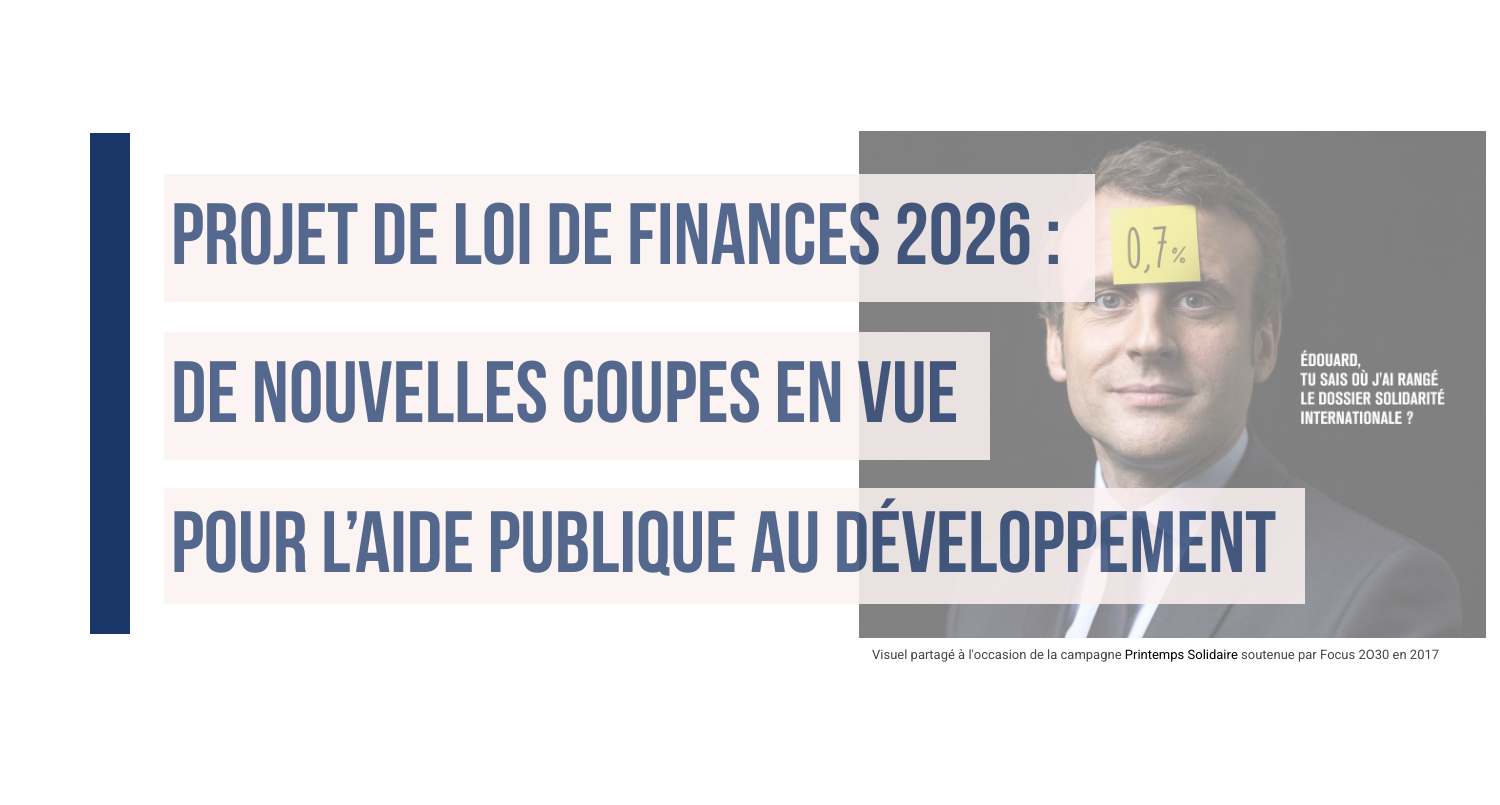
The 2026 Finance Act cuts appropriations for the “Official Development Assistance” programme by €803 million, an 18% decrease in one year. Focus 2030 analyses the consequences of this fifth consecutive cut for humanitarian assistance, multilateral financing and support for NGOs.
Read the 2026 budget analysis →The programme therefore suffered one of the largest reductions in the government budget, while other programmes fell by an average of 0.7%. It recorded the second-largest cut, both in absolute and proportional terms.
In June 2026, amid a contraction in public spending in response to the war in the Middle East, two decrees enacted the additional cancellation of €21 million in payment appropriations for the ODA programme, equivalent to 0.6% of the appropriations provided for in the 2026 Finance Act. Its total payment appropriations therefore reached €3.548 billion.
2027 Finance Bill: a further €300 million cut under consideration
On 15 July 2026, the Prime Minister’s Office presented the proposed spending ceilings prepared for the 2027 Finance Bill. At this stage, these amounts constitute the government’s budget framework. They foreshadow the appropriations that will appear in the 2027 Finance Bill, but may still change before the bill is presented to the Council of Ministers and during its examination by Parliament.
Under this framework, the “Official Development Assistance” programme would suffer its sixth consecutive cut since February 2024. Its ceiling would fall from €3.6 billion in the initial 2026 Finance Act to €3.3 billion in 2027, a decrease of €300 million, or 8%. Meanwhile, appropriations for other programmes would rise by an average of around 1%.
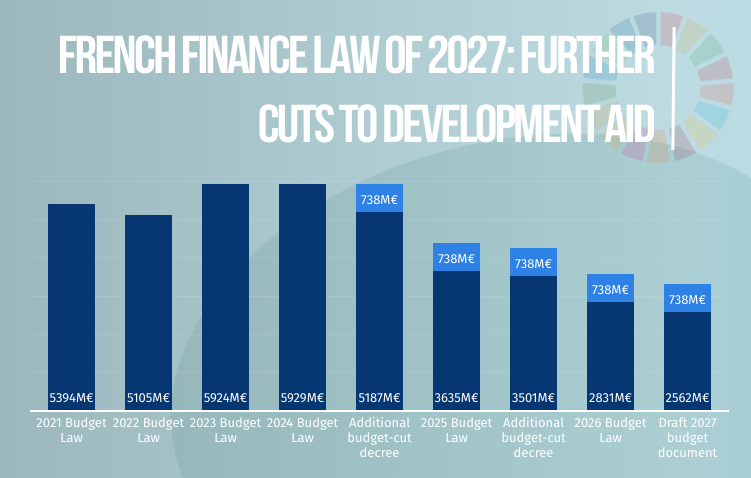
2027 Finance Bill: a further €300 million cut threatens development assistance
The budget framework for the 2027 Finance Bill proposes reducing appropriations for the “Official Development Assistance” programme to €3.3 billion. This further €300 million cut would represent a decrease of 8% in one year and 44% since 2024.
Read the 2027 Finance Bill analysis →This reduction would represent the programme’s sixth successive cut since February 2024. Its funding would be 44% below the amount provided for in the 2024 Finance Act. In three years, it would have fallen from approximately €5.9 billion to €3.3 billion, a reduction of nearly €2.6 billion.
The spending-ceiling letters also reveal a particularly worrying decline in commitment appropriations, which allow new multi-year projects to be launched. Based on available information, they would fall by approximately €917 million across the programme’s two main components: €600 million for programme 110, “Economic and Financial Development Assistance”, and €317 million for programme 209, “Solidarity with Developing Countries”.
This reduction would therefore have effects beyond 2027: it would severely limit France’s ability to make new commitments in subsequent years.
“The Thread of Our Future”: more than 200 organisations mobilise against the cuts
In response to this withdrawal, Coordination SUD, the platform for French international solidarity NGOs, launched the “Thread of Our Future” campaign in June 2026, supported by more than 200 organisations.
Through a manifesto, a petition and an awareness-raising film, this mobilisation stresses that international solidarity is not a secondary policy or one removed from domestic concerns. In a world facing health, climate, food and geopolitical crises, France’s future remains closely linked to that of other countries.
The coalition calls on France to preserve resources for international cooperation, support organisations working directly with communities, and reaffirm a policy based on human rights, the fight against inequality and the fulfilment of essential needs.
This mobilisation comes as the consequences of the cuts are already becoming visible. According to a study by Coordination SUD and CartONG, the decline in funding since 2024 has affected 94% of French NGOs. It is estimated to have led to the scaling back or termination of 1,700 projects, affected 17.5 million people and caused the loss of around 10,000 jobs.
Budget decisions at odds with citizens’ aspirations
As part of the Development Engagement Lab project, Focus 2030 and its partners have measured changes in French public support for official development assistance since 2013. In June 2026, 56% of respondents said they favoured increasing or maintaining the ODA budget.
More media coverage of official development assistance, but often through the lens of controversy
The budget debate is also taking place in a media landscape where international solidarity issues remain relatively invisible and are often viewed through the prism of crises. Focus 2030’s MEDIA 2030 report, based on an analysis of 110 French media outlets between January 2023 and September 2025, shows that only 13% of the countries cited in the content analysed are in Africa. The 44 least developed countries, which account for 14% of the world’s population, receive only 6% of mentions.
Official development assistance has nevertheless received a marked increase in attention: the volume of content devoted to it doubled between 2023 and 2025, driven in particular by French budget cuts and the dismantling of USAID. In 2025, the expression “official development assistance” accounted for 73% of mentions relating to international aid. However, this increased visibility comes amid a polarised debate: long discussed only rarely, ODA is now frequently addressed through budget controversies, misleading claims and disinformation, while its concrete results and the progress achieved through international cooperation remain less visible.
Discover MEDIA 2030
Find out more
Explore Focus 2030 analyses and civil society publications on the budget trajectory of French official development assistance and the consequences of its decline.
France: the human and geopolitical cost of cuts to international aid
- UNICEF France · A further €300 million cut to ODA: the cost for children is immense
- Coordination SUD · Open letter: development assistance must meet the needs of the most vulnerable people
- Coordination SUD · Less development assistance, greater risks: the cost of disengagement
- Focus 2030 · Official development assistance: the trajectory of budget cuts in France
- Focus 2030 · CICID 2023: a new international development cooperation strategy