OUTCOME OF THE 4TH MINISTERIAL CONFERENCE ON FEMINIST FOREIGN POLICY
Published on 27/10/2025.
On October 22 and 23, 2025, Paris hosted the 4th Ministerial Conference on Feminist Foreign Policies, bringing together 450 participants from 55 countries, 27 international organizations, and more than 100 NGOs. Under France’s leadership, the event marked a new milestone in building an international coalition for gender equality, gathering both countries that have already adopted a feminist foreign policy and states committed, or wishing to commit, to this approach. The conference stood out for its broad geographic representation, spanning all continents and illustrating the global reach of the movement for women’s rights. It follows previous editions held in Germany (2022), the Netherlands (2023), and Mexico (2024).
Watch the recording of the conference.
AN AMBITIOUS JOINT DECLARATION FOR GENDER EQUALITY
The conference concluded with the adoption of a joint declaration, signed by 31 states, an ambitious text promoting gender equality and the rights of women and girls. Among the major developments, four new countries joined the Feminist Foreign Policy+ Group (FFP+), including Morocco, the United Kingdom, and Nepal, while Sri Lanka announced its intention to adopt a feminist foreign policy.
The declaration reaffirms the importance of historic and international commitments such as the Beijing Platform for Action, CEDAW, the Sustainable Development Goals, and the Women, Peace and Security Agenda. It also highlights states’ commitment to achieving ambitious results for gender equality and the empowerment of all women and girls, in alignment with the UNFCCC, the Paris Agreement, the Convention on Biological Diversity (CBD), and the UN Convention to Combat Desertification, while reaffirming strong support for the principles of the Pact for Prosperity, People and Planet (4P).
The signatory states commit to working together to :
- Promote and ensure the fundamental rights of all women and girls, and guarantee the effective implementation of international norms.
- Combat all forms of gender-based violence and discrimination, acknowledging intersecting forms of discrimination, including those related to sexual orientation, gender identity, and technology-facilitated violence.
- Engage men and boys as allies for change, particularly in transforming social norms and power structures.
- Strengthen the role of feminist organizations and civil society, ensuring civic space is preserved and human rights defenders are protected.
- Guarantee and advance sexual and reproductive rights and health, ensuring full and timely access to maternal and reproductive health services, including pregnancy monitoring, childbirth care, and safe abortion services, and preventing unintended pregnancies.
- Recognize and protect the diversity of family structures.
- Ensure the full, equal, and effective participation of women and young people at all levels of political, economic, and social decision-making.
- Embed a feminist culture within public administrations and diplomatic processes.
The declaration also reaffirms the importance of multilateralism in the face of growing crises and threats to international law.
OUTLOOK AND NEXT STEPS
The conference marks another significant step in building a progressive diplomatic movement capable of uniting a growing number of countries around gender equality. The next edition will take place in Spain in 2026, continuing collective efforts to advance gender equality and the empowerment of all women and girls.
It demonstrated that feminist foreign policy is not an isolated concept, and provided tangible evidence that an increasing number of countries can come together to form a progressive international movement ready to defend and promote women’s rights in the face of rising conservatism and global backlash.
CIVIL SOCIETY MOBILIZATION
Civil society played a central role before and during the conference. Ahead of the event, nearly 150 organizations published a joint statement, outlining recommendations and expectations for translating political commitments into concrete action. During the conference, they emphasized that feminist foreign policy cannot be limited to declarations : sustained funding, meaningful participation, and rigorous monitoring are essential to turn commitments into tangible results.
The pre-conference “Avec Nous / Pour Toustes,” organized by a coalition of international feminist solidarity associations, provided feminist organizations with a space to connect and increase the visibility of their work, highlighting the need to mobilize society as a whole to defend the rights of women and girls globally.
The key messages from feminist organizations were clear : adopting declarations is not enough. Commitments must be measurable, funded, and monitored, while ensuring a safe civic space for human rights defenders.
PUBLICATIONS
The Feminist Foreign Policy Repository (FFPR) : The Feminist Foreign Policy Repository compiles and organizes key resources (analyses, tools, and recommendations) to support governments, international organizations, and civil society actors in implementing feminist foreign policies.
Report “Defining a Feminist Foreign Policy 2025” from the Feminist Foreign Policy Collaborative : This report provides a comprehensive overview of the state of feminist foreign policies in 2025. Based on 14 country profiles, it evaluates progress, setbacks, and emerging dynamics across five dimensions—rights, resources, representation, knowledge, and influence. It also identifies seven countries to watch, whose growing engagement could signal future leadership.
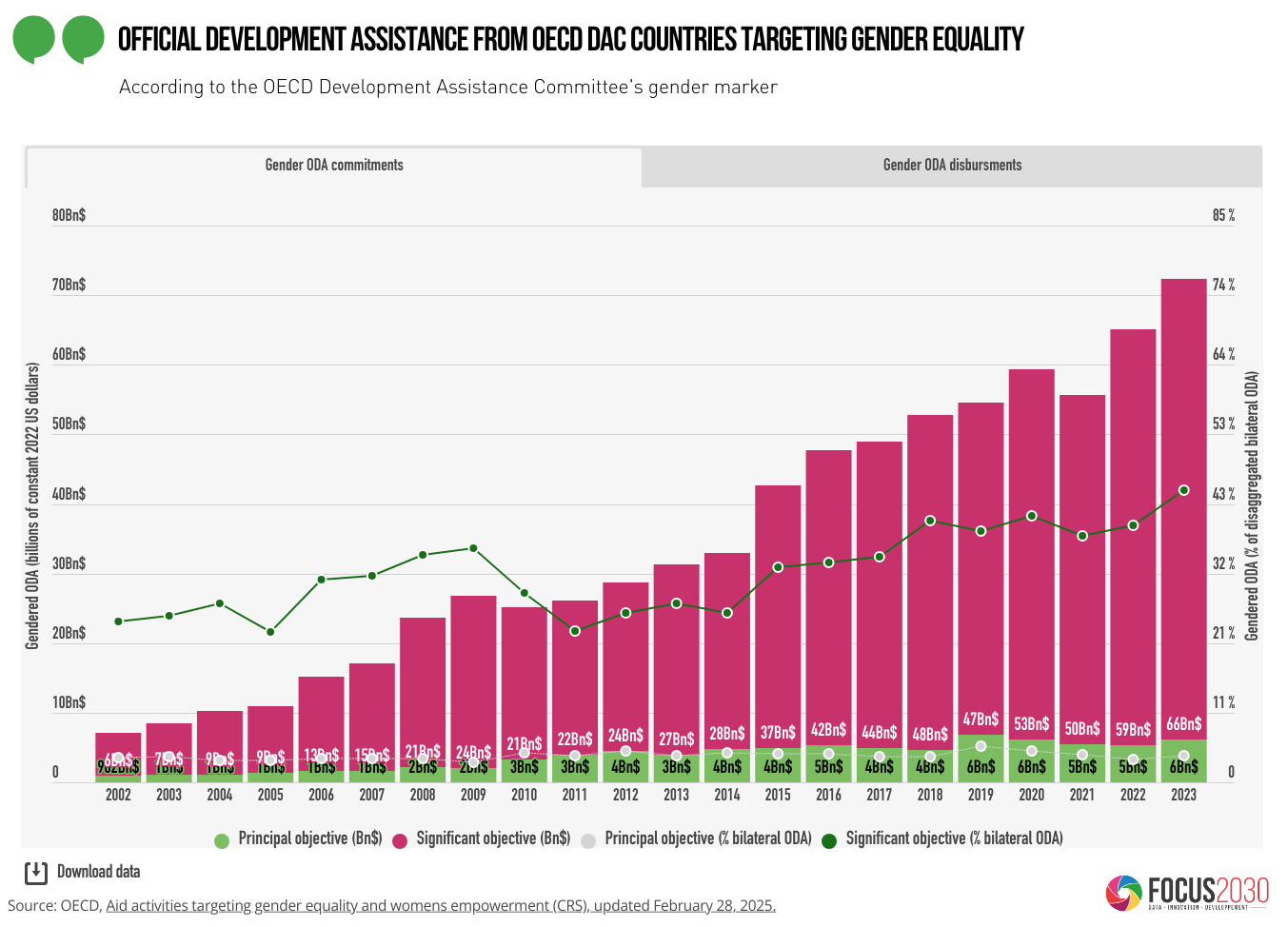
Report “Feminist Foreign Policy and Development Finance for Gender Equality : A Momentum Under Threat” from the Feminist Foreign Policy Collaborative : This report analyzes trends in international financing for gender equality and notes a significant decrease in resources allocated to women’s rights organizations, especially in the Global South. It warns of the expansion of anti-gender actors and updates the 2022 ODA analysis, evaluating commitments up to 2023.
Report “Mundializar la igualdad : política exterior feminista desde América Latina” from the Feminist Foreign Policy Collaborative : This report illustrates how feminist foreign policy can serve as a transformative tool in Latin America by addressing the legacies of patriarchy, colonialism, and racism. Featuring contributions from diplomats, academics, and activists from the Global South, it emphasizes recognition, redistribution, and intersectionality, and explores regional alliances that could strengthen justice and equality.
Policy brief “No Time to Backtrack : The Urgency of a Feminist Foreign Policy” from Oxfam : In the context of multiple crises and rising authoritarianism, and amid rollbacks of the rights of women, girls, and LGBTQIA+ people, this report urges governments to adopt feminist foreign policy as an ambitious action framework. Oxfam stresses the need to translate commitments into decisions, resources, and partnerships grounded in human rights, inclusion, and justice.
Report “Where Is the Money ? An Evidence-Driven Call to Resource Feminist Organizing” from AWID : This report analyzes over a decade of funding trends for feminist organizations, highlighting limited progress, persistent gaps, and growing risks due to shrinking aid and philanthropy. AWID calls for substantial, flexible, and sustained support for feminist movements—essential to advancing gender justice and rights.
Report “Why feminists should lead ?” from Womankind Worldwide : This report argues that gender equality cannot be achieved without feminist leadership grounded in community realities. Drawing on experiences from East Africa and Asia, it documents systemic barriers faced by women and the transformative strategies implemented. Womankind calls for placing feminist leadership at the heart of public policy and funding, as anti-rights movements continue to gain ground.